

200
R. Fausto and N. Kuş
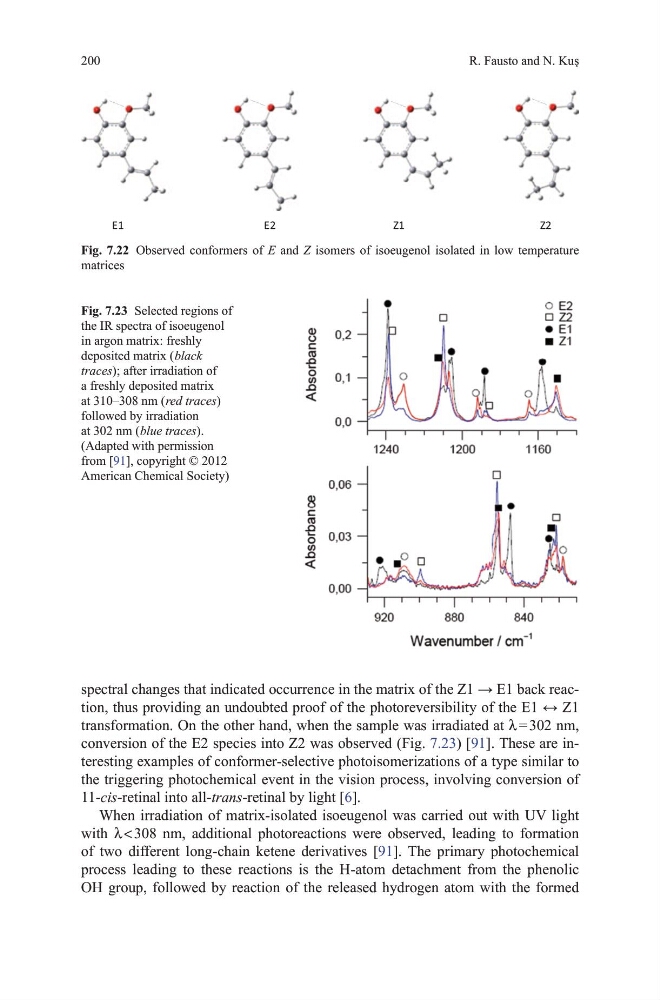
spectral changes that indicated occurrence in the matrix of the Z1 → E1 back reaction, thus providing an undoubted proof of the photoreversibility of the E1 ↔ Z1
transformation. on the other hand, when the sample was irradiated at λ = 302 nm,
conversion of the E2 species into Z2 was observed (Fig. 7.23) [91]. these are interesting examples of conformer-selective photoisomerizations of a type similar to
the triggering photochemical event in the vision process, involving conversion of
11-cis-retinal into all-trans-retinal by light [6].
When irradiation of matrix-isolated isoeugenol was carried out with uv light
with λ < 308 nm, additional photoreactions were observed, leading to formation
of two different long-chain ketene derivatives [91]. the primary photochemical
process leading to these reactions is the h-atom detachment from the phenolic
oh group, followed by reaction of the released hydrogen atom with the formed
Fig. 7.23 Selected regions of
the IR spectra of isoeugenol
in argon matrix: freshly
deposited matrix ( black
traces); after irradiation of
a freshly deposited matrix
at 310–308 nm ( red traces)
followed by irradiation
at 302 nm ( blue traces).
(Adapted with permission
from [91], copyright © 2012
American Chemical Society)
E1
E2
Z1
Z2
Fig. 7.22 observed conformers of E and Z isomers of isoeugenol isolated in low temperature
matrices
R. Fausto and N. Kuş
spectral changes that indicated occurrence in the matrix of the Z1 → E1 back reaction, thus providing an undoubted proof of the photoreversibility of the E1 ↔ Z1
transformation. on the other hand, when the sample was irradiated at λ = 302 nm,
conversion of the E2 species into Z2 was observed (Fig. 7.23) [91]. these are interesting examples of conformer-selective photoisomerizations of a type similar to
the triggering photochemical event in the vision process, involving conversion of
11-cis-retinal into all-trans-retinal by light [6].
When irradiation of matrix-isolated isoeugenol was carried out with uv light
with λ < 308 nm, additional photoreactions were observed, leading to formation
of two different long-chain ketene derivatives [91]. the primary photochemical
process leading to these reactions is the h-atom detachment from the phenolic
oh group, followed by reaction of the released hydrogen atom with the formed
Fig. 7.23 Selected regions of
the IR spectra of isoeugenol
in argon matrix: freshly
deposited matrix ( black
traces); after irradiation of
a freshly deposited matrix
at 310–308 nm ( red traces)
followed by irradiation
at 302 nm ( blue traces).
(Adapted with permission
from [91], copyright © 2012
American Chemical Society)
E1
E2
Z1
Z2
Fig. 7.22 observed conformers of E and Z isomers of isoeugenol isolated in low temperature
matrices