

7 Biologically Relevant Molecules Studied in Low Temperature Inert Matrices
197
In a second experiment [70], narrowband tunable uv-induced mutual
conformational interconversions between the two imino–oxo forms were observed,
together with the oxo-hydroxy and amino-imino phototautomeric reactions. Irradiation of an argon matrix containing cytosine monomers with uv (λ = 313 nm)
laser light resulted in syn↔anti photoisomerizations between the two imino–oxo
forms, whereas the substantially more populated amino–hydroxy and amino–oxo
forms stayed intact (Fig. 7.20). Subsequent irradiation with shorter-wavelength uv
(λ = 311 nm) laser light led to two concomitant phototautomeric processes consuming the amino–oxo isomer (Fig. 7.21): (i) an oxo→hydroxy hydrogen-atom transfer
photoprocess converting the amino–oxo form into the amino–hydroxy tautomer;
(ii) an amino→imino hydrogen-atom transfer converting the amino–oxo form into
0
1000
2000
3000
0
1
2
0
1000
2000
3000
0.0
0.2
0.4
0.6
0.8
1.0
0
1000
2000
3000
0
1
2
0
1000
2000
3000
0.0
0.2
0.4
0.6
0.8
1.0
a
b
c
n(AH2) / n(AH2)
t=0
n(AH1) / n(AH2)
time / min
time / min
time / min
time / min
n(AH2) / n(AH2)
t=0
n(AH1) / n(AH2)
d
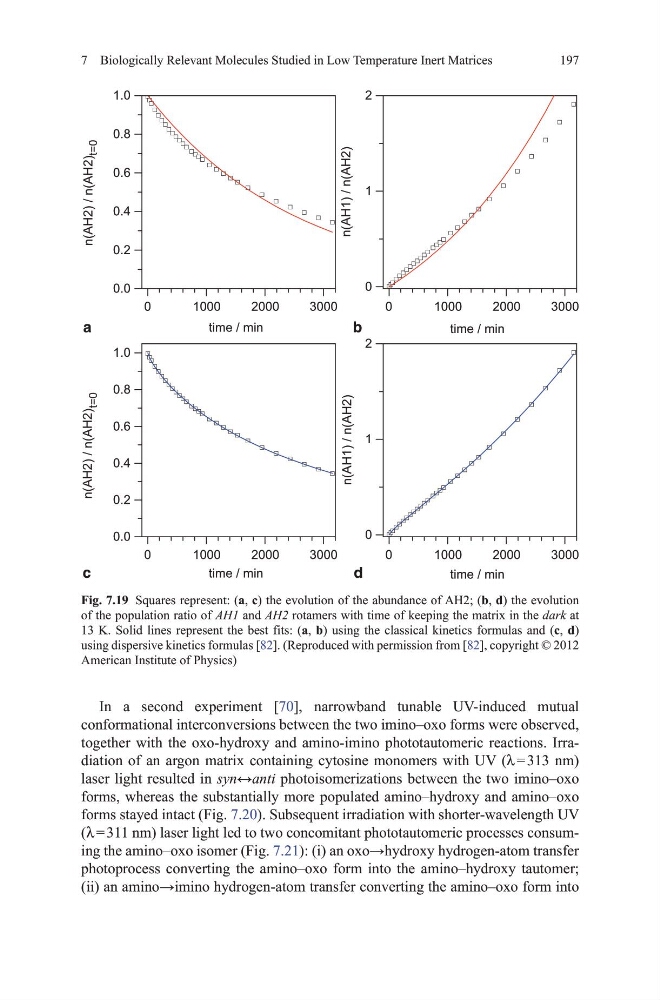
Fig. 7.19 Squares represent: (a, c) the evolution of the abundance of Ah2; (b, d) the evolution
of the population ratio of AH1 and AH2 rotamers with time of keeping the matrix in the dark at
13 K. Solid lines represent the best fits: (a, b) using the classical kinetics formulas and (c, d)
using dispersive kinetics formulas [82]. (Reproduced with permission from [82], copyright © 2012
American Institute of Physics)
197
In a second experiment [70], narrowband tunable uv-induced mutual
conformational interconversions between the two imino–oxo forms were observed,
together with the oxo-hydroxy and amino-imino phototautomeric reactions. Irradiation of an argon matrix containing cytosine monomers with uv (λ = 313 nm)
laser light resulted in syn↔anti photoisomerizations between the two imino–oxo
forms, whereas the substantially more populated amino–hydroxy and amino–oxo
forms stayed intact (Fig. 7.20). Subsequent irradiation with shorter-wavelength uv
(λ = 311 nm) laser light led to two concomitant phototautomeric processes consuming the amino–oxo isomer (Fig. 7.21): (i) an oxo→hydroxy hydrogen-atom transfer
photoprocess converting the amino–oxo form into the amino–hydroxy tautomer;
(ii) an amino→imino hydrogen-atom transfer converting the amino–oxo form into
0
1000
2000
3000
0
1
2
0
1000
2000
3000
0.0
0.2
0.4
0.6
0.8
1.0
0
1000
2000
3000
0
1
2
0
1000
2000
3000
0.0
0.2
0.4
0.6
0.8
1.0
a
b
c
n(AH2) / n(AH2)
t=0
n(AH1) / n(AH2)
time / min
time / min
time / min
time / min
n(AH2) / n(AH2)
t=0
n(AH1) / n(AH2)
d
Fig. 7.19 Squares represent: (a, c) the evolution of the abundance of Ah2; (b, d) the evolution
of the population ratio of AH1 and AH2 rotamers with time of keeping the matrix in the dark at
13 K. Solid lines represent the best fits: (a, b) using the classical kinetics formulas and (c, d)
using dispersive kinetics formulas [82]. (Reproduced with permission from [82], copyright © 2012
American Institute of Physics)