

7 Biologically Relevant Molecules Studied in Low Temperature Inert Matrices
189
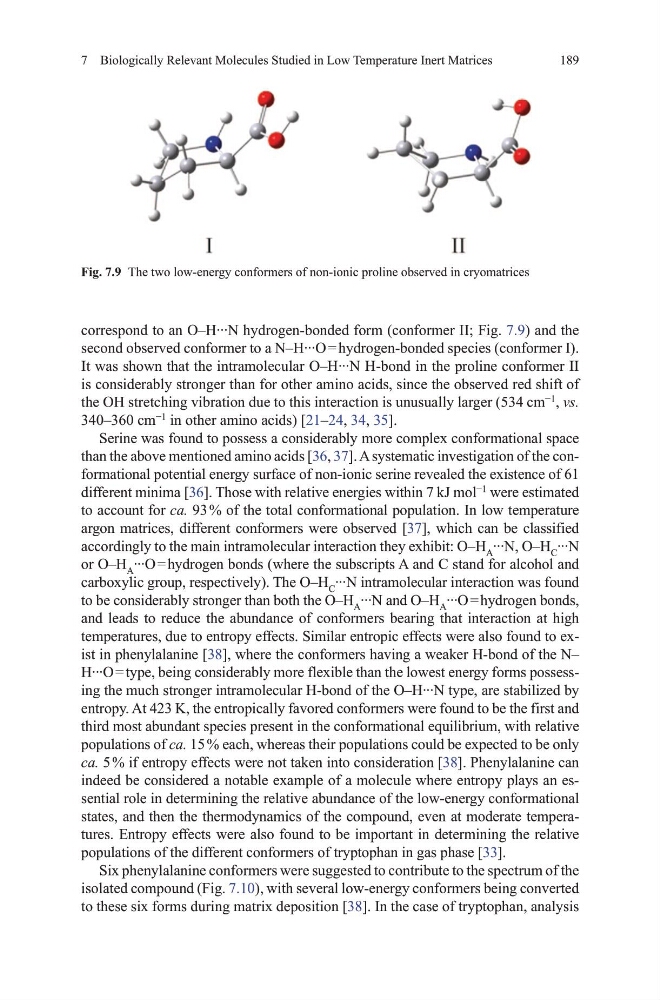
correspond to an o–h···N hydrogen-bonded form (conformer II; Fig. 7.9) and the
second observed conformer to a N–h···o = hydrogen-bonded species (conformer I).
It was shown that the intramolecular o–h···N h-bond in the proline conformer II
is considerably stronger than for other amino acids, since the observed red shift of
the oh stretching vibration due to this interaction is unusually larger (534 cm
−1
, vs.
340–360 cm
−1
in other amino acids) [21–24, 34, 35].
Serine was found to possess a considerably more complex conformational space
than the above mentioned amino acids [36, 37]. A systematic investigation of the conformational potential energy surface of non-ionic serine revealed the existence of 61
different minima [36]. those with relative energies within 7 kJ mol
−1
were estimated
to account for ca. 93 % of the total conformational population. In low temperature
argon matrices, different conformers were observed [37], which can be classified
accordingly to the main intramolecular interaction they exhibit: o–h A ···N, o–h C ···N
or o–h A ···o = hydrogen bonds (where the subscripts A and C stand for alcohol and
carboxylic group, respectively). the o–h C ···N intramolecular interaction was found
to be considerably stronger than both the o–h A ···N and o–h A ···o = hydrogen bonds,
and leads to reduce the abundance of conformers bearing that interaction at high
temperatures, due to entropy effects. Similar entropic effects were also found to exist in phenylalanine [38], where the conformers having a weaker h-bond of the N–
h···o = type, being considerably more flexible than the lowest energy forms possessing the much stronger intramolecular h-bond of the o–h···N type, are stabilized by
entropy. At 423 K, the entropically favored conformers were found to be the first and
third most abundant species present in the conformational equilibrium, with relative
populations of ca. 15 % each, whereas their populations could be expected to be only
ca. 5 % if entropy effects were not taken into consideration [38]. Phenylalanine can
indeed be considered a notable example of a molecule where entropy plays an essential role in determining the relative abundance of the low-energy conformational
states, and then the thermodynamics of the compound, even at moderate temperatures. Entropy effects were also found to be important in determining the relative
populations of the different conformers of tryptophan in gas phase [33].
Six phenylalanine conformers were suggested to contribute to the spectrum of the
isolated compound (Fig. 7.10), with several low-energy conformers being converted
to these six forms during matrix deposition [38]. In the case of tryptophan, analysis
Fig. 7.9 the two low-energy conformers of non-ionic proline observed in cryomatrices
189
correspond to an o–h···N hydrogen-bonded form (conformer II; Fig. 7.9) and the
second observed conformer to a N–h···o = hydrogen-bonded species (conformer I).
It was shown that the intramolecular o–h···N h-bond in the proline conformer II
is considerably stronger than for other amino acids, since the observed red shift of
the oh stretching vibration due to this interaction is unusually larger (534 cm
−1
, vs.
340–360 cm
−1
in other amino acids) [21–24, 34, 35].
Serine was found to possess a considerably more complex conformational space
than the above mentioned amino acids [36, 37]. A systematic investigation of the conformational potential energy surface of non-ionic serine revealed the existence of 61
different minima [36]. those with relative energies within 7 kJ mol
−1
were estimated
to account for ca. 93 % of the total conformational population. In low temperature
argon matrices, different conformers were observed [37], which can be classified
accordingly to the main intramolecular interaction they exhibit: o–h A ···N, o–h C ···N
or o–h A ···o = hydrogen bonds (where the subscripts A and C stand for alcohol and
carboxylic group, respectively). the o–h C ···N intramolecular interaction was found
to be considerably stronger than both the o–h A ···N and o–h A ···o = hydrogen bonds,
and leads to reduce the abundance of conformers bearing that interaction at high
temperatures, due to entropy effects. Similar entropic effects were also found to exist in phenylalanine [38], where the conformers having a weaker h-bond of the N–
h···o = type, being considerably more flexible than the lowest energy forms possessing the much stronger intramolecular h-bond of the o–h···N type, are stabilized by
entropy. At 423 K, the entropically favored conformers were found to be the first and
third most abundant species present in the conformational equilibrium, with relative
populations of ca. 15 % each, whereas their populations could be expected to be only
ca. 5 % if entropy effects were not taken into consideration [38]. Phenylalanine can
indeed be considered a notable example of a molecule where entropy plays an essential role in determining the relative abundance of the low-energy conformational
states, and then the thermodynamics of the compound, even at moderate temperatures. Entropy effects were also found to be important in determining the relative
populations of the different conformers of tryptophan in gas phase [33].
Six phenylalanine conformers were suggested to contribute to the spectrum of the
isolated compound (Fig. 7.10), with several low-energy conformers being converted
to these six forms during matrix deposition [38]. In the case of tryptophan, analysis
Fig. 7.9 the two low-energy conformers of non-ionic proline observed in cryomatrices