

190
R. Fausto and N. Kuş
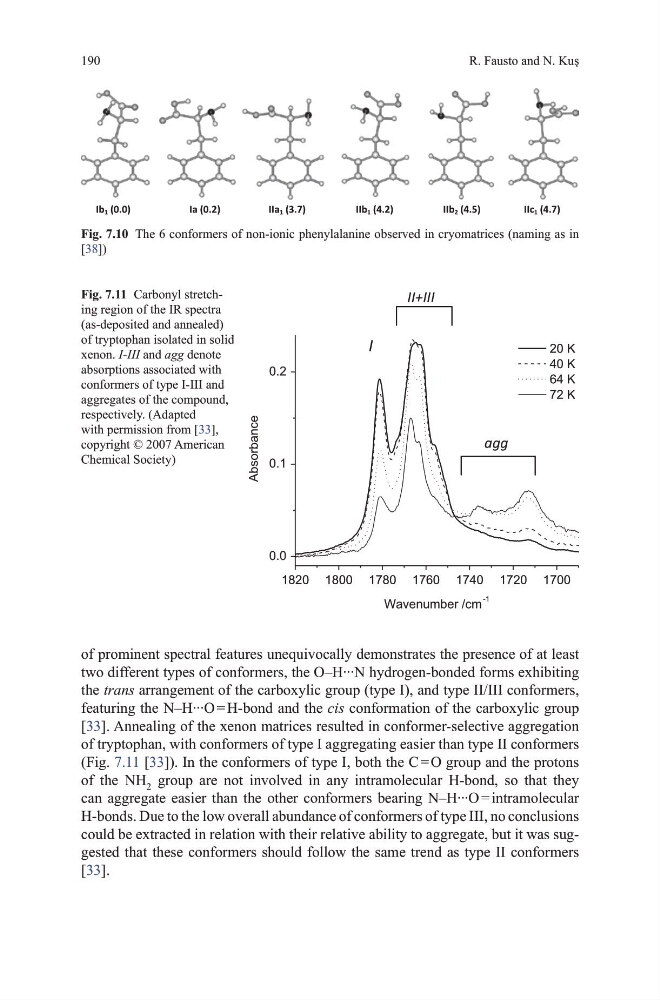
of prominent spectral features unequivocally demonstrates the presence of at least
two different types of conformers, the o–h···N hydrogen-bonded forms exhibiting
the trans arrangement of the carboxylic group (type I), and type II/III conformers,
featuring the N–h···o = h-bond and the cis conformation of the carboxylic group
[33]. Annealing of the xenon matrices resulted in conformer-selective aggregation
of tryptophan, with conformers of type I aggregating easier than type II conformers
(Fig. 7.11 [33]). In the conformers of type I, both the C = o group and the protons
of the Nh 2 group are not involved in any intramolecular h-bond, so that they
can aggregate easier than the other conformers bearing N–h···o = intramolecular
h-bonds. due to the low overall abundance of conformers of type III, no conclusions
could be extracted in relation with their relative ability to aggregate, but it was suggested that these conformers should follow the same trend as type II conformers
[33].
agg
I
II+III
1820 1800 1780 1760 1740 1720 1700
0.0
0.1
0.2
Absorbance
Wavenumber /cm
-1
20 K
40 K
64 K
72 K
Fig. 7.11 Carbonyl stretching region of the IR spectra
(as-deposited and annealed)
of tryptophan isolated in solid
xenon. I-III and agg denote
absorptions associated with
conformers of type I-III and
aggregates of the compound,
respectively. (Adapted
with permission from [33],
copyright © 2007 American
Chemical Society)
Ib 1 (0.0)
I a (0.2)
IIc 1 (4.7)
IIb 2 (4.5)
IIb 1 (4.2)
IIa 1 (3.7)
Fig. 7.10 the 6 conformers of non-ionic phenylalanine observed in cryomatrices (naming as in
[38])
R. Fausto and N. Kuş
of prominent spectral features unequivocally demonstrates the presence of at least
two different types of conformers, the o–h···N hydrogen-bonded forms exhibiting
the trans arrangement of the carboxylic group (type I), and type II/III conformers,
featuring the N–h···o = h-bond and the cis conformation of the carboxylic group
[33]. Annealing of the xenon matrices resulted in conformer-selective aggregation
of tryptophan, with conformers of type I aggregating easier than type II conformers
(Fig. 7.11 [33]). In the conformers of type I, both the C = o group and the protons
of the Nh 2 group are not involved in any intramolecular h-bond, so that they
can aggregate easier than the other conformers bearing N–h···o = intramolecular
h-bonds. due to the low overall abundance of conformers of type III, no conclusions
could be extracted in relation with their relative ability to aggregate, but it was suggested that these conformers should follow the same trend as type II conformers
[33].
agg
I
II+III
1820 1800 1780 1760 1740 1720 1700
0.0
0.1
0.2
Absorbance
Wavenumber /cm
-1
20 K
40 K
64 K
72 K
Fig. 7.11 Carbonyl stretching region of the IR spectra
(as-deposited and annealed)
of tryptophan isolated in solid
xenon. I-III and agg denote
absorptions associated with
conformers of type I-III and
aggregates of the compound,
respectively. (Adapted
with permission from [33],
copyright © 2007 American
Chemical Society)
Ib 1 (0.0)
I a (0.2)
IIc 1 (4.7)
IIb 2 (4.5)
IIb 1 (4.2)
IIa 1 (3.7)
Fig. 7.10 the 6 conformers of non-ionic phenylalanine observed in cryomatrices (naming as in
[38])