

188
R. Fausto and N. Kuş
stable conformer and is characterized by an intramolecular N–h···o = hydrogen
bond and a cis carboxylic group, while the second most stable conformer (g’At)
exhibits a strong o–h···N intramolecular hydrogen bond and a trans carboxylic
group, being similar to the most stable form of N,N-dimethylglycine. In consonance with theoretical predictions [23], the infrared spectra of the matrix-isolated
compound revealed the presence of four conformers, ASC, g’At, gSC and AAC
(see Fig. 7.7), with the two most stable forms accounting for ca. 70 % of the total
population in the gas phase prior to deposition.
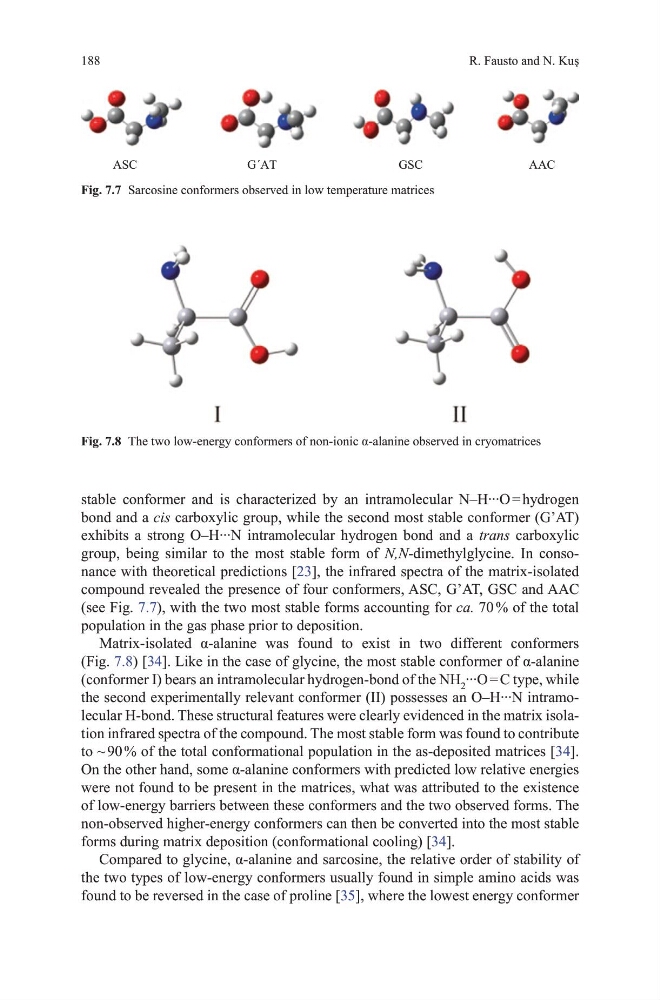
Matrix-isolated α-alanine was found to exist in two different conformers
(Fig. 7.8) [34]. Like in the case of glycine, the most stable conformer of α-alanine
(conformer I) bears an intramolecular hydrogen-bond of the Nh 2 ···o = C type, while
the second experimentally relevant conformer (II) possesses an o–h···N intramolecular h-bond. these structural features were clearly evidenced in the matrix isolation infrared spectra of the compound. the most stable form was found to contribute
to ~ 90 % of the total conformational population in the as-deposited matrices [34].
On the other hand, some α-alanine conformers with predicted low relative energies
were not found to be present in the matrices, what was attributed to the existence
of low-energy barriers between these conformers and the two observed forms. the
non-observed higher-energy conformers can then be converted into the most stable
forms during matrix deposition (conformational cooling) [34].
Compared to glycine, α-alanine and sarcosine, the relative order of stability of
the two types of low-energy conformers usually found in simple amino acids was
found to be reversed in the case of proline [35], where the lowest energy conformer
Fig. 7.8 The two low-energy conformers of non-ionic α-alanine observed in cryomatrices
GSC
AAC
ASC
G´AT
Fig. 7.7 Sarcosine conformers observed in low temperature matrices
R. Fausto and N. Kuş
stable conformer and is characterized by an intramolecular N–h···o = hydrogen
bond and a cis carboxylic group, while the second most stable conformer (g’At)
exhibits a strong o–h···N intramolecular hydrogen bond and a trans carboxylic
group, being similar to the most stable form of N,N-dimethylglycine. In consonance with theoretical predictions [23], the infrared spectra of the matrix-isolated
compound revealed the presence of four conformers, ASC, g’At, gSC and AAC
(see Fig. 7.7), with the two most stable forms accounting for ca. 70 % of the total
population in the gas phase prior to deposition.
Matrix-isolated α-alanine was found to exist in two different conformers
(Fig. 7.8) [34]. Like in the case of glycine, the most stable conformer of α-alanine
(conformer I) bears an intramolecular hydrogen-bond of the Nh 2 ···o = C type, while
the second experimentally relevant conformer (II) possesses an o–h···N intramolecular h-bond. these structural features were clearly evidenced in the matrix isolation infrared spectra of the compound. the most stable form was found to contribute
to ~ 90 % of the total conformational population in the as-deposited matrices [34].
On the other hand, some α-alanine conformers with predicted low relative energies
were not found to be present in the matrices, what was attributed to the existence
of low-energy barriers between these conformers and the two observed forms. the
non-observed higher-energy conformers can then be converted into the most stable
forms during matrix deposition (conformational cooling) [34].
Compared to glycine, α-alanine and sarcosine, the relative order of stability of
the two types of low-energy conformers usually found in simple amino acids was
found to be reversed in the case of proline [35], where the lowest energy conformer
Fig. 7.8 The two low-energy conformers of non-ionic α-alanine observed in cryomatrices
GSC
AAC
ASC
G´AT
Fig. 7.7 Sarcosine conformers observed in low temperature matrices