

7 Biologically Relevant Molecules Studied in Low Temperature Inert Matrices
187
matrix isolation IR spectroscopic studies also provided the first experimental observation and spectral signature characterization of the three lowest energy
conformers of N,N-dimethylglycine (dmg) [24]. detailed analysis of the spectra
obtained in both argon and xenon matrices for the parent (o–h) dmg and its o–d
isotopologue demonstrated that, for this molecule, the conformational ground state
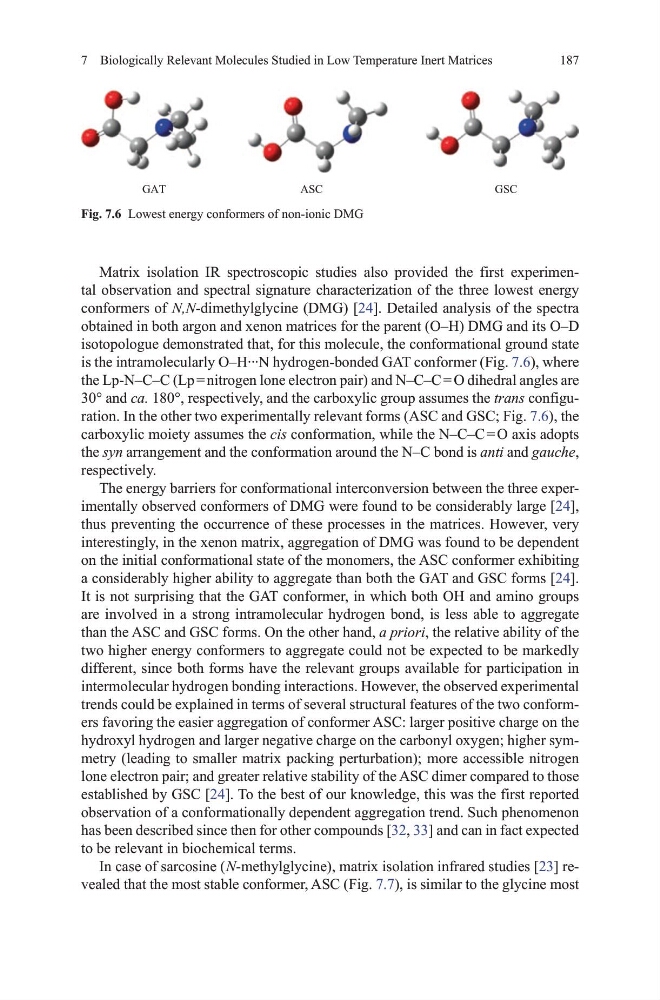
is the intramolecularly o–h···N hydrogen-bonded gAt conformer (Fig. 7.6), where
the Lp-N–C–C (Lp = nitrogen lone electron pair) and N–C–C = o dihedral angles are
30° and ca. 180°, respectively, and the carboxylic group assumes the trans configuration. In the other two experimentally relevant forms (ASC and gSC; Fig. 7.6), the
carboxylic moiety assumes the cis conformation, while the N–C–C = o axis adopts
the syn arrangement and the conformation around the N–C bond is anti and gauche,
respectively.
the energy barriers for conformational interconversion between the three experimentally observed conformers of dmg were found to be considerably large [24],
thus preventing the occurrence of these processes in the matrices. however, very
interestingly, in the xenon matrix, aggregation of dmg was found to be dependent
on the initial conformational state of the monomers, the ASC conformer exhibiting
a considerably higher ability to aggregate than both the gAt and gSC forms [24].
It is not surprising that the gAt conformer, in which both oh and amino groups
are involved in a strong intramolecular hydrogen bond, is less able to aggregate
than the ASC and gSC forms. on the other hand, a priori, the relative ability of the
two higher energy conformers to aggregate could not be expected to be markedly
different, since both forms have the relevant groups available for participation in
intermolecular hydrogen bonding interactions. however, the observed experimental
trends could be explained in terms of several structural features of the two conformers favoring the easier aggregation of conformer ASC: larger positive charge on the
hydroxyl hydrogen and larger negative charge on the carbonyl oxygen; higher symmetry (leading to smaller matrix packing perturbation); more accessible nitrogen
lone electron pair; and greater relative stability of the ASC dimer compared to those
established by gSC [24]. to the best of our knowledge, this was the first reported
observation of a conformationally dependent aggregation trend. Such phenomenon
has been described since then for other compounds [32, 33] and can in fact expected
to be relevant in biochemical terms.
In case of sarcosine ( N-methylglycine), matrix isolation infrared studies [23] revealed that the most stable conformer, ASC (Fig. 7.7), is similar to the glycine most
ASC
GAT
G SC
Fig. 7.6 Lowest energy conformers of non-ionic dmg
187
matrix isolation IR spectroscopic studies also provided the first experimental observation and spectral signature characterization of the three lowest energy
conformers of N,N-dimethylglycine (dmg) [24]. detailed analysis of the spectra
obtained in both argon and xenon matrices for the parent (o–h) dmg and its o–d
isotopologue demonstrated that, for this molecule, the conformational ground state
is the intramolecularly o–h···N hydrogen-bonded gAt conformer (Fig. 7.6), where
the Lp-N–C–C (Lp = nitrogen lone electron pair) and N–C–C = o dihedral angles are
30° and ca. 180°, respectively, and the carboxylic group assumes the trans configuration. In the other two experimentally relevant forms (ASC and gSC; Fig. 7.6), the
carboxylic moiety assumes the cis conformation, while the N–C–C = o axis adopts
the syn arrangement and the conformation around the N–C bond is anti and gauche,
respectively.
the energy barriers for conformational interconversion between the three experimentally observed conformers of dmg were found to be considerably large [24],
thus preventing the occurrence of these processes in the matrices. however, very
interestingly, in the xenon matrix, aggregation of dmg was found to be dependent
on the initial conformational state of the monomers, the ASC conformer exhibiting
a considerably higher ability to aggregate than both the gAt and gSC forms [24].
It is not surprising that the gAt conformer, in which both oh and amino groups
are involved in a strong intramolecular hydrogen bond, is less able to aggregate
than the ASC and gSC forms. on the other hand, a priori, the relative ability of the
two higher energy conformers to aggregate could not be expected to be markedly
different, since both forms have the relevant groups available for participation in
intermolecular hydrogen bonding interactions. however, the observed experimental
trends could be explained in terms of several structural features of the two conformers favoring the easier aggregation of conformer ASC: larger positive charge on the
hydroxyl hydrogen and larger negative charge on the carbonyl oxygen; higher symmetry (leading to smaller matrix packing perturbation); more accessible nitrogen
lone electron pair; and greater relative stability of the ASC dimer compared to those
established by gSC [24]. to the best of our knowledge, this was the first reported
observation of a conformationally dependent aggregation trend. Such phenomenon
has been described since then for other compounds [32, 33] and can in fact expected
to be relevant in biochemical terms.
In case of sarcosine ( N-methylglycine), matrix isolation infrared studies [23] revealed that the most stable conformer, ASC (Fig. 7.7), is similar to the glycine most
ASC
GAT
G SC
Fig. 7.6 Lowest energy conformers of non-ionic dmg