

J. C. Dobrowolsk et al.
132
level. It was shown that the population of these complexes strongly depends on
the inclusion of the thermochemical term. the formation of strong intermolecular
hydrogen bond complexes with water increases the entropy term, and the structures
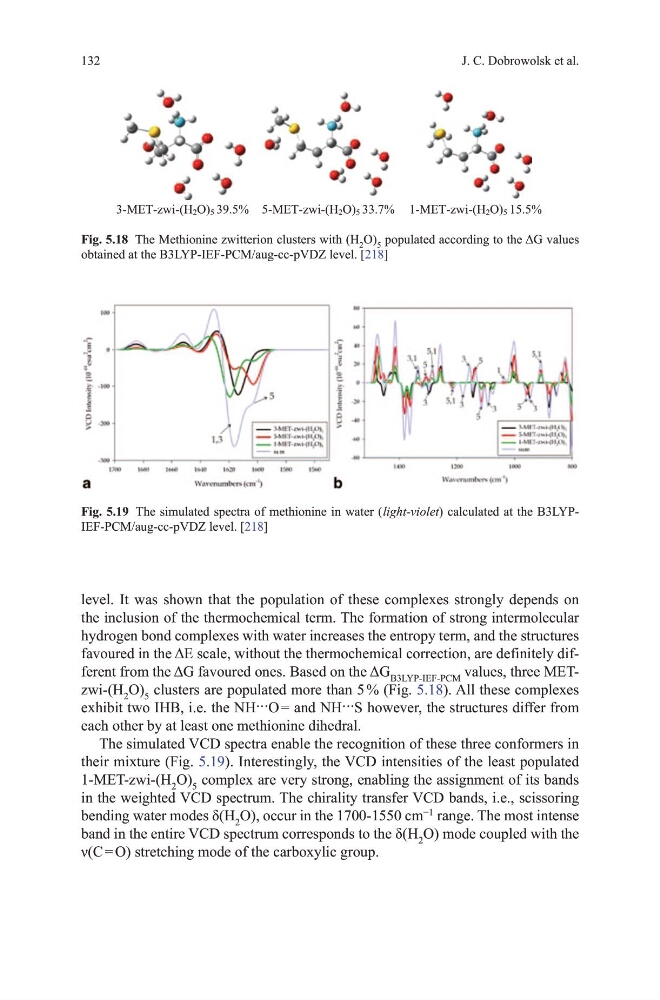
favoured in the ΔE scale, without the thermochemical correction, are definitely different from the ΔG favoured ones. Based on the ΔG B3LYP-IEF-PCm values, three mEtzwi-(h 2 o) 5 clusters are populated more than 5 % (Fig. 5.18). All these complexes
exhibit two IHB, i.e. the NH···O = and NH···S however, the structures differ from
each other by at least one methionine dihedral.
the simulated vCd spectra enable the recognition of these three conformers in
their mixture (Fig. 5.19). Interestingly, the vCd intensities of the least populated
1-mEt-zwi-(h 2 o) 5 complex are very strong, enabling the assignment of its bands
in the weighted vCd spectrum. the chirality transfer vCd bands, i.e., scissoring
bending water modes δ(H 2 o), occur in the 1700-1550 cm
−1
range. the most intense
band in the entire VCD spectrum corresponds to the δ(H 2 o) mode coupled with the
ν(C = O) stretching mode of the carboxylic group.
Fig. 5.18 the methionine zwitterion clusters with (h 2 o) 5 populated according to the ΔG values
obtained at the B3LYP-IEF-PCm/aug-cc-pvdZ level. [218]
3-MET-zwi-(H 2 O) 5 39.5% 5-MET-zwi-(H 2 O) 5 33.7% 1-MET-zwi-(H 2 O) 5 15.5%
Fig. 5.19 the simulated spectra of methionine in water ( light-violet) calculated at the B3LYPIEF-PCm/aug-cc-pvdZ level. [218]
132
level. It was shown that the population of these complexes strongly depends on
the inclusion of the thermochemical term. the formation of strong intermolecular
hydrogen bond complexes with water increases the entropy term, and the structures
favoured in the ΔE scale, without the thermochemical correction, are definitely different from the ΔG favoured ones. Based on the ΔG B3LYP-IEF-PCm values, three mEtzwi-(h 2 o) 5 clusters are populated more than 5 % (Fig. 5.18). All these complexes
exhibit two IHB, i.e. the NH···O = and NH···S however, the structures differ from
each other by at least one methionine dihedral.
the simulated vCd spectra enable the recognition of these three conformers in
their mixture (Fig. 5.19). Interestingly, the vCd intensities of the least populated
1-mEt-zwi-(h 2 o) 5 complex are very strong, enabling the assignment of its bands
in the weighted vCd spectrum. the chirality transfer vCd bands, i.e., scissoring
bending water modes δ(H 2 o), occur in the 1700-1550 cm
−1
range. the most intense
band in the entire VCD spectrum corresponds to the δ(H 2 o) mode coupled with the
ν(C = O) stretching mode of the carboxylic group.
Fig. 5.18 the methionine zwitterion clusters with (h 2 o) 5 populated according to the ΔG values
obtained at the B3LYP-IEF-PCm/aug-cc-pvdZ level. [218]
3-MET-zwi-(H 2 O) 5 39.5% 5-MET-zwi-(H 2 O) 5 33.7% 1-MET-zwi-(H 2 O) 5 15.5%
Fig. 5.19 the simulated spectra of methionine in water ( light-violet) calculated at the B3LYPIEF-PCm/aug-cc-pvdZ level. [218]