

We assume that photons are absorbed independently of previous absorptions and
use Poisson statistics:
P n
ð Þ ¼ ν
ð Þ
n =n! Â exp Àν
ð Þ:
(5.1)
Here, υ is the average number of photons absorbed during the laser pulse, which
is given by (cross section times flux):
ν ¼ σ
E laser λ
Ahc
,
(5.2)
where E laser is the laser-pulse energy, A is the overlap area, h is Planck’s constant,
and c is the speed of light.
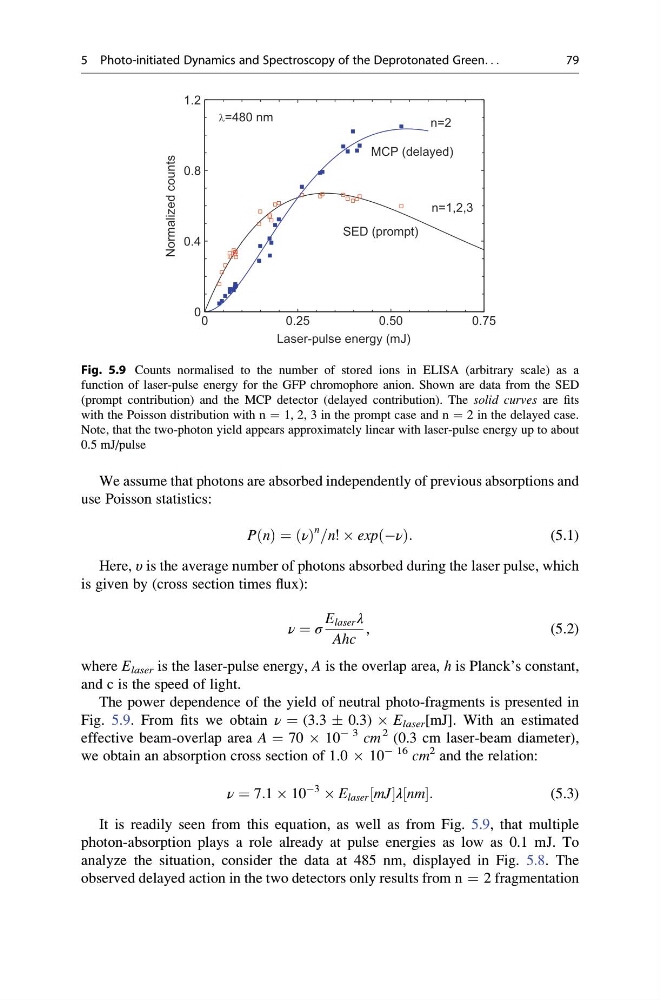
The power dependence of the yield of neutral photo-fragments is presented in
Fig. 5.9. From fits we obtain ν ¼ (3.3 Æ 0.3) Â E laser [mJ]. With an estimated
effective beam-overlap area A ¼ 70 Â 10
À 3 cm
2 (0.3 cm laser-beam diameter),
we obtain an absorption cross section of 1.0 Â 10
À 16 cm
2 and the relation:
ν ¼ 7:1 Â 10
À3
 E laser mJ
½ λ nm
½ :
(5.3)
It is readily seen from this equation, as well as from Fig. 5.9, that multiple
photon-absorption plays a role already at pulse energies as low as 0.1 mJ. To
analyze the situation, consider the data at 485 nm, displayed in Fig. 5.8. The
observed delayed action in the two detectors only results from n ¼ 2 fragmentation
0
0.4
0.8
1.2
0
0.25
0.50
0.75
SED (prompt)
n=1,2,3
n=2
=480 nm
MCP (delayed)
Laser-pulse energy (mJ)
Normalized counts
Fig. 5.9 Counts normalised to the number of stored ions in ELISA (arbitrary scale) as a
function of laser-pulse energy for the GFP chromophore anion. Shown are data from the SED
(prompt contribution) and the MCP detector (delayed contribution). The solid curves are fits
with the Poisson distribution with n ¼ 1, 2, 3 in the prompt case and n ¼ 2 in the delayed case.
Note, that the two-photon yield appears approximately linear with laser-pulse energy up to about
0.5 mJ/pulse
5 Photo-initiated Dynamics and Spectroscopy of the Deprotonated Green. . .
79
use Poisson statistics:
P n
ð Þ ¼ ν
ð Þ
n =n! Â exp Àν
ð Þ:
(5.1)
Here, υ is the average number of photons absorbed during the laser pulse, which
is given by (cross section times flux):
ν ¼ σ
E laser λ
Ahc
,
(5.2)
where E laser is the laser-pulse energy, A is the overlap area, h is Planck’s constant,
and c is the speed of light.
The power dependence of the yield of neutral photo-fragments is presented in
Fig. 5.9. From fits we obtain ν ¼ (3.3 Æ 0.3) Â E laser [mJ]. With an estimated
effective beam-overlap area A ¼ 70 Â 10
À 3 cm
2 (0.3 cm laser-beam diameter),
we obtain an absorption cross section of 1.0 Â 10
À 16 cm
2 and the relation:
ν ¼ 7:1 Â 10
À3
 E laser mJ
½ λ nm
½ :
(5.3)
It is readily seen from this equation, as well as from Fig. 5.9, that multiple
photon-absorption plays a role already at pulse energies as low as 0.1 mJ. To
analyze the situation, consider the data at 485 nm, displayed in Fig. 5.8. The
observed delayed action in the two detectors only results from n ¼ 2 fragmentation
0
0.4
0.8
1.2
0
0.25
0.50
0.75
SED (prompt)
n=1,2,3
n=2
=480 nm
MCP (delayed)
Laser-pulse energy (mJ)
Normalized counts
Fig. 5.9 Counts normalised to the number of stored ions in ELISA (arbitrary scale) as a
function of laser-pulse energy for the GFP chromophore anion. Shown are data from the SED
(prompt contribution) and the MCP detector (delayed contribution). The solid curves are fits
with the Poisson distribution with n ¼ 1, 2, 3 in the prompt case and n ¼ 2 in the delayed case.
Note, that the two-photon yield appears approximately linear with laser-pulse energy up to about
0.5 mJ/pulse
5 Photo-initiated Dynamics and Spectroscopy of the Deprotonated Green. . .
79