

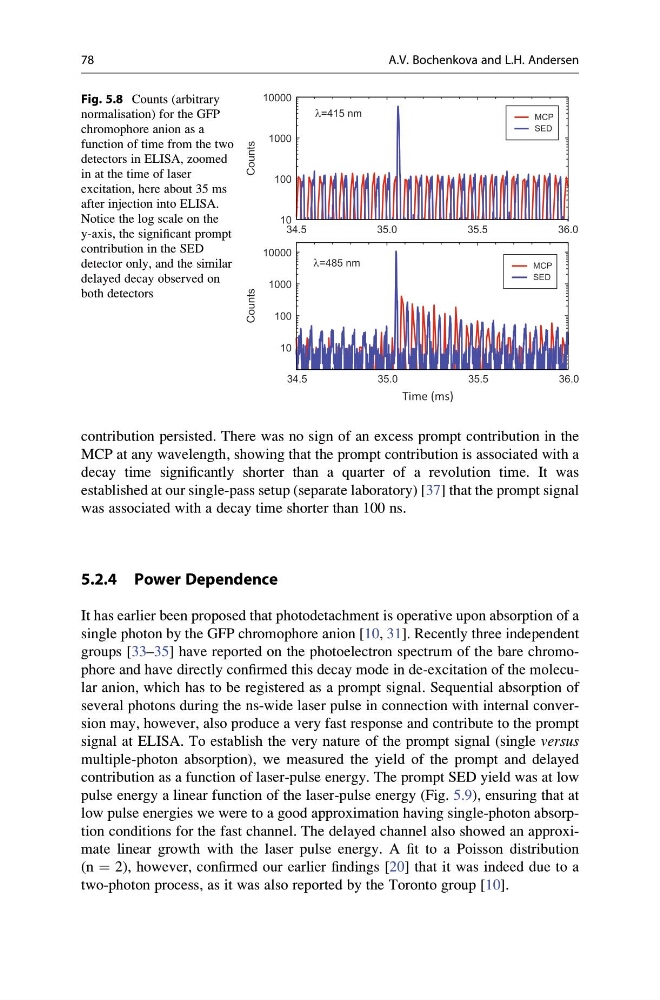
contribution persisted. There was no sign of an excess prompt contribution in the
MCP at any wavelength, showing that the prompt contribution is associated with a
decay time significantly shorter than a quarter of a revolution time. It was
established at our single-pass setup (separate laboratory) [37] that the prompt signal
was associated with a decay time shorter than 100 ns.
5.2.4 Power Dependence
It has earlier been proposed that photodetachment is operative upon absorption of a
single photon by the GFP chromophore anion [10, 31]. Recently three independent
groups [33–35] have reported on the photoelectron spectrum of the bare chromophore and have directly confirmed this decay mode in de-excitation of the molecular anion, which has to be registered as a prompt signal. Sequential absorption of
several photons during the ns-wide laser pulse in connection with internal conversion may, however, also produce a very fast response and contribute to the prompt
signal at ELISA. To establish the very nature of the prompt signal (single versus
multiple-photon absorption), we measured the yield of the prompt and delayed
contribution as a function of laser-pulse energy. The prompt SED yield was at low
pulse energy a linear function of the laser-pulse energy (Fig. 5.9), ensuring that at
low pulse energies we were to a good approximation having single-photon absorption conditions for the fast channel. The delayed channel also showed an approximate linear growth with the laser pulse energy. A fit to a Poisson distribution
(n ¼ 2), however, confirmed our earlier findings [20] that it was indeed due to a
two-photon process, as it was also reported by the Toronto group [10].
Time (ms)
Fig. 5.8 Counts (arbitrary
normalisation) for the GFP
chromophore anion as a
function of time from the two
detectors in ELISA, zoomed
in at the time of laser
excitation, here about 35 ms
after injection into ELISA.
Notice the log scale on the
y-axis, the significant prompt
contribution in the SED
detector only, and the similar
delayed decay observed on
both detectors
78
A.V. Bochenkova and L.H. Andersen
MCP at any wavelength, showing that the prompt contribution is associated with a
decay time significantly shorter than a quarter of a revolution time. It was
established at our single-pass setup (separate laboratory) [37] that the prompt signal
was associated with a decay time shorter than 100 ns.
5.2.4 Power Dependence
It has earlier been proposed that photodetachment is operative upon absorption of a
single photon by the GFP chromophore anion [10, 31]. Recently three independent
groups [33–35] have reported on the photoelectron spectrum of the bare chromophore and have directly confirmed this decay mode in de-excitation of the molecular anion, which has to be registered as a prompt signal. Sequential absorption of
several photons during the ns-wide laser pulse in connection with internal conversion may, however, also produce a very fast response and contribute to the prompt
signal at ELISA. To establish the very nature of the prompt signal (single versus
multiple-photon absorption), we measured the yield of the prompt and delayed
contribution as a function of laser-pulse energy. The prompt SED yield was at low
pulse energy a linear function of the laser-pulse energy (Fig. 5.9), ensuring that at
low pulse energies we were to a good approximation having single-photon absorption conditions for the fast channel. The delayed channel also showed an approximate linear growth with the laser pulse energy. A fit to a Poisson distribution
(n ¼ 2), however, confirmed our earlier findings [20] that it was indeed due to a
two-photon process, as it was also reported by the Toronto group [10].
Time (ms)
Fig. 5.8 Counts (arbitrary
normalisation) for the GFP
chromophore anion as a
function of time from the two
detectors in ELISA, zoomed
in at the time of laser
excitation, here about 35 ms
after injection into ELISA.
Notice the log scale on the
y-axis, the significant prompt
contribution in the SED
detector only, and the similar
delayed decay observed on
both detectors
78
A.V. Bochenkova and L.H. Andersen