

3.1.4 Dissociation in an Electric Field
Ionic dissociation can be studied in an electric field (Fig. 3.17). In the illustrated
apparatus, ions are produced, bunched and accelerated, after which they are
deflected along a new trajectory in order to remove any generated neutrals. The
bunch is subsequently trapped in a Zajfman trap (see below), extracted and
accelerated from a potential of V 0 . Neutral products are unaffected by the following
45
electrostatic parallel-plate analyser and detected on a position sensitive detector
(PSD), while ions are deflected and identified on another PSD. Photoexcitation is
performed in either the ion trap or the following interaction region, depending on
the fragmentation time scale of interest. This interaction region is set at a higher
potential than V 0 , in order to differentiate the fast fragmentation which occurs
inside the region from that which occurs outside. Neutral fragments resulting
from CID can be excluded as their arrival times will depend on the parent ion
velocities during fragmentation. Experiments monitor single fragmentation events
in order to determine the number of fragmentation steps involved and are
repeated with different settings as only fragment ions within a narrow mass window
(Δm % 10 amu) can be detected for each setting.
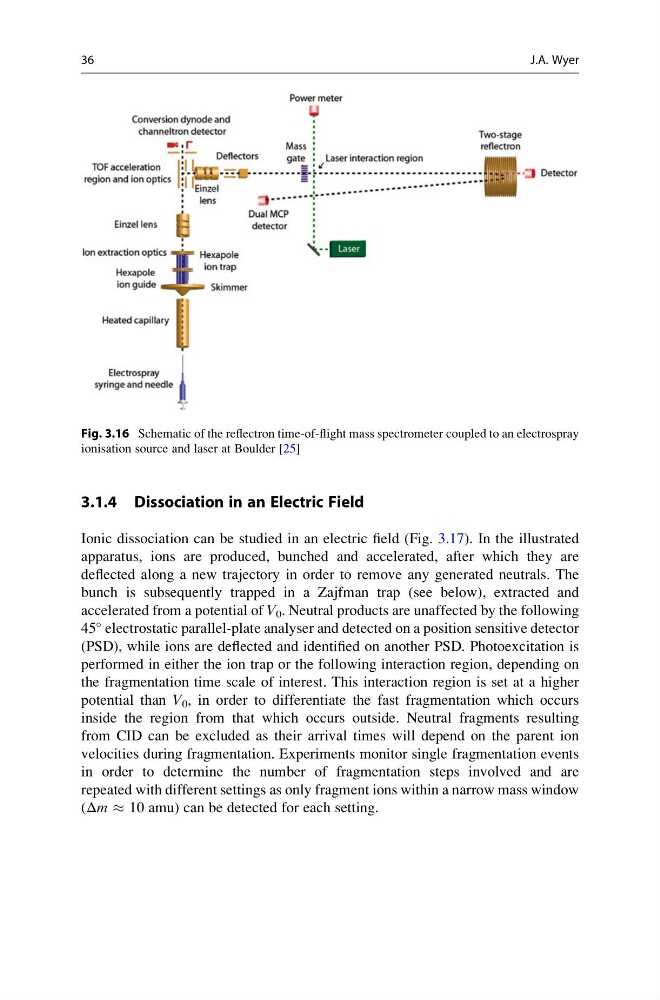
Fig. 3.16 Schematic of the reflectron time-of-flight mass spectrometer coupled to an electrospray
ionisation source and laser at Boulder [25]
36
J.A. Wyer
Ionic dissociation can be studied in an electric field (Fig. 3.17). In the illustrated
apparatus, ions are produced, bunched and accelerated, after which they are
deflected along a new trajectory in order to remove any generated neutrals. The
bunch is subsequently trapped in a Zajfman trap (see below), extracted and
accelerated from a potential of V 0 . Neutral products are unaffected by the following
45
electrostatic parallel-plate analyser and detected on a position sensitive detector
(PSD), while ions are deflected and identified on another PSD. Photoexcitation is
performed in either the ion trap or the following interaction region, depending on
the fragmentation time scale of interest. This interaction region is set at a higher
potential than V 0 , in order to differentiate the fast fragmentation which occurs
inside the region from that which occurs outside. Neutral fragments resulting
from CID can be excluded as their arrival times will depend on the parent ion
velocities during fragmentation. Experiments monitor single fragmentation events
in order to determine the number of fragmentation steps involved and are
repeated with different settings as only fragment ions within a narrow mass window
(Δm % 10 amu) can be detected for each setting.
Fig. 3.16 Schematic of the reflectron time-of-flight mass spectrometer coupled to an electrospray
ionisation source and laser at Boulder [25]
36
J.A. Wyer