

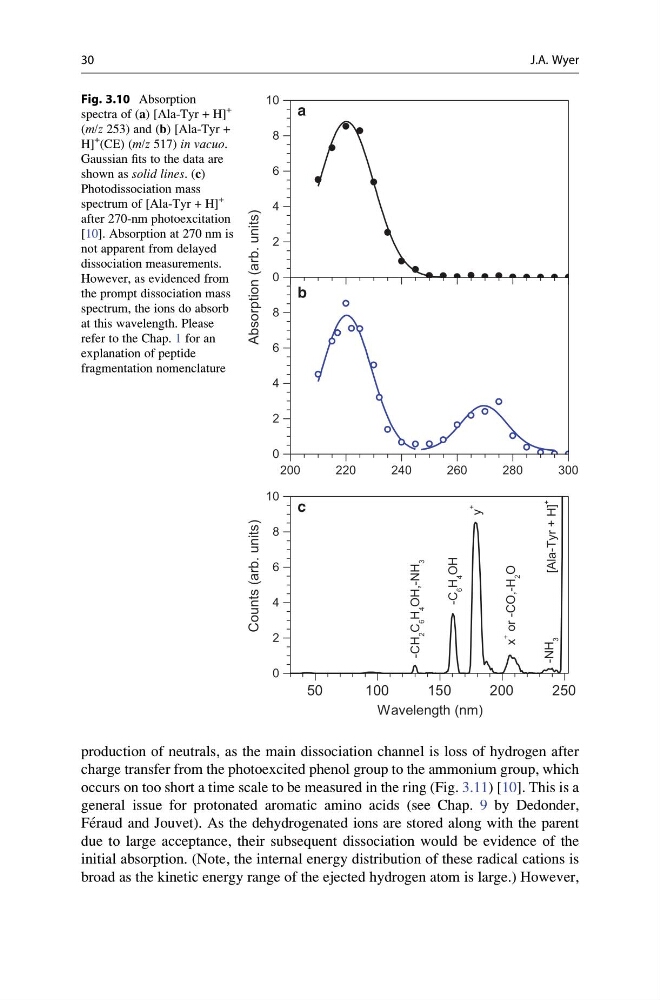
production of neutrals, as the main dissociation channel is loss of hydrogen after
charge transfer from the photoexcited phenol group to the ammonium group, which
occurs on too short a time scale to be measured in the ring (Fig. 3.11) [10]. This is a
general issue for protonated aromatic amino acids (see Chap. 9 by Dedonder,
Fe ´raud and Jouvet). As the dehydrogenated ions are stored along with the parent
due to large acceptance, their subsequent dissociation would be evidence of the
initial absorption. (Note, the internal energy distribution of these radical cations is
broad as the kinetic energy range of the ejected hydrogen atom is large.) However,
200
220
240
260
280
300
0
2
4
6
8
Counts (arb. units)
Wavelength (nm)
50
100
150
200
250
0
2
4
6
8
10
[Ala-Tyr + H]
+
-CH
2
C
6
H
4
OH,-NH
3
-NH
3
x
+
or -CO,-H
2
O
-C
6
H
4
OH
y
+
0
2
4
6
8
10
c
b
a
Absorption (arb. units)
Fig. 3.10 Absorption
spectra of (a) [Ala-Tyr + H]
+
(m/z 253) and (b) [Ala-Tyr +
H]
+ (CE) (m/z 517) in vacuo.
Gaussian fits to the data are
shown as solid lines. (c)
Photodissociation mass
spectrum of [Ala-Tyr + H]
+
after 270-nm photoexcitation
[10]. Absorption at 270 nm is
not apparent from delayed
dissociation measurements.
However, as evidenced from
the prompt dissociation mass
spectrum, the ions do absorb
at this wavelength. Please
refer to the Chap. 1 for an
explanation of peptide
fragmentation nomenclature
30
J.A. Wyer
charge transfer from the photoexcited phenol group to the ammonium group, which
occurs on too short a time scale to be measured in the ring (Fig. 3.11) [10]. This is a
general issue for protonated aromatic amino acids (see Chap. 9 by Dedonder,
Fe ´raud and Jouvet). As the dehydrogenated ions are stored along with the parent
due to large acceptance, their subsequent dissociation would be evidence of the
initial absorption. (Note, the internal energy distribution of these radical cations is
broad as the kinetic energy range of the ejected hydrogen atom is large.) However,
200
220
240
260
280
300
0
2
4
6
8
Counts (arb. units)
Wavelength (nm)
50
100
150
200
250
0
2
4
6
8
10
[Ala-Tyr + H]
+
-CH
2
C
6
H
4
OH,-NH
3
-NH
3
x
+
or -CO,-H
2
O
-C
6
H
4
OH
y
+
0
2
4
6
8
10
c
b
a
Absorption (arb. units)
Fig. 3.10 Absorption
spectra of (a) [Ala-Tyr + H]
+
(m/z 253) and (b) [Ala-Tyr +
H]
+ (CE) (m/z 517) in vacuo.
Gaussian fits to the data are
shown as solid lines. (c)
Photodissociation mass
spectrum of [Ala-Tyr + H]
+
after 270-nm photoexcitation
[10]. Absorption at 270 nm is
not apparent from delayed
dissociation measurements.
However, as evidenced from
the prompt dissociation mass
spectrum, the ions do absorb
at this wavelength. Please
refer to the Chap. 1 for an
explanation of peptide
fragmentation nomenclature
30
J.A. Wyer