

one-photon absorption was too little to cause dissociation on the relevant time
scale due to the large number of degrees of freedom. If instead the experiment was
done for protein anions, electron detachment was an open channel, and this channel
could be used to obtain the action spectrum of the anion. Note: it is not necessarily
the photoactive electron that is lost. If not, then a coupling between the photoactive
site and the site where the electron loss occurs is present.
As mentioned above, the absorption by ions at all or particular wavelengths may
not be identifiable from delayed dissociation experiments due to fast dissociation
timescales. Thus, if the lifetime of the ions is on the limit of being detected, one
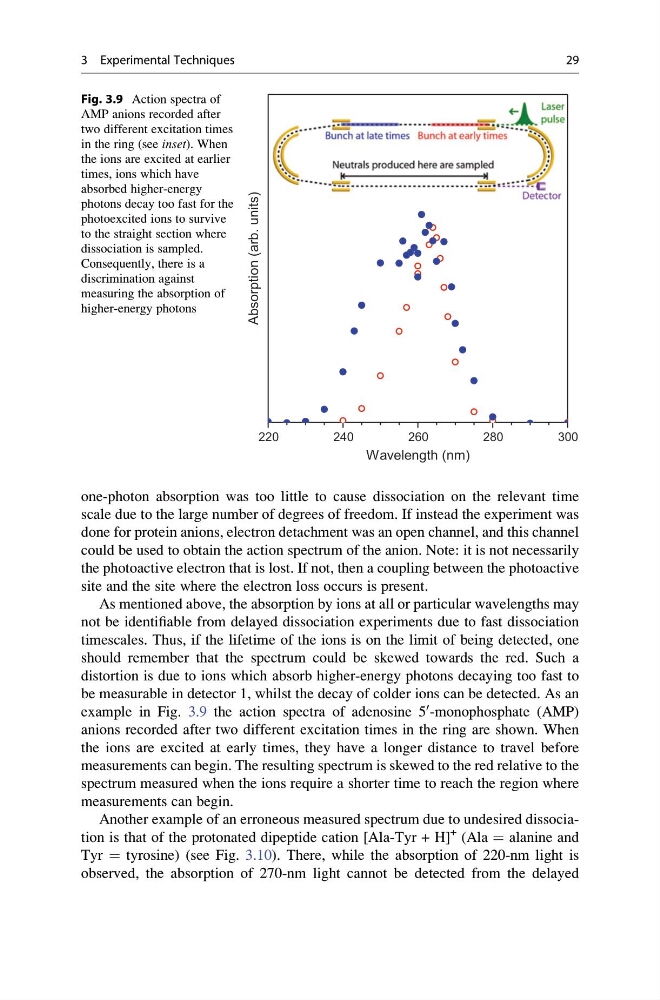
should remember that the spectrum could be skewed towards the red. Such a
distortion is due to ions which absorb higher-energy photons decaying too fast to
be measurable in detector 1, whilst the decay of colder ions can be detected. As an
example in Fig. 3.9 the action spectra of adenosine 5
0 -monophosphate (AMP)
anions recorded after two different excitation times in the ring are shown. When
the ions are excited at early times, they have a longer distance to travel before
measurements can begin. The resulting spectrum is skewed to the red relative to the
spectrum measured when the ions require a shorter time to reach the region where
measurements can begin.
Another example of an erroneous measured spectrum due to undesired dissociation is that of the protonated dipeptide cation [Ala-Tyr + H]
+ (Ala ¼ alanine and
Tyr ¼ tyrosine) (see Fig. 3.10). There, while the absorption of 220-nm light is
observed, the absorption of 270-nm light cannot be detected from the delayed
220
240
260
280
300
Wavelength (nm)
Absorption (arb. units)
Fig. 3.9 Action spectra of
AMP anions recorded after
two different excitation times
in the ring (see inset). When
the ions are excited at earlier
times, ions which have
absorbed higher-energy
photons decay too fast for the
photoexcited ions to survive
to the straight section where
dissociation is sampled.
Consequently, there is a
discrimination against
measuring the absorption of
higher-energy photons
3 Experimental Techniques
29
scale due to the large number of degrees of freedom. If instead the experiment was
done for protein anions, electron detachment was an open channel, and this channel
could be used to obtain the action spectrum of the anion. Note: it is not necessarily
the photoactive electron that is lost. If not, then a coupling between the photoactive
site and the site where the electron loss occurs is present.
As mentioned above, the absorption by ions at all or particular wavelengths may
not be identifiable from delayed dissociation experiments due to fast dissociation
timescales. Thus, if the lifetime of the ions is on the limit of being detected, one
should remember that the spectrum could be skewed towards the red. Such a
distortion is due to ions which absorb higher-energy photons decaying too fast to
be measurable in detector 1, whilst the decay of colder ions can be detected. As an
example in Fig. 3.9 the action spectra of adenosine 5
0 -monophosphate (AMP)
anions recorded after two different excitation times in the ring are shown. When
the ions are excited at early times, they have a longer distance to travel before
measurements can begin. The resulting spectrum is skewed to the red relative to the
spectrum measured when the ions require a shorter time to reach the region where
measurements can begin.
Another example of an erroneous measured spectrum due to undesired dissociation is that of the protonated dipeptide cation [Ala-Tyr + H]
+ (Ala ¼ alanine and
Tyr ¼ tyrosine) (see Fig. 3.10). There, while the absorption of 220-nm light is
observed, the absorption of 270-nm light cannot be detected from the delayed
220
240
260
280
300
Wavelength (nm)
Absorption (arb. units)
Fig. 3.9 Action spectra of
AMP anions recorded after
two different excitation times
in the ring (see inset). When
the ions are excited at earlier
times, ions which have
absorbed higher-energy
photons decay too fast for the
photoexcited ions to survive
to the straight section where
dissociation is sampled.
Consequently, there is a
discrimination against
measuring the absorption of
higher-energy photons
3 Experimental Techniques
29