

and accordingly, Y related yields always exceed the F related ones, with their ratio
increasing with n.
The underlying hole migration process must be different from (and thus much
faster than) IVR because i) for fixed n, the fragmentation pattern is only weakly
dependent on hν and thus on the excitation energy and ii) for a given hν, the
fragmentation pattern only weakly depends on n. In an IVR/statistical fragmentation scenario, an increase in system size and thus phase space would necessarily
lead to an exponential decrease in dissociation rates for given channels. The
fragmentation pattern would have to change dramatically.
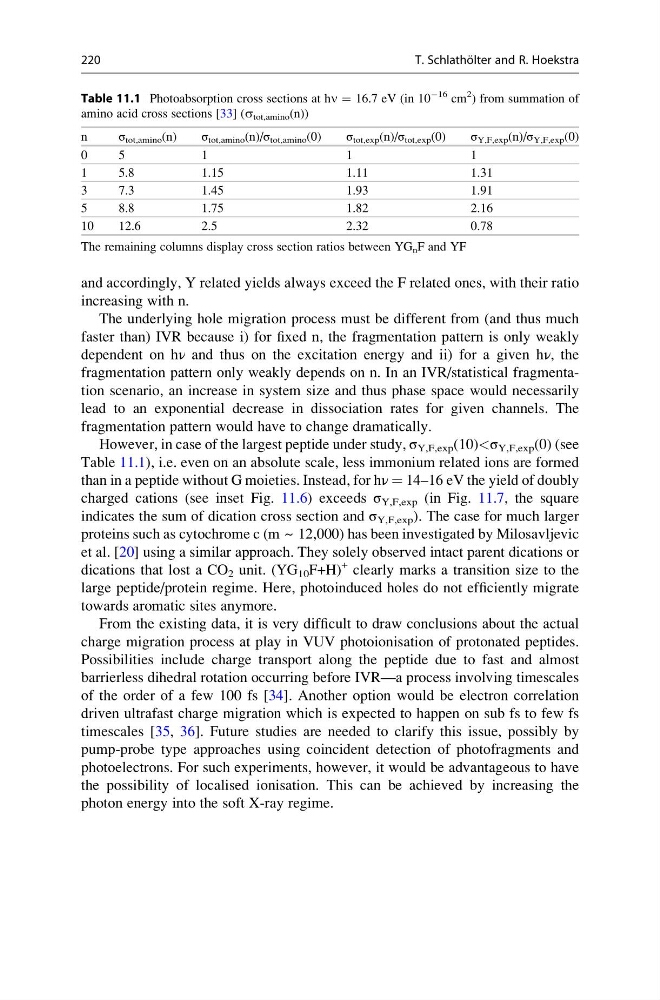
However, in case of the largest peptide under study, σ Y,F,exp (10)<σ Y,F,exp (0) (see
Table 11.1), i.e. even on an absolute scale, less immonium related ions are formed
than in a peptide without G moieties. Instead, for hν ¼ 14–16 eV the yield of doubly
charged cations (see inset Fig. 11.6) exceeds σ Y,F,exp (in Fig. 11.7, the square
indicates the sum of dication cross section and σ Y,F,exp ). The case for much larger
proteins such as cytochrome c (m ~ 12,000) has been investigated by Milosavljevic
et al. [20] using a similar approach. They solely observed intact parent dications or
dications that lost a CO 2 unit. (YG 10 F+H)
+ clearly marks a transition size to the
large peptide/protein regime. Here, photoinduced holes do not efficiently migrate
towards aromatic sites anymore.
From the existing data, it is very difficult to draw conclusions about the actual
charge migration process at play in VUV photoionisation of protonated peptides.
Possibilities include charge transport along the peptide due to fast and almost
barrierless dihedral rotation occurring before IVR—a process involving timescales
of the order of a few 100 fs [34]. Another option would be electron correlation
driven ultrafast charge migration which is expected to happen on sub fs to few fs
timescales [35, 36]. Future studies are needed to clarify this issue, possibly by
pump-probe type approaches using coincident detection of photofragments and
photoelectrons. For such experiments, however, it would be advantageous to have
the possibility of localised ionisation. This can be achieved by increasing the
photon energy into the soft X-ray regime.
Table 11.1 Photoabsorption cross sections at hn ¼ 16.7 eV (in 10
À16 cm
2
) from summation of
amino acid cross sections [33] (s tot,amino (n))
n
σ tot,amino (n)
σ tot,amino (n)/σ tot,amino (0)
σ tot,exp (n)/σ tot,exp (0)
σ Y,F,exp (n)/σ Y,F,exp (0)
0
5
1
1
1
1
5.8
1.15
1.11
1.31
3
7.3
1.45
1.93
1.91
5
8.8
1.75
1.82
2.16
10
12.6
2.5
2.32
0.78
The remaining columns display cross section ratios between YG n F and YF
220
T. Schlatho ¨ lter and R. Hoekstra
increasing with n.
The underlying hole migration process must be different from (and thus much
faster than) IVR because i) for fixed n, the fragmentation pattern is only weakly
dependent on hν and thus on the excitation energy and ii) for a given hν, the
fragmentation pattern only weakly depends on n. In an IVR/statistical fragmentation scenario, an increase in system size and thus phase space would necessarily
lead to an exponential decrease in dissociation rates for given channels. The
fragmentation pattern would have to change dramatically.
However, in case of the largest peptide under study, σ Y,F,exp (10)<σ Y,F,exp (0) (see
Table 11.1), i.e. even on an absolute scale, less immonium related ions are formed
than in a peptide without G moieties. Instead, for hν ¼ 14–16 eV the yield of doubly
charged cations (see inset Fig. 11.6) exceeds σ Y,F,exp (in Fig. 11.7, the square
indicates the sum of dication cross section and σ Y,F,exp ). The case for much larger
proteins such as cytochrome c (m ~ 12,000) has been investigated by Milosavljevic
et al. [20] using a similar approach. They solely observed intact parent dications or
dications that lost a CO 2 unit. (YG 10 F+H)
+ clearly marks a transition size to the
large peptide/protein regime. Here, photoinduced holes do not efficiently migrate
towards aromatic sites anymore.
From the existing data, it is very difficult to draw conclusions about the actual
charge migration process at play in VUV photoionisation of protonated peptides.
Possibilities include charge transport along the peptide due to fast and almost
barrierless dihedral rotation occurring before IVR—a process involving timescales
of the order of a few 100 fs [34]. Another option would be electron correlation
driven ultrafast charge migration which is expected to happen on sub fs to few fs
timescales [35, 36]. Future studies are needed to clarify this issue, possibly by
pump-probe type approaches using coincident detection of photofragments and
photoelectrons. For such experiments, however, it would be advantageous to have
the possibility of localised ionisation. This can be achieved by increasing the
photon energy into the soft X-ray regime.
Table 11.1 Photoabsorption cross sections at hn ¼ 16.7 eV (in 10
À16 cm
2
) from summation of
amino acid cross sections [33] (s tot,amino (n))
n
σ tot,amino (n)
σ tot,amino (n)/σ tot,amino (0)
σ tot,exp (n)/σ tot,exp (0)
σ Y,F,exp (n)/σ Y,F,exp (0)
0
5
1
1
1
1
5.8
1.15
1.11
1.31
3
7.3
1.45
1.93
1.91
5
8.8
1.75
1.82
2.16
10
12.6
2.5
2.32
0.78
The remaining columns display cross section ratios between YG n F and YF
220
T. Schlatho ¨ lter and R. Hoekstra