

phenylalanine σ F . It can be assumed that σ F ~ σ Y because of the similar molecular
structure of phenylalanine and tyrosine. For hν ¼ 16.7 eV, the total cross sections
then amount to σ tot,amino ¼ σ Y + nσ G + σ F and can be found in Table 11.1.
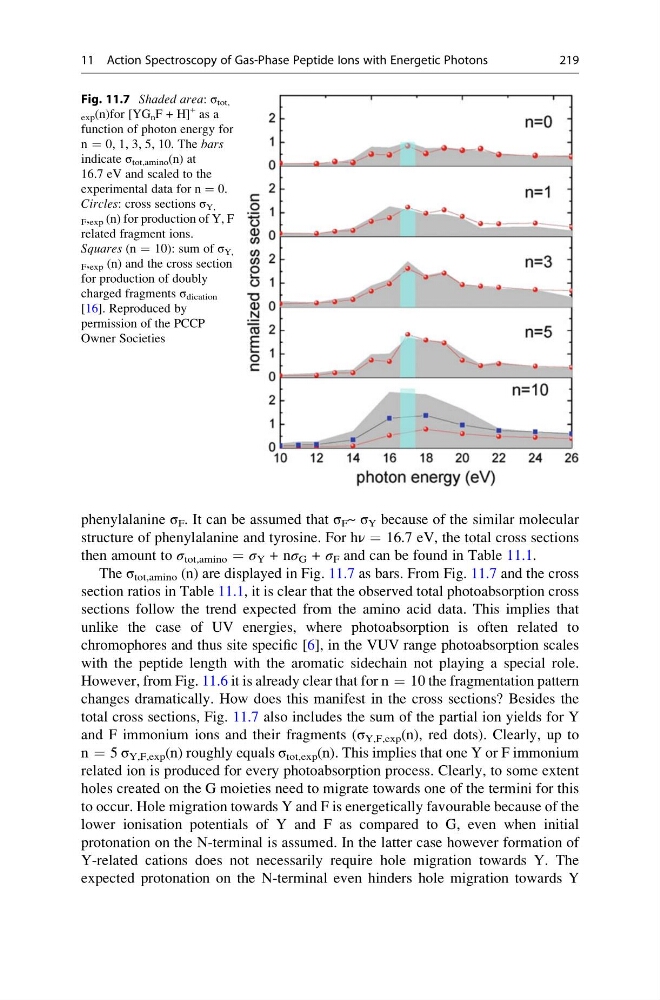
The σ tot,amino (n) are displayed in Fig. 11.7 as bars. From Fig. 11.7 and the cross
section ratios in Table 11.1, it is clear that the observed total photoabsorption cross
sections follow the trend expected from the amino acid data. This implies that
unlike the case of UV energies, where photoabsorption is often related to
chromophores and thus site specific [6], in the VUV range photoabsorption scales
with the peptide length with the aromatic sidechain not playing a special role.
However, from Fig. 11.6 it is already clear that for n ¼ 10 the fragmentation pattern
changes dramatically. How does this manifest in the cross sections? Besides the
total cross sections, Fig. 11.7 also includes the sum of the partial ion yields for Y
and F immonium ions and their fragments (σ Y,F,exp (n), red dots). Clearly, up to
n ¼ 5 σ Y,F,exp (n) roughly equals σ tot,exp (n). This implies that one Y or F immonium
related ion is produced for every photoabsorption process. Clearly, to some extent
holes created on the G moieties need to migrate towards one of the termini for this
to occur. Hole migration towards Y and F is energetically favourable because of the
lower ionisation potentials of Y and F as compared to G, even when initial
protonation on the N-terminal is assumed. In the latter case however formation of
Y-related cations does not necessarily require hole migration towards Y. The
expected protonation on the N-terminal even hinders hole migration towards Y
Fig. 11.7 Shaded area: σ tot,
exp (n)for [YG n F + H]
+ as a
function of photon energy for
n ¼ 0, 1, 3, 5, 10. The bars
indicate σ tot,amino (n) at
16.7 eV and scaled to the
experimental data for n ¼ 0.
Circles: cross sections σ Y,
F , exp (n) for production of Y, F
related fragment ions.
Squares (n ¼ 10): sum of σ Y,
F , exp (n) and the cross section
for production of doubly
charged fragments σ dication
[16]. Reproduced by
permission of the PCCP
Owner Societies
11 Action Spectroscopy of Gas-Phase Peptide Ions with Energetic Photons
219
structure of phenylalanine and tyrosine. For hν ¼ 16.7 eV, the total cross sections
then amount to σ tot,amino ¼ σ Y + nσ G + σ F and can be found in Table 11.1.
The σ tot,amino (n) are displayed in Fig. 11.7 as bars. From Fig. 11.7 and the cross
section ratios in Table 11.1, it is clear that the observed total photoabsorption cross
sections follow the trend expected from the amino acid data. This implies that
unlike the case of UV energies, where photoabsorption is often related to
chromophores and thus site specific [6], in the VUV range photoabsorption scales
with the peptide length with the aromatic sidechain not playing a special role.
However, from Fig. 11.6 it is already clear that for n ¼ 10 the fragmentation pattern
changes dramatically. How does this manifest in the cross sections? Besides the
total cross sections, Fig. 11.7 also includes the sum of the partial ion yields for Y
and F immonium ions and their fragments (σ Y,F,exp (n), red dots). Clearly, up to
n ¼ 5 σ Y,F,exp (n) roughly equals σ tot,exp (n). This implies that one Y or F immonium
related ion is produced for every photoabsorption process. Clearly, to some extent
holes created on the G moieties need to migrate towards one of the termini for this
to occur. Hole migration towards Y and F is energetically favourable because of the
lower ionisation potentials of Y and F as compared to G, even when initial
protonation on the N-terminal is assumed. In the latter case however formation of
Y-related cations does not necessarily require hole migration towards Y. The
expected protonation on the N-terminal even hinders hole migration towards Y
Fig. 11.7 Shaded area: σ tot,
exp (n)for [YG n F + H]
+ as a
function of photon energy for
n ¼ 0, 1, 3, 5, 10. The bars
indicate σ tot,amino (n) at
16.7 eV and scaled to the
experimental data for n ¼ 0.
Circles: cross sections σ Y,
F , exp (n) for production of Y, F
related fragment ions.
Squares (n ¼ 10): sum of σ Y,
F , exp (n) and the cross section
for production of doubly
charged fragments σ dication
[16]. Reproduced by
permission of the PCCP
Owner Societies
11 Action Spectroscopy of Gas-Phase Peptide Ions with Energetic Photons
219