

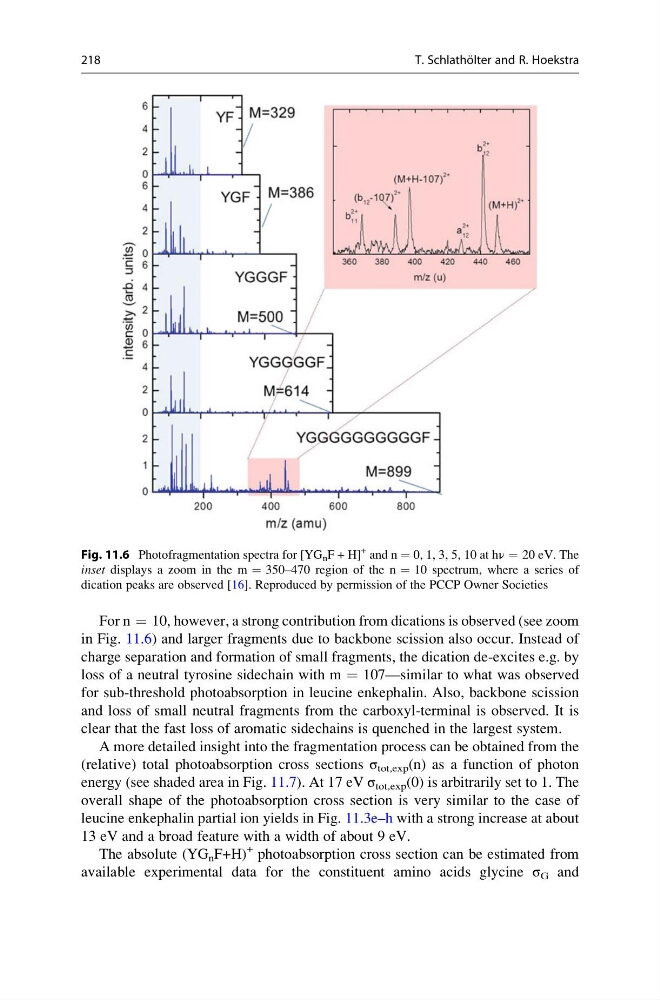
For n ¼ 10, however, a strong contribution from dications is observed (see zoom
in Fig. 11.6) and larger fragments due to backbone scission also occur. Instead of
charge separation and formation of small fragments, the dication de-excites e.g. by
loss of a neutral tyrosine sidechain with m ¼ 107—similar to what was observed
for sub-threshold photoabsorption in leucine enkephalin. Also, backbone scission
and loss of small neutral fragments from the carboxyl-terminal is observed. It is
clear that the fast loss of aromatic sidechains is quenched in the largest system.
A more detailed insight into the fragmentation process can be obtained from the
(relative) total photoabsorption cross sections σ tot,exp (n) as a function of photon
energy (see shaded area in Fig. 11.7). At 17 eV σ tot,exp (0) is arbitrarily set to 1. The
overall shape of the photoabsorption cross section is very similar to the case of
leucine enkephalin partial ion yields in Fig. 11.3e–h with a strong increase at about
13 eV and a broad feature with a width of about 9 eV.
The absolute (YG n F+H)
+ photoabsorption cross section can be estimated from
available experimental data for the constituent amino acids glycine σ G and
Fig. 11.6 Photofragmentation spectra for [YG n F + H]
+ and n ¼ 0, 1, 3, 5, 10 at hν ¼ 20 eV. The
inset displays a zoom in the m ¼ 350–470 region of the n ¼ 10 spectrum, where a series of
dication peaks are observed [16]. Reproduced by permission of the PCCP Owner Societies
218
T. Schlatho ¨ lter and R. Hoekstra
in Fig. 11.6) and larger fragments due to backbone scission also occur. Instead of
charge separation and formation of small fragments, the dication de-excites e.g. by
loss of a neutral tyrosine sidechain with m ¼ 107—similar to what was observed
for sub-threshold photoabsorption in leucine enkephalin. Also, backbone scission
and loss of small neutral fragments from the carboxyl-terminal is observed. It is
clear that the fast loss of aromatic sidechains is quenched in the largest system.
A more detailed insight into the fragmentation process can be obtained from the
(relative) total photoabsorption cross sections σ tot,exp (n) as a function of photon
energy (see shaded area in Fig. 11.7). At 17 eV σ tot,exp (0) is arbitrarily set to 1. The
overall shape of the photoabsorption cross section is very similar to the case of
leucine enkephalin partial ion yields in Fig. 11.3e–h with a strong increase at about
13 eV and a broad feature with a width of about 9 eV.
The absolute (YG n F+H)
+ photoabsorption cross section can be estimated from
available experimental data for the constituent amino acids glycine σ G and
Fig. 11.6 Photofragmentation spectra for [YG n F + H]
+ and n ¼ 0, 1, 3, 5, 10 at hν ¼ 20 eV. The
inset displays a zoom in the m ¼ 350–470 region of the n ¼ 10 spectrum, where a series of
dication peaks are observed [16]. Reproduced by permission of the PCCP Owner Societies
218
T. Schlatho ¨ lter and R. Hoekstra