

that the adenine-containing species were much less stable with respect to electron
loss than the thymine-containing ions (see Fig. 10.14). In fact, the electron binding
energy in [dA 5 –4H]
4À was found to be slightly negative, the tetra-anion being
stabilised only through the presence of a repulsive Coulomb barrier that dominates
the long-range electron-molecule potential in multiply charged anions [72–75].
Although direct detachment is possible for photon energies above the electronbinding energies, the wavelength dependence for photodetachment from
hexanucleotide trianions [dB 6 –3H]
3À measured by Gabelica and co-workers [23]
suggests that excitation of the base significantly enhances the photodetachment
efficiency (as discussed above).
Relative Electron Intensity
3
4
X 4
5
6
7
Binding Energy (eV)
a
b
c
d
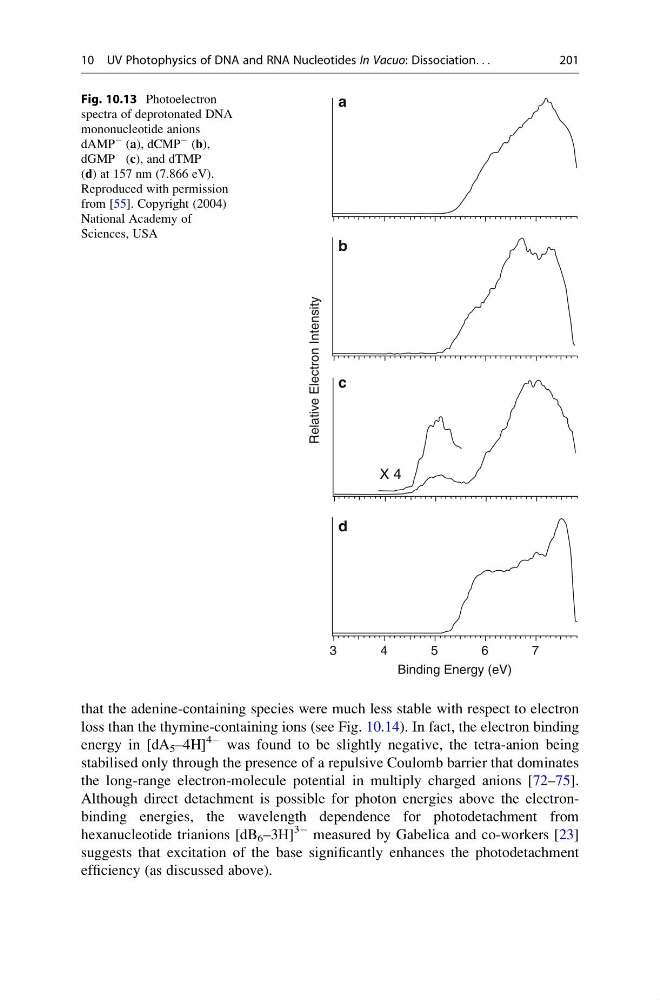
Fig. 10.13 Photoelectron
spectra of deprotonated DNA
mononucleotide anions
dAMP
À (a), dCMP
À (b),
dGMP
À (c), and dTMP
À
(d) at 157 nm (7.866 eV).
Reproduced with permission
from [55]. Copyright (2004)
National Academy of
Sciences, USA
10 UV Photophysics of DNA and RNA Nucleotides In Vacuo: Dissociation. . .
201
loss than the thymine-containing ions (see Fig. 10.14). In fact, the electron binding
energy in [dA 5 –4H]
4À was found to be slightly negative, the tetra-anion being
stabilised only through the presence of a repulsive Coulomb barrier that dominates
the long-range electron-molecule potential in multiply charged anions [72–75].
Although direct detachment is possible for photon energies above the electronbinding energies, the wavelength dependence for photodetachment from
hexanucleotide trianions [dB 6 –3H]
3À measured by Gabelica and co-workers [23]
suggests that excitation of the base significantly enhances the photodetachment
efficiency (as discussed above).
Relative Electron Intensity
3
4
X 4
5
6
7
Binding Energy (eV)
a
b
c
d
Fig. 10.13 Photoelectron
spectra of deprotonated DNA
mononucleotide anions
dAMP
À (a), dCMP
À (b),
dGMP
À (c), and dTMP
À
(d) at 157 nm (7.866 eV).
Reproduced with permission
from [55]. Copyright (2004)
National Academy of
Sciences, USA
10 UV Photophysics of DNA and RNA Nucleotides In Vacuo: Dissociation. . .
201