

groups. The photoelectron spectra of singly charged DNA nucleotide anions were
first studied by Wang and co-workers [55]. The electron-binding energies in
mononucleotides are slightly above 5 eV, except [dGMP–H]
À , which has an
electron-binding energy ca. 0.7 eV lower than any of the others (see Fig. 10.13).
Likewise, the presence of guanine in DNA di- and trinucleotides significantly
lowers the electron-binding energies in these species. This indicates that the
HOMO of guanine-containing nucleotide anions resides on the guanine base (in a
π orbital) rather than on the phosphate group. Of the other di- and trinucleotides
investigated by Wang and co-workers, only the singly charged [dA 3 –H]
À ion shows
features at similarly low binding energies, suggesting that adenine also has a
propensity towards accommodating excess electrons. The low electron-binding
energies of guanine-containing nucleotides are consistent with evidence from
condensed-phase studies indicating that ionisation of DNA predominantly leads
to holes localised on poly-G sequences (so-called guanine runs), particularly GGG
[24, 70, 71].
In principle, every phosphate group can be deprotonated to carry a negative
excess charge, allowing oligonucleotides to be multiply-charged negative ions.
Multiply-charged oligonucleotide anions were first studied by Weber et al. [67],
who reported photoelectron spectra of [dB 5 –4H]
4À ions (B ¼ A, T). They observed
0.0
0.2
0.4
0.6
0.8
1.0
Energy (eV)
250 260 270 280 290 300 310 320 330 340 350
0.0
0.2
0.4
0.6
0.8
1.0
Normalised yield of photofragments
Wavelength (nm)
m/z 119
m/z 109
4.8 4.6 4.4 4.2
4
3.8
3.6
N
N
N
N
NH 2
H
H
H
H
1
+
N
N
N
N
NH 2
H
H
H
H
2
+
N
N
N
N
NH 2
H
H
H
H
3
+
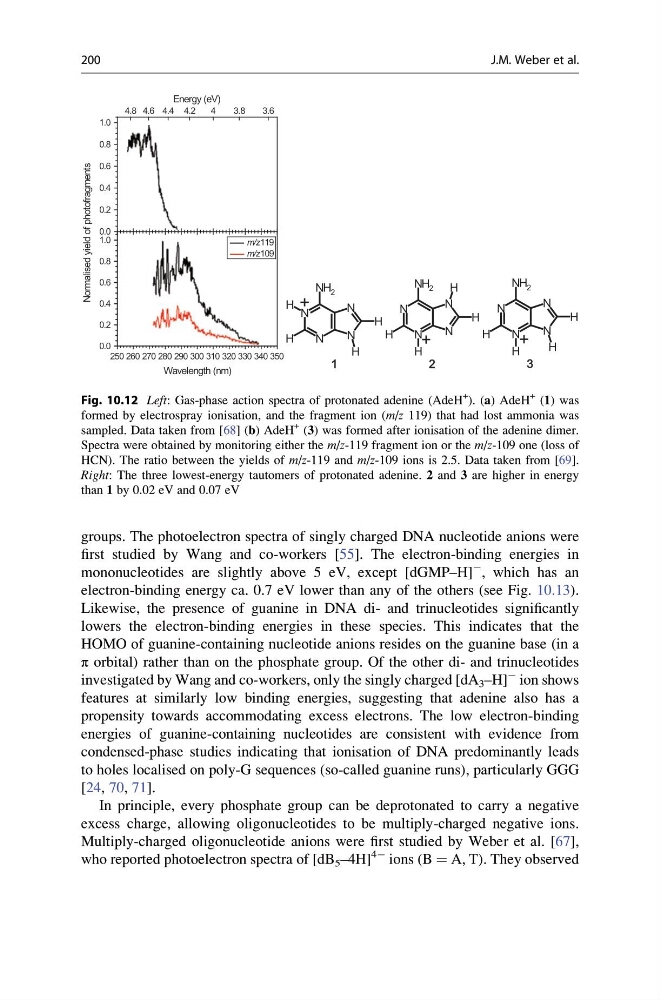
Fig. 10.12 Left: Gas-phase action spectra of protonated adenine (AdeH
+ ). (a) AdeH
+ (1) was
formed by electrospray ionisation, and the fragment ion (m/z 119) that had lost ammonia was
sampled. Data taken from [68] (b) AdeH
+ (3) was formed after ionisation of the adenine dimer.
Spectra were obtained by monitoring either the m/z-119 fragment ion or the m/z-109 one (loss of
HCN). The ratio between the yields of m/z-119 and m/z-109 ions is 2.5. Data taken from [69].
Right: The three lowest-energy tautomers of protonated adenine. 2 and 3 are higher in energy
than 1 by 0.02 eV and 0.07 eV
200
J.M. Weber et al.
first studied by Wang and co-workers [55]. The electron-binding energies in
mononucleotides are slightly above 5 eV, except [dGMP–H]
À , which has an
electron-binding energy ca. 0.7 eV lower than any of the others (see Fig. 10.13).
Likewise, the presence of guanine in DNA di- and trinucleotides significantly
lowers the electron-binding energies in these species. This indicates that the
HOMO of guanine-containing nucleotide anions resides on the guanine base (in a
π orbital) rather than on the phosphate group. Of the other di- and trinucleotides
investigated by Wang and co-workers, only the singly charged [dA 3 –H]
À ion shows
features at similarly low binding energies, suggesting that adenine also has a
propensity towards accommodating excess electrons. The low electron-binding
energies of guanine-containing nucleotides are consistent with evidence from
condensed-phase studies indicating that ionisation of DNA predominantly leads
to holes localised on poly-G sequences (so-called guanine runs), particularly GGG
[24, 70, 71].
In principle, every phosphate group can be deprotonated to carry a negative
excess charge, allowing oligonucleotides to be multiply-charged negative ions.
Multiply-charged oligonucleotide anions were first studied by Weber et al. [67],
who reported photoelectron spectra of [dB 5 –4H]
4À ions (B ¼ A, T). They observed
0.0
0.2
0.4
0.6
0.8
1.0
Energy (eV)
250 260 270 280 290 300 310 320 330 340 350
0.0
0.2
0.4
0.6
0.8
1.0
Normalised yield of photofragments
Wavelength (nm)
m/z 119
m/z 109
4.8 4.6 4.4 4.2
4
3.8
3.6
N
N
N
N
NH 2
H
H
H
H
1
+
N
N
N
N
NH 2
H
H
H
H
2
+
N
N
N
N
NH 2
H
H
H
H
3
+
Fig. 10.12 Left: Gas-phase action spectra of protonated adenine (AdeH
+ ). (a) AdeH
+ (1) was
formed by electrospray ionisation, and the fragment ion (m/z 119) that had lost ammonia was
sampled. Data taken from [68] (b) AdeH
+ (3) was formed after ionisation of the adenine dimer.
Spectra were obtained by monitoring either the m/z-119 fragment ion or the m/z-109 one (loss of
HCN). The ratio between the yields of m/z-119 and m/z-109 ions is 2.5. Data taken from [69].
Right: The three lowest-energy tautomers of protonated adenine. 2 and 3 are higher in energy
than 1 by 0.02 eV and 0.07 eV
200
J.M. Weber et al.