

10.6 Concluding Remarks
The last 10 years have provided a wealth of information on the behaviour of isolated
nucleotides in vacuo after UV photoexcitation, but there are still many issues that
need to be properly addressed. It seems that base protonation leads to more prompt
photodissociation, but different experiments have provided quite different results
regarding the importance and the time scales of statistical and nonstatistical dissociation processes. Additionally, no spectroscopic data are available for these ions.
There is also a lack of data when it comes to the photodissociation channels of
protonated oligonucleotides. With respect to spectroscopy of strands where exciton
coupling plays a role, it would be interesting to freeze out the structural fluctuations.
If the frozen structures increase base stacking, this would also increase the
corresponding electronic coupling. Spectroscopy of cold nucleic acids in ion traps
would provide important data to benchmark the nontrivial problem of carrying out
electronic-structure calculations of excited states. In addition to information on
-1
0
1
2
3
4
0
a
-1
0
1
2
3
4
0
b
photoelectron yield [arb. units]
electron binding energy [eV]
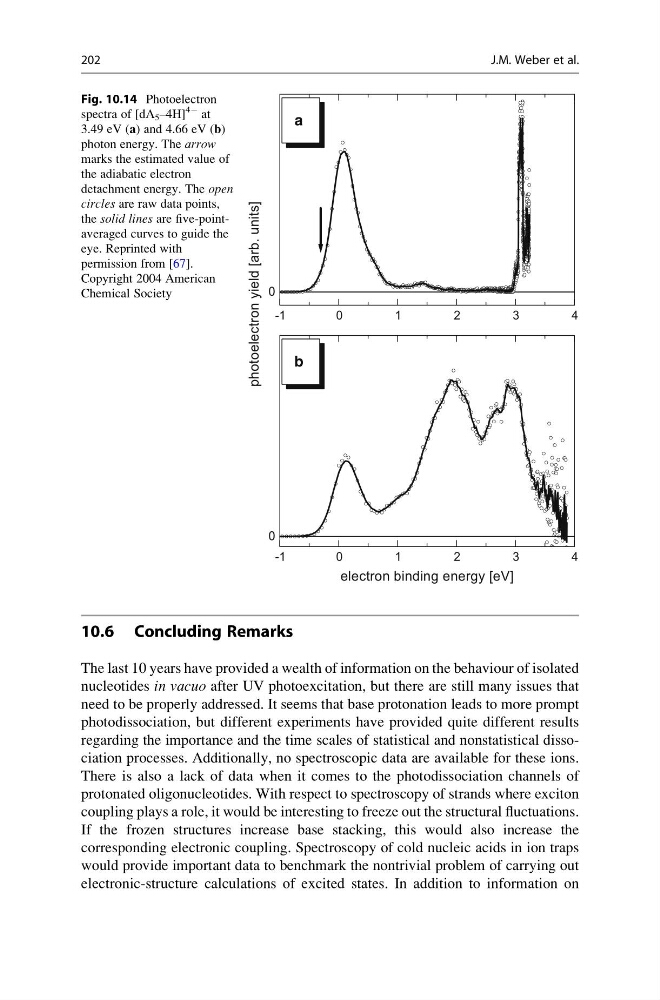
Fig. 10.14 Photoelectron
spectra of [dA 5 –4H]
4À at
3.49 eV (a) and 4.66 eV (b)
photon energy. The arrow
marks the estimated value of
the adiabatic electron
detachment energy. The open
circles are raw data points,
the solid lines are five-pointaveraged curves to guide the
eye. Reprinted with
permission from [67].
Copyright 2004 American
Chemical Society
202
J.M. Weber et al.
The last 10 years have provided a wealth of information on the behaviour of isolated
nucleotides in vacuo after UV photoexcitation, but there are still many issues that
need to be properly addressed. It seems that base protonation leads to more prompt
photodissociation, but different experiments have provided quite different results
regarding the importance and the time scales of statistical and nonstatistical dissociation processes. Additionally, no spectroscopic data are available for these ions.
There is also a lack of data when it comes to the photodissociation channels of
protonated oligonucleotides. With respect to spectroscopy of strands where exciton
coupling plays a role, it would be interesting to freeze out the structural fluctuations.
If the frozen structures increase base stacking, this would also increase the
corresponding electronic coupling. Spectroscopy of cold nucleic acids in ion traps
would provide important data to benchmark the nontrivial problem of carrying out
electronic-structure calculations of excited states. In addition to information on
-1
0
1
2
3
4
0
a
-1
0
1
2
3
4
0
b
photoelectron yield [arb. units]
electron binding energy [eV]
Fig. 10.14 Photoelectron
spectra of [dA 5 –4H]
4À at
3.49 eV (a) and 4.66 eV (b)
photon energy. The arrow
marks the estimated value of
the adiabatic electron
detachment energy. The open
circles are raw data points,
the solid lines are five-pointaveraged curves to guide the
eye. Reprinted with
permission from [67].
Copyright 2004 American
Chemical Society
202
J.M. Weber et al.