

Gas-phase spectroscopy of larger multiply charged DNA oligonucleotide strands
in vacuo has been studied by Gabelica et al. [22–24] based on electron detachment.
They found that the neutral base is the site of detachment in agreement with the idea
that the highest occupied molecular orbital (HOMO) is located on the base [55, 66,
67], and that guanine strands had the highest electron detachment yield in accordance with the fact that it has the lowest ionisation energy among the four canonical
DNA bases. Importantly, plots of the electron detachment cross section as a
function of excitation wavelength showed that highest values were obtained in
the region of base absorption. This is illustrated for single-stranded [dG 6 –3H]
3À and
double-stranded [dsC–5H]
5À in Fig. 10.10. These results indicate that the involved
electronic states (resonance states) act as doorway states to the detachment continuum, and base excitation enhances electron detachment. In other work, Rosu et al.
[25] used wavelength-dependent electron-detachment efficiencies to shed light on
the difference in absorption by single strands, double strands and quadruplexes in
vacuo. The systems chosen for study are shown in Fig. 10.11 together with the
corresponding spectra. It is clearly evident that the duplexes and the quadruplex
H-bonded
stacked
open
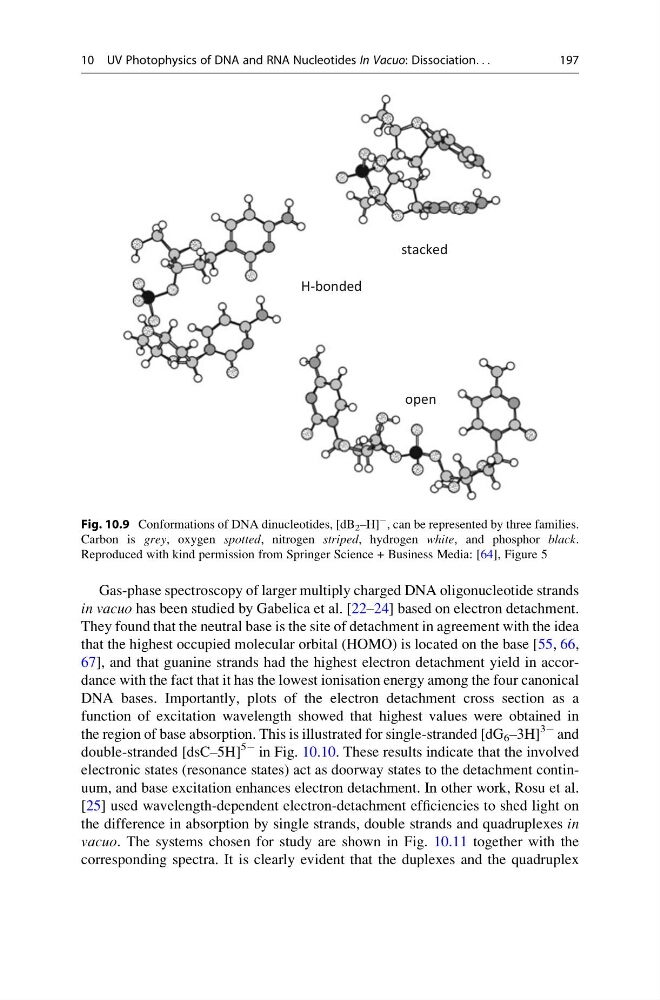
Fig. 10.9 Conformations of DNA dinucleotides, [dB 2 –H]
À , can be represented by three families.
Carbon is grey, oxygen spotted, nitrogen striped, hydrogen white, and phosphor black.
Reproduced with kind permission from Springer Science + Business Media: [64], Figure 5
10 UV Photophysics of DNA and RNA Nucleotides In Vacuo: Dissociation. . .
197
in vacuo has been studied by Gabelica et al. [22–24] based on electron detachment.
They found that the neutral base is the site of detachment in agreement with the idea
that the highest occupied molecular orbital (HOMO) is located on the base [55, 66,
67], and that guanine strands had the highest electron detachment yield in accordance with the fact that it has the lowest ionisation energy among the four canonical
DNA bases. Importantly, plots of the electron detachment cross section as a
function of excitation wavelength showed that highest values were obtained in
the region of base absorption. This is illustrated for single-stranded [dG 6 –3H]
3À and
double-stranded [dsC–5H]
5À in Fig. 10.10. These results indicate that the involved
electronic states (resonance states) act as doorway states to the detachment continuum, and base excitation enhances electron detachment. In other work, Rosu et al.
[25] used wavelength-dependent electron-detachment efficiencies to shed light on
the difference in absorption by single strands, double strands and quadruplexes in
vacuo. The systems chosen for study are shown in Fig. 10.11 together with the
corresponding spectra. It is clearly evident that the duplexes and the quadruplex
H-bonded
stacked
open
Fig. 10.9 Conformations of DNA dinucleotides, [dB 2 –H]
À , can be represented by three families.
Carbon is grey, oxygen spotted, nitrogen striped, hydrogen white, and phosphor black.
Reproduced with kind permission from Springer Science + Business Media: [64], Figure 5
10 UV Photophysics of DNA and RNA Nucleotides In Vacuo: Dissociation. . .
197