

molecular orbitals, and these amino acids thus absorb to the red of the other
seventeen naturally occurring ones. Excitations in this region are typically ππ*
transitions. Due to these properties, peptides subjected to UV spectroscopic
experiments often contain at least one aromatic amino acid.
A dipeptide is made when two amino acids join together, release a water
molecule and form an amide bond (see Fig. 1.9). Addition of more amino acids
in a similar way results in longer peptides. Proteins are peptides with a biological
function, e.g., transport of small molecules or enzymatic activity. A classification of
the structural hierarchy was introduced by Linderstrøm-Lang. The sequence of
amino acid residues is denoted the primary structure, while the secondary structure
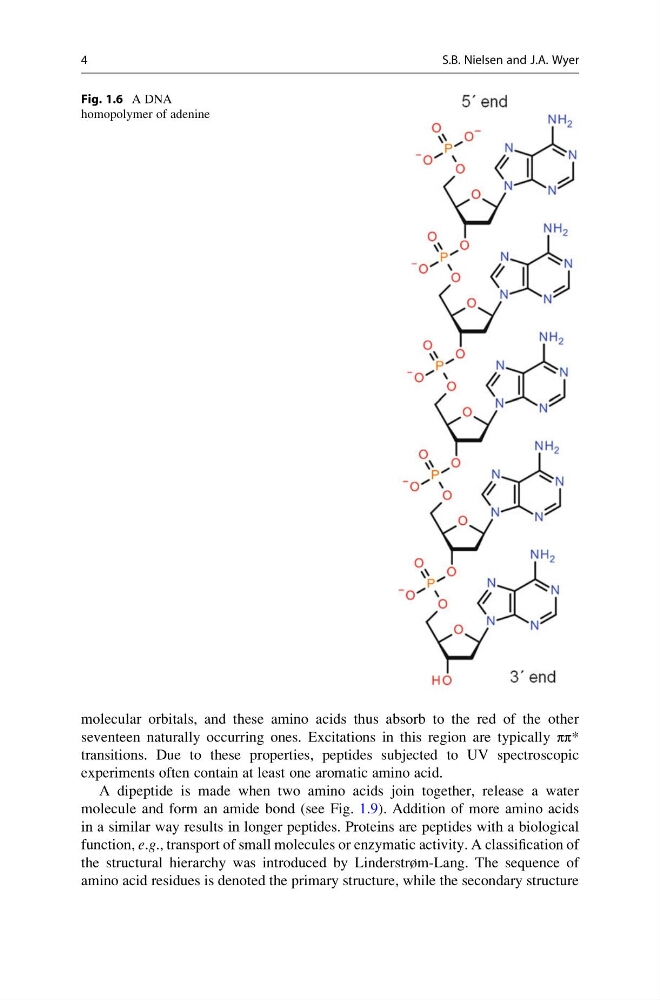
Fig. 1.6 A DNA
homopolymer of adenine
4
S.B. Nielsen and J.A. Wyer
seventeen naturally occurring ones. Excitations in this region are typically ππ*
transitions. Due to these properties, peptides subjected to UV spectroscopic
experiments often contain at least one aromatic amino acid.
A dipeptide is made when two amino acids join together, release a water
molecule and form an amide bond (see Fig. 1.9). Addition of more amino acids
in a similar way results in longer peptides. Proteins are peptides with a biological
function, e.g., transport of small molecules or enzymatic activity. A classification of
the structural hierarchy was introduced by Linderstrøm-Lang. The sequence of
amino acid residues is denoted the primary structure, while the secondary structure
Fig. 1.6 A DNA
homopolymer of adenine
4
S.B. Nielsen and J.A. Wyer