

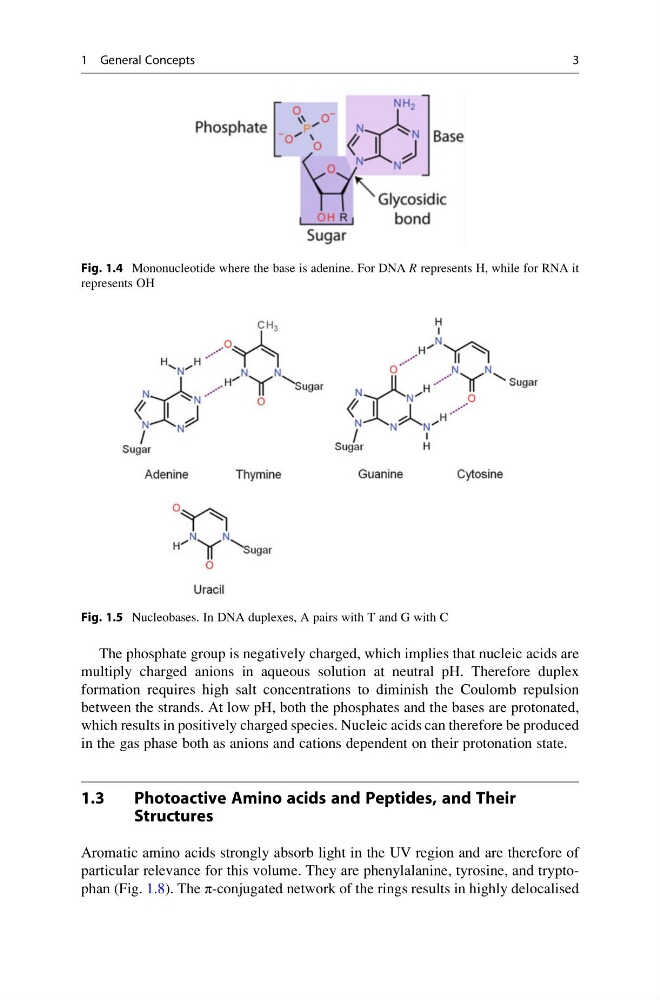
The phosphate group is negatively charged, which implies that nucleic acids are
multiply charged anions in aqueous solution at neutral pH. Therefore duplex
formation requires high salt concentrations to diminish the Coulomb repulsion
between the strands. At low pH, both the phosphates and the bases are protonated,
which results in positively charged species. Nucleic acids can therefore be produced
in the gas phase both as anions and cations dependent on their protonation state.
1.3
Photoactive Amino acids and Peptides, and Their
Structures
Aromatic amino acids strongly absorb light in the UV region and are therefore of
particular relevance for this volume. They are phenylalanine, tyrosine, and tryptophan (Fig. 1.8). The π-conjugated network of the rings results in highly delocalised
Fig. 1.4 Mononucleotide where the base is adenine. For DNA R represents H, while for RNA it
represents OH
Fig. 1.5 Nucleobases. In DNA duplexes, A pairs with T and G with C
1 General Concepts
3
multiply charged anions in aqueous solution at neutral pH. Therefore duplex
formation requires high salt concentrations to diminish the Coulomb repulsion
between the strands. At low pH, both the phosphates and the bases are protonated,
which results in positively charged species. Nucleic acids can therefore be produced
in the gas phase both as anions and cations dependent on their protonation state.
1.3
Photoactive Amino acids and Peptides, and Their
Structures
Aromatic amino acids strongly absorb light in the UV region and are therefore of
particular relevance for this volume. They are phenylalanine, tyrosine, and tryptophan (Fig. 1.8). The π-conjugated network of the rings results in highly delocalised
Fig. 1.4 Mononucleotide where the base is adenine. For DNA R represents H, while for RNA it
represents OH
Fig. 1.5 Nucleobases. In DNA duplexes, A pairs with T and G with C
1 General Concepts
3