

Since internal conversion is a dominant excited-state decay channel in the gas
phase at low excitation energies, as well as in solutions, one might be interested in
comparing the IC lifetimes in both environments. Remarkably, the experimental
results in various solvents also reveal an ultrafast bi-exponential fluorescence decay
with a sub-picosecond predominant component, indicating a nearly barrierless
radiationless conversion, and a weak dependence on solvent viscosity [15, 18].
This striking agreement in the excited-state decay of the chromophore anion in the
gas phase and in solution clearly indicates that internal conversion is indeed a very
efficient nearly barrierless decay channel with a very steep potential, leading to the
lowest-lying conical intersection [36].
5.4.3 Branching Ratio in Excited-State Decay Channels
After excitation to the S 1 state there is at a given wavelength a branching ratio for
prompt electron detachment (PD) versus internal conversion (IC), where the latter
results in delayed action. The following discussion pertains to the spectral region of
low excitation energies close to the maximum at 482 nm observed in both prompt
and delayed action spectra.
The PD and IC rate constants, their branching ratio and the associated excitedstate lifetimes may be estimated using the RRKM/QET quasi-equilibrium theory
[36], provided that both excited-state decay channels are IVR-mediated and have a
statistical nature at low excitation energies. The average excited-state lifetime
equals the inverse of the effective rate constant, which is a sum of the PD and IC
microcanonical unimolecular rate constants.
The IC lifetime is determined by crossing a barrier along the two branches that
lead out of the planar fluorescent state. Here, we provide an estimation of the IC
lifetime based on a somewhat simplified scheme, disregarding a re-population of
the fluorescent state from the transient twisted intermediate in S 1 , as discussed
above. Such a timescale should provide an estimation that lies in between the two
lifetime components found experimentally [63], as shown below.
According to the generalised scheme, the decay of the fluorescent state occurs
along the two branches, where one of them directly leads to the S 1 /S 0 conical
intersection and the other leads to a short-lived transient intermediate in S 1 that may
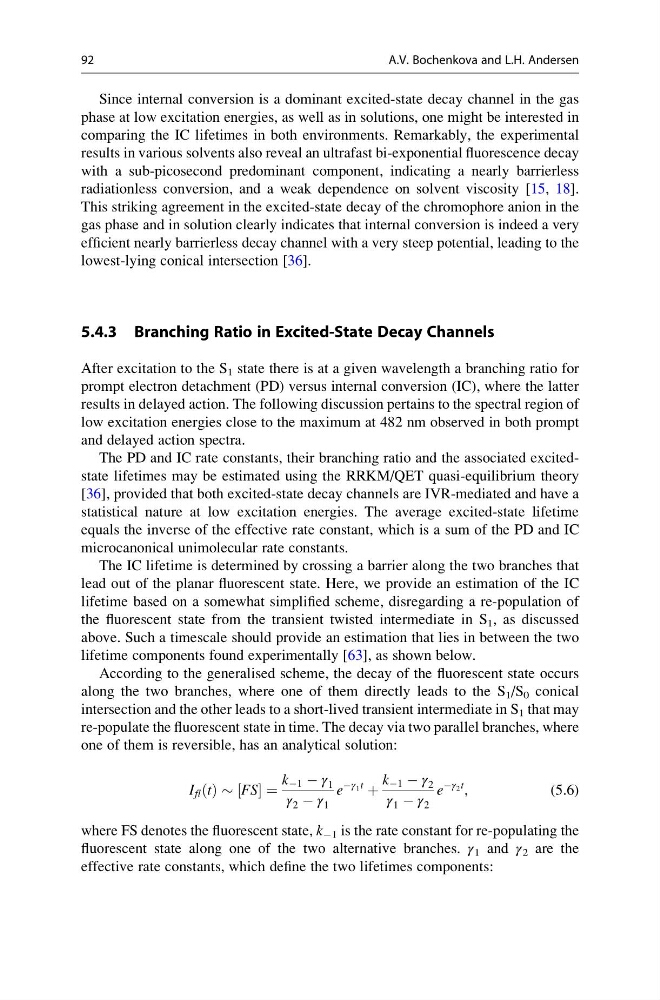
re-populate the fluorescent state in time. The decay via two parallel branches, where
one of them is reversible, has an analytical solution:
I fl t
ð Þ $ FS
½ ¼
k À1 À γ 1
γ 2 À γ 1
e
Àγ 1 t
þ
k À1 À γ 2
γ 1 À γ 2
e
Àγ 2 t ,
(5.6)
where FS denotes the fluorescent state, k À1 is the rate constant for re-populating the
fluorescent state along one of the two alternative branches. γ 1 and γ 2 are the
effective rate constants, which define the two lifetimes components:
92
A.V. Bochenkova and L.H. Andersen
phase at low excitation energies, as well as in solutions, one might be interested in
comparing the IC lifetimes in both environments. Remarkably, the experimental
results in various solvents also reveal an ultrafast bi-exponential fluorescence decay
with a sub-picosecond predominant component, indicating a nearly barrierless
radiationless conversion, and a weak dependence on solvent viscosity [15, 18].
This striking agreement in the excited-state decay of the chromophore anion in the
gas phase and in solution clearly indicates that internal conversion is indeed a very
efficient nearly barrierless decay channel with a very steep potential, leading to the
lowest-lying conical intersection [36].
5.4.3 Branching Ratio in Excited-State Decay Channels
After excitation to the S 1 state there is at a given wavelength a branching ratio for
prompt electron detachment (PD) versus internal conversion (IC), where the latter
results in delayed action. The following discussion pertains to the spectral region of
low excitation energies close to the maximum at 482 nm observed in both prompt
and delayed action spectra.
The PD and IC rate constants, their branching ratio and the associated excitedstate lifetimes may be estimated using the RRKM/QET quasi-equilibrium theory
[36], provided that both excited-state decay channels are IVR-mediated and have a
statistical nature at low excitation energies. The average excited-state lifetime
equals the inverse of the effective rate constant, which is a sum of the PD and IC
microcanonical unimolecular rate constants.
The IC lifetime is determined by crossing a barrier along the two branches that
lead out of the planar fluorescent state. Here, we provide an estimation of the IC
lifetime based on a somewhat simplified scheme, disregarding a re-population of
the fluorescent state from the transient twisted intermediate in S 1 , as discussed
above. Such a timescale should provide an estimation that lies in between the two
lifetime components found experimentally [63], as shown below.
According to the generalised scheme, the decay of the fluorescent state occurs
along the two branches, where one of them directly leads to the S 1 /S 0 conical
intersection and the other leads to a short-lived transient intermediate in S 1 that may
re-populate the fluorescent state in time. The decay via two parallel branches, where
one of them is reversible, has an analytical solution:
I fl t
ð Þ $ FS
½ ¼
k À1 À γ 1
γ 2 À γ 1
e
Àγ 1 t
þ
k À1 À γ 2
γ 1 À γ 2
e
Àγ 2 t ,
(5.6)
where FS denotes the fluorescent state, k À1 is the rate constant for re-populating the
fluorescent state along one of the two alternative branches. γ 1 and γ 2 are the
effective rate constants, which define the two lifetimes components:
92
A.V. Bochenkova and L.H. Andersen