

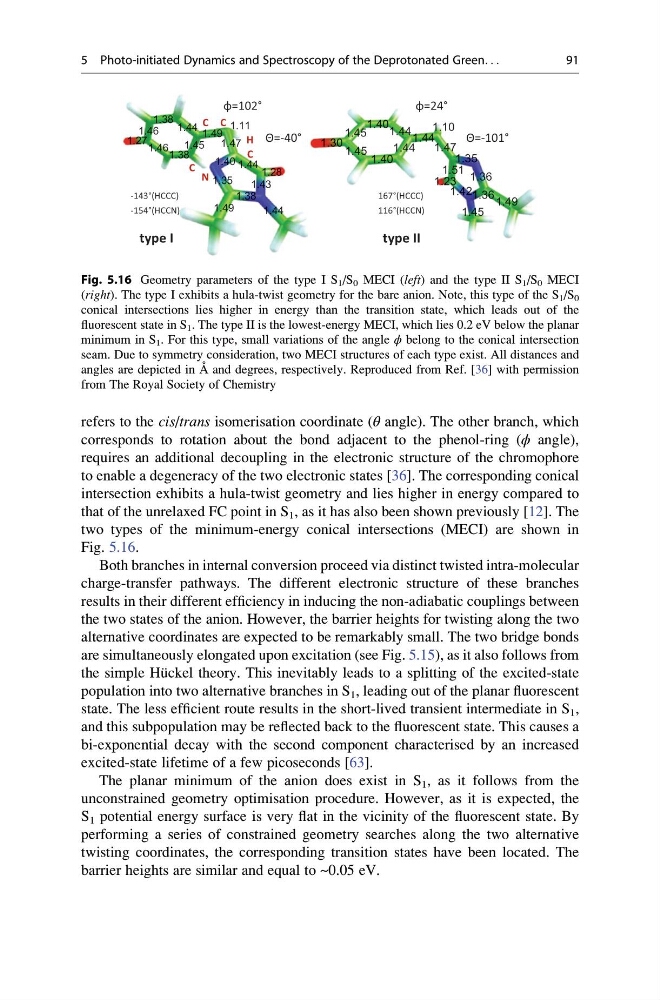
refers to the cis/trans isomerisation coordinate (θ angle). The other branch, which
corresponds to rotation about the bond adjacent to the phenol-ring (ϕ angle),
requires an additional decoupling in the electronic structure of the chromophore
to enable a degeneracy of the two electronic states [36]. The corresponding conical
intersection exhibits a hula-twist geometry and lies higher in energy compared to
that of the unrelaxed FC point in S 1 , as it has also been shown previously [12]. The
two types of the minimum-energy conical intersections (MECI) are shown in
Fig. 5.16.
Both branches in internal conversion proceed via distinct twisted intra-molecular
charge-transfer pathways. The different electronic structure of these branches
results in their different efficiency in inducing the non-adiabatic couplings between
the two states of the anion. However, the barrier heights for twisting along the two
alternative coordinates are expected to be remarkably small. The two bridge bonds
are simultaneously elongated upon excitation (see Fig. 5.15), as it also follows from
the simple Hu ¨ckel theory. This inevitably leads to a splitting of the excited-state
population into two alternative branches in S 1 , leading out of the planar fluorescent
state. The less efficient route results in the short-lived transient intermediate in S 1 ,
and this subpopulation may be reflected back to the fluorescent state. This causes a
bi-exponential decay with the second component characterised by an increased
excited-state lifetime of a few picoseconds [63].
The planar minimum of the anion does exist in S 1 , as it follows from the
unconstrained geometry optimisation procedure. However, as it is expected, the
S 1 potential energy surface is very flat in the vicinity of the fluorescent state. By
performing a series of constrained geometry searches along the two alternative
twisting coordinates, the corresponding transition states have been located. The
barrier heights are similar and equal to ~0.05 eV.
1.49
1.35
1.38
1.40
1.47
1.44
1.11
1.49
1.45
1.44
1.38
1.38
1.46
1.46
1.27
1.28
1.43
1.44
=102°
143°(HCCC)
154°(HCCN)
C
C C
H
type I
= 40°
1.49
1.36
1.36
1.35
1.47
1.51
1.10
1.44
1.44
1.44
1.40
1.40
1.45
1.45
1.30
1.23
1.42
1.45
type II
C
N
=24°
= 101°
167°(HCCC)
116°(HCCN)
Fig. 5.16 Geometry parameters of the type I S 1 /S 0 MECI (left) and the type II S 1 /S 0 MECI
(right). The type I exhibits a hula-twist geometry for the bare anion. Note, this type of the S 1 /S 0
conical intersections lies higher in energy than the transition state, which leads out of the
fluorescent state in S 1 . The type II is the lowest-energy MECI, which lies 0.2 eV below the planar
minimum in S 1 . For this type, small variations of the angle ϕ belong to the conical intersection
seam. Due to symmetry consideration, two MECI structures of each type exist. All distances and
angles are depicted in A ˚ and degrees, respectively. Reproduced from Ref. [36] with permission
from The Royal Society of Chemistry
5 Photo-initiated Dynamics and Spectroscopy of the Deprotonated Green. . .
91
corresponds to rotation about the bond adjacent to the phenol-ring (ϕ angle),
requires an additional decoupling in the electronic structure of the chromophore
to enable a degeneracy of the two electronic states [36]. The corresponding conical
intersection exhibits a hula-twist geometry and lies higher in energy compared to
that of the unrelaxed FC point in S 1 , as it has also been shown previously [12]. The
two types of the minimum-energy conical intersections (MECI) are shown in
Fig. 5.16.
Both branches in internal conversion proceed via distinct twisted intra-molecular
charge-transfer pathways. The different electronic structure of these branches
results in their different efficiency in inducing the non-adiabatic couplings between
the two states of the anion. However, the barrier heights for twisting along the two
alternative coordinates are expected to be remarkably small. The two bridge bonds
are simultaneously elongated upon excitation (see Fig. 5.15), as it also follows from
the simple Hu ¨ckel theory. This inevitably leads to a splitting of the excited-state
population into two alternative branches in S 1 , leading out of the planar fluorescent
state. The less efficient route results in the short-lived transient intermediate in S 1 ,
and this subpopulation may be reflected back to the fluorescent state. This causes a
bi-exponential decay with the second component characterised by an increased
excited-state lifetime of a few picoseconds [63].
The planar minimum of the anion does exist in S 1 , as it follows from the
unconstrained geometry optimisation procedure. However, as it is expected, the
S 1 potential energy surface is very flat in the vicinity of the fluorescent state. By
performing a series of constrained geometry searches along the two alternative
twisting coordinates, the corresponding transition states have been located. The
barrier heights are similar and equal to ~0.05 eV.
1.49
1.35
1.38
1.40
1.47
1.44
1.11
1.49
1.45
1.44
1.38
1.38
1.46
1.46
1.27
1.28
1.43
1.44
=102°
143°(HCCC)
154°(HCCN)
C
C C
H
type I
= 40°
1.49
1.36
1.36
1.35
1.47
1.51
1.10
1.44
1.44
1.44
1.40
1.40
1.45
1.45
1.30
1.23
1.42
1.45
type II
C
N
=24°
= 101°
167°(HCCC)
116°(HCCN)
Fig. 5.16 Geometry parameters of the type I S 1 /S 0 MECI (left) and the type II S 1 /S 0 MECI
(right). The type I exhibits a hula-twist geometry for the bare anion. Note, this type of the S 1 /S 0
conical intersections lies higher in energy than the transition state, which leads out of the
fluorescent state in S 1 . The type II is the lowest-energy MECI, which lies 0.2 eV below the planar
minimum in S 1 . For this type, small variations of the angle ϕ belong to the conical intersection
seam. Due to symmetry consideration, two MECI structures of each type exist. All distances and
angles are depicted in A ˚ and degrees, respectively. Reproduced from Ref. [36] with permission
from The Royal Society of Chemistry
5 Photo-initiated Dynamics and Spectroscopy of the Deprotonated Green. . .
91