

558
V. N. Pustovit and T. V. Shahbazyan
(a)
(b)
(c)
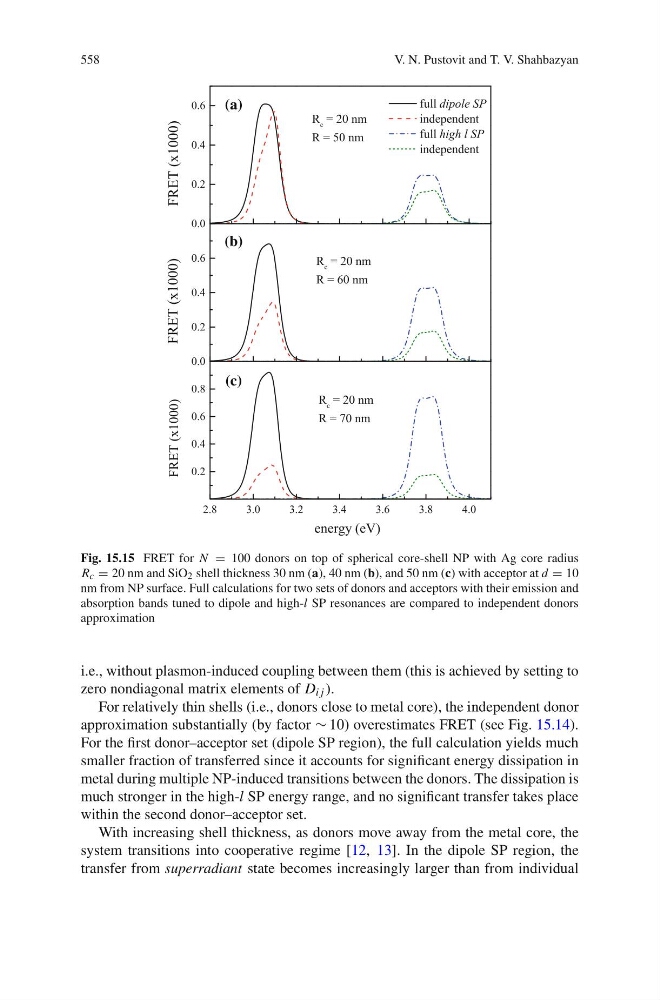
Fig. 15.15 FRET for N = 100 donors on top of spherical core-shell NP with Ag core radius
R c = 20 nm and SiO 2 shell thickness 30 nm (a), 40 nm (b), and 50 nm (c) with acceptor at d = 10
nm from NP surface. Full calculations for two sets of donors and acceptors with their emission and
absorption bands tuned to dipole and high-l SP resonances are compared to independent donors
approximation
i.e., without plasmon-induced coupling between them (this is achieved by setting to
zero nondiagonal matrix elements of D i j ).
For relatively thin shells (i.e., donors close to metal core), the independent donor
approximation substantially (by factor ∪ 10) overestimates FRET (see Fig. 15.14).
For the first donor–acceptor set (dipole SP region), the full calculation yields much
smaller fraction of transferred since it accounts for significant energy dissipation in
metal during multiple NP-induced transitions between the donors. The dissipation is
much stronger in the high-l SP energy range, and no significant transfer takes place
within the second donor–acceptor set.
With increasing shell thickness, as donors move away from the metal core, the
system transitions into cooperative regime [12, 13]. In the dipole SP region, the
transfer from superradiant state becomes increasingly larger than from individual
V. N. Pustovit and T. V. Shahbazyan
(a)
(b)
(c)
Fig. 15.15 FRET for N = 100 donors on top of spherical core-shell NP with Ag core radius
R c = 20 nm and SiO 2 shell thickness 30 nm (a), 40 nm (b), and 50 nm (c) with acceptor at d = 10
nm from NP surface. Full calculations for two sets of donors and acceptors with their emission and
absorption bands tuned to dipole and high-l SP resonances are compared to independent donors
approximation
i.e., without plasmon-induced coupling between them (this is achieved by setting to
zero nondiagonal matrix elements of D i j ).
For relatively thin shells (i.e., donors close to metal core), the independent donor
approximation substantially (by factor ∪ 10) overestimates FRET (see Fig. 15.14).
For the first donor–acceptor set (dipole SP region), the full calculation yields much
smaller fraction of transferred since it accounts for significant energy dissipation in
metal during multiple NP-induced transitions between the donors. The dissipation is
much stronger in the high-l SP energy range, and no significant transfer takes place
within the second donor–acceptor set.
With increasing shell thickness, as donors move away from the metal core, the
system transitions into cooperative regime [12, 13]. In the dipole SP region, the
transfer from superradiant state becomes increasingly larger than from individual