

15 Cooperative Effects in Plasmonics
559
(a)
(b)
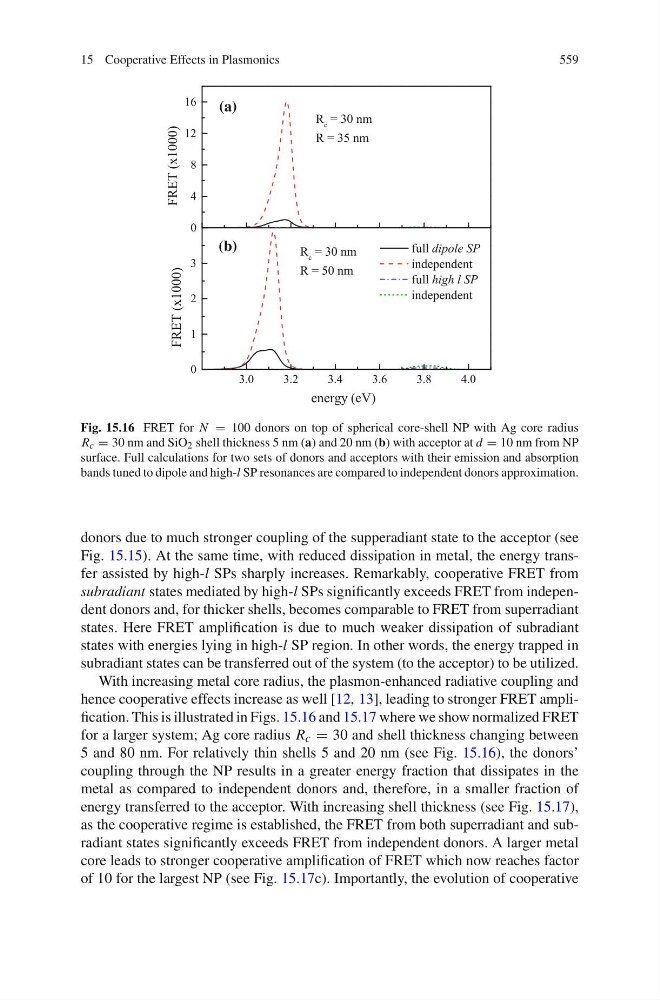
Fig. 15.16 FRET for N = 100 donors on top of spherical core-shell NP with Ag core radius
R c = 30 nm and SiO 2 shell thickness 5 nm (a) and 20 nm (b) with acceptor at d = 10 nm from NP
surface. Full calculations for two sets of donors and acceptors with their emission and absorption
bands tuned to dipole and high-l SP resonances are compared to independent donors approximation.
donors due to much stronger coupling of the supperadiant state to the acceptor (see
Fig. 15.15). At the same time, with reduced dissipation in metal, the energy transfer assisted by high-l SPs sharply increases. Remarkably, cooperative FRET from
subradiant states mediated by high-l SPs significantly exceeds FRET from independent donors and, for thicker shells, becomes comparable to FRET from superradiant
states. Here FRET amplification is due to much weaker dissipation of subradiant
states with energies lying in high-l SP region. In other words, the energy trapped in
subradiant states can be transferred out of the system (to the acceptor) to be utilized.
With increasing metal core radius, the plasmon-enhanced radiative coupling and
hence cooperative effects increase as well [12, 13], leading to stronger FRET amplification. This is illustrated in Figs. 15.16 and 15.17 where we show normalized FRET
for a larger system; Ag core radius R c = 30 and shell thickness changing between
5 and 80 nm. For relatively thin shells 5 and 20 nm (see Fig. 15.16), the donors’
coupling through the NP results in a greater energy fraction that dissipates in the
metal as compared to independent donors and, therefore, in a smaller fraction of
energy transferred to the acceptor. With increasing shell thickness (see Fig. 15.17),
as the cooperative regime is established, the FRET from both superradiant and subradiant states significantly exceeds FRET from independent donors. A larger metal
core leads to stronger cooperative amplification of FRET which now reaches factor
of 10 for the largest NP (see Fig. 15.17c). Importantly, the evolution of cooperative
559
(a)
(b)
Fig. 15.16 FRET for N = 100 donors on top of spherical core-shell NP with Ag core radius
R c = 30 nm and SiO 2 shell thickness 5 nm (a) and 20 nm (b) with acceptor at d = 10 nm from NP
surface. Full calculations for two sets of donors and acceptors with their emission and absorption
bands tuned to dipole and high-l SP resonances are compared to independent donors approximation.
donors due to much stronger coupling of the supperadiant state to the acceptor (see
Fig. 15.15). At the same time, with reduced dissipation in metal, the energy transfer assisted by high-l SPs sharply increases. Remarkably, cooperative FRET from
subradiant states mediated by high-l SPs significantly exceeds FRET from independent donors and, for thicker shells, becomes comparable to FRET from superradiant
states. Here FRET amplification is due to much weaker dissipation of subradiant
states with energies lying in high-l SP region. In other words, the energy trapped in
subradiant states can be transferred out of the system (to the acceptor) to be utilized.
With increasing metal core radius, the plasmon-enhanced radiative coupling and
hence cooperative effects increase as well [12, 13], leading to stronger FRET amplification. This is illustrated in Figs. 15.16 and 15.17 where we show normalized FRET
for a larger system; Ag core radius R c = 30 and shell thickness changing between
5 and 80 nm. For relatively thin shells 5 and 20 nm (see Fig. 15.16), the donors’
coupling through the NP results in a greater energy fraction that dissipates in the
metal as compared to independent donors and, therefore, in a smaller fraction of
energy transferred to the acceptor. With increasing shell thickness (see Fig. 15.17),
as the cooperative regime is established, the FRET from both superradiant and subradiant states significantly exceeds FRET from independent donors. A larger metal
core leads to stronger cooperative amplification of FRET which now reaches factor
of 10 for the largest NP (see Fig. 15.17c). Importantly, the evolution of cooperative