

15 Cooperative Effects in Plasmonics
557
15.2.5 Numerical Results for Cooperative Energy Transfer
As an example, consider an ensemble of N donors randomly distributed on surface of
spherical core-shell NP of radius R submerged in water, with Ag core radius R c and
Silica shell thickness L = R−R c , and a single acceptor separated from the NP surface
by distance d (see inset in Fig. 15.14). We assume that the donors’ and acceptor’s
dipole orientations are all normal to the NP surface and their respective emission
and absorption bands are Lorentzians of width 0.1 eV centered at energies ω d and
ω a which we chose depending on particular FRET mechanism we wish to study (see
below). The dipole surface plasmon (SP) spectral band is centered at about 3.15 eV
and weakly depends on shell thickness, while energies of higher angular momenta
(l ∇ 2) SPs are distributed in the interval 3.75 and 4.0 eV. Note that high-l SPs with
energies above 4.0 eV are damped by electronic interband transitions in Ag.
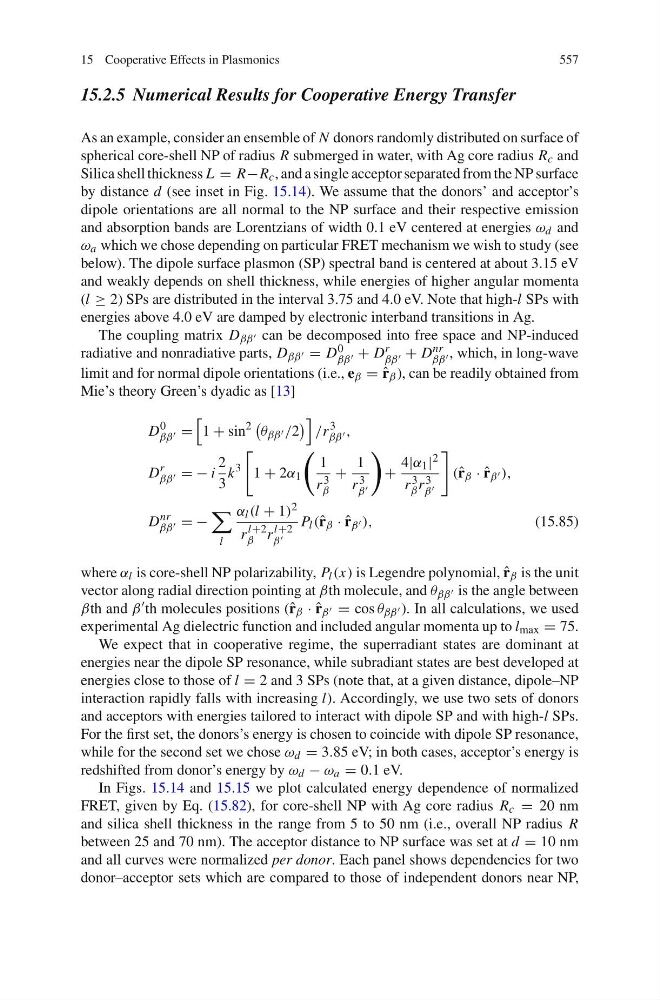
The coupling matrix D ββ √ can be decomposed into free space and NP-induced
radiative and nonradiative parts, D ββ √ = D 0
ββ √ + D r
ββ √ + D nr
ββ √ , which, in long-wave
limit and for normal dipole orientations (i.e., e β = ˆ
r β ), can be readily obtained from
Mie’s theory Green’s dyadic as [13]
D
0
ββ √ =
1 + sin
2
θ ββ √ /2
/r
3
ββ √ ,
D
r
ββ √ = − i
2
3
k
3
1 + 2α 1
1
r 3
β
+
1
r 3
β √
+
4|α 1 | 2
r 3
β r 3
β √
(ˆ r β · ˆ
r β √ ),
D
nr
ββ √ = −
l
α l (l + 1) 2
r
l+2
β r
l+2
β √
P l (ˆ r β · ˆ
r β √ ),
(15.85)
where α l is core-shell NP polarizability, P l (x) is Legendre polynomial, ˆ
r β is the unit
vector along radial direction pointing at βth molecule, and θ ββ √ is the angle between
βth and β √ th molecules positions (ˆ r β · ˆ
r β √ = cos θ ββ √ ). In all calculations, we used
experimental Ag dielectric function and included angular momenta up to l max = 75.
We expect that in cooperative regime, the superradiant states are dominant at
energies near the dipole SP resonance, while subradiant states are best developed at
energies close to those of l = 2 and 3 SPs (note that, at a given distance, dipole–NP
interaction rapidly falls with increasing l). Accordingly, we use two sets of donors
and acceptors with energies tailored to interact with dipole SP and with high-l SPs.
For the first set, the donors’s energy is chosen to coincide with dipole SP resonance,
while for the second set we chose ω d = 3.85 eV; in both cases, acceptor’s energy is
redshifted from donor’s energy by ω d − ω a = 0.1 eV.
In Figs. 15.14 and 15.15 we plot calculated energy dependence of normalized
FRET, given by Eq. (15.82), for core-shell NP with Ag core radius R c = 20 nm
and silica shell thickness in the range from 5 to 50 nm (i.e., overall NP radius R
between 25 and 70 nm). The acceptor distance to NP surface was set at d = 10 nm
and all curves were normalized per donor. Each panel shows dependencies for two
donor–acceptor sets which are compared to those of independent donors near NP,
557
15.2.5 Numerical Results for Cooperative Energy Transfer
As an example, consider an ensemble of N donors randomly distributed on surface of
spherical core-shell NP of radius R submerged in water, with Ag core radius R c and
Silica shell thickness L = R−R c , and a single acceptor separated from the NP surface
by distance d (see inset in Fig. 15.14). We assume that the donors’ and acceptor’s
dipole orientations are all normal to the NP surface and their respective emission
and absorption bands are Lorentzians of width 0.1 eV centered at energies ω d and
ω a which we chose depending on particular FRET mechanism we wish to study (see
below). The dipole surface plasmon (SP) spectral band is centered at about 3.15 eV
and weakly depends on shell thickness, while energies of higher angular momenta
(l ∇ 2) SPs are distributed in the interval 3.75 and 4.0 eV. Note that high-l SPs with
energies above 4.0 eV are damped by electronic interband transitions in Ag.
The coupling matrix D ββ √ can be decomposed into free space and NP-induced
radiative and nonradiative parts, D ββ √ = D 0
ββ √ + D r
ββ √ + D nr
ββ √ , which, in long-wave
limit and for normal dipole orientations (i.e., e β = ˆ
r β ), can be readily obtained from
Mie’s theory Green’s dyadic as [13]
D
0
ββ √ =
1 + sin
2
θ ββ √ /2
/r
3
ββ √ ,
D
r
ββ √ = − i
2
3
k
3
1 + 2α 1
1
r 3
β
+
1
r 3
β √
+
4|α 1 | 2
r 3
β r 3
β √
(ˆ r β · ˆ
r β √ ),
D
nr
ββ √ = −
l
α l (l + 1) 2
r
l+2
β r
l+2
β √
P l (ˆ r β · ˆ
r β √ ),
(15.85)
where α l is core-shell NP polarizability, P l (x) is Legendre polynomial, ˆ
r β is the unit
vector along radial direction pointing at βth molecule, and θ ββ √ is the angle between
βth and β √ th molecules positions (ˆ r β · ˆ
r β √ = cos θ ββ √ ). In all calculations, we used
experimental Ag dielectric function and included angular momenta up to l max = 75.
We expect that in cooperative regime, the superradiant states are dominant at
energies near the dipole SP resonance, while subradiant states are best developed at
energies close to those of l = 2 and 3 SPs (note that, at a given distance, dipole–NP
interaction rapidly falls with increasing l). Accordingly, we use two sets of donors
and acceptors with energies tailored to interact with dipole SP and with high-l SPs.
For the first set, the donors’s energy is chosen to coincide with dipole SP resonance,
while for the second set we chose ω d = 3.85 eV; in both cases, acceptor’s energy is
redshifted from donor’s energy by ω d − ω a = 0.1 eV.
In Figs. 15.14 and 15.15 we plot calculated energy dependence of normalized
FRET, given by Eq. (15.82), for core-shell NP with Ag core radius R c = 20 nm
and silica shell thickness in the range from 5 to 50 nm (i.e., overall NP radius R
between 25 and 70 nm). The acceptor distance to NP surface was set at d = 10 nm
and all curves were normalized per donor. Each panel shows dependencies for two
donor–acceptor sets which are compared to those of independent donors near NP,