

556
V. N. Pustovit and T. V. Shahbazyan
where
˜
D a J =
D a J
1 − ˜
α a
J D a J ˜
α J D J a
(15.83)
is acceptor–eigenstate coupling that includes high-order transitions, and
¯
σ a =
4π k
3
α √√
a
|1 + α a D aa | 2 , ˜
f J (ω) =
ω ˜
α √√
J (ω)
dωω ˜
α √√
d0 (ω)
(15.84)
are acceptor’s absorption crossection and eigenstates’s spectral function. Note that
the latter is not integral-normalized to unity.
Expression (15.82) generalizes the FRET from a single donor, Eq. (15.61), to
the case of an ensemble. The energy transfer now takes place from each system
eigenstate independently and the full transferred energy is obtained by summing
up over all eigenstates’ contributions. As we show below, in cooperative regime,
superradiant and subradiant eigenstates provide significantly more efficient transfer
than individual donors.
(a)
(b)
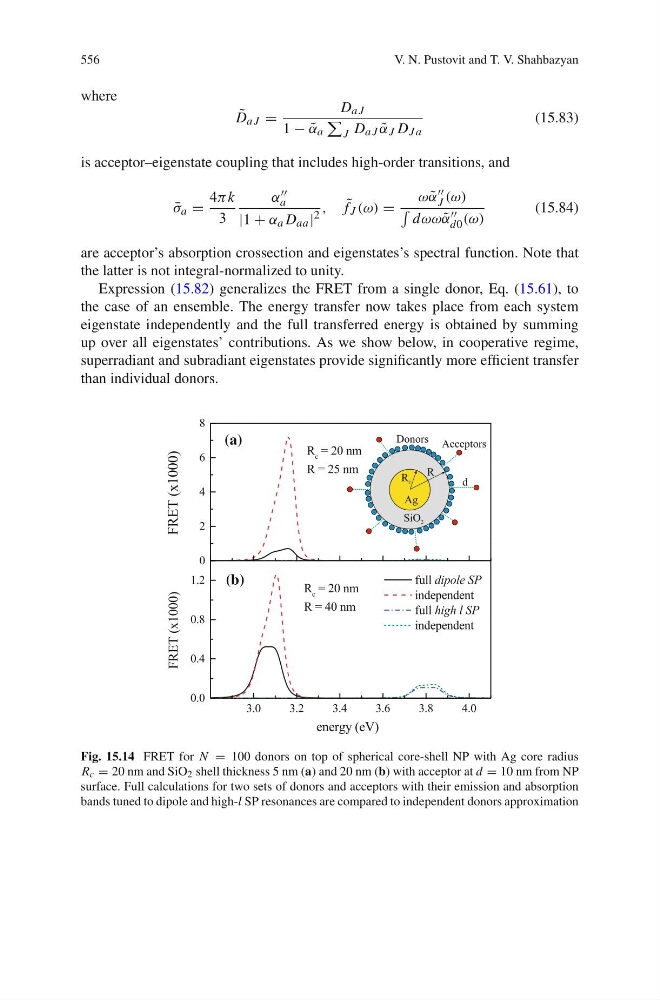
Fig. 15.14 FRET for N = 100 donors on top of spherical core-shell NP with Ag core radius
R c = 20 nm and SiO 2 shell thickness 5 nm (a) and 20 nm (b) with acceptor at d = 10 nm from NP
surface. Full calculations for two sets of donors and acceptors with their emission and absorption
bands tuned to dipole and high-l SP resonances are compared to independent donors approximation
V. N. Pustovit and T. V. Shahbazyan
where
˜
D a J =
D a J
1 − ˜
α a
J D a J ˜
α J D J a
(15.83)
is acceptor–eigenstate coupling that includes high-order transitions, and
¯
σ a =
4π k
3
α √√
a
|1 + α a D aa | 2 , ˜
f J (ω) =
ω ˜
α √√
J (ω)
dωω ˜
α √√
d0 (ω)
(15.84)
are acceptor’s absorption crossection and eigenstates’s spectral function. Note that
the latter is not integral-normalized to unity.
Expression (15.82) generalizes the FRET from a single donor, Eq. (15.61), to
the case of an ensemble. The energy transfer now takes place from each system
eigenstate independently and the full transferred energy is obtained by summing
up over all eigenstates’ contributions. As we show below, in cooperative regime,
superradiant and subradiant eigenstates provide significantly more efficient transfer
than individual donors.
(a)
(b)
Fig. 15.14 FRET for N = 100 donors on top of spherical core-shell NP with Ag core radius
R c = 20 nm and SiO 2 shell thickness 5 nm (a) and 20 nm (b) with acceptor at d = 10 nm from NP
surface. Full calculations for two sets of donors and acceptors with their emission and absorption
bands tuned to dipole and high-l SP resonances are compared to independent donors approximation