

15 Cooperative Effects in Plasmonics
555
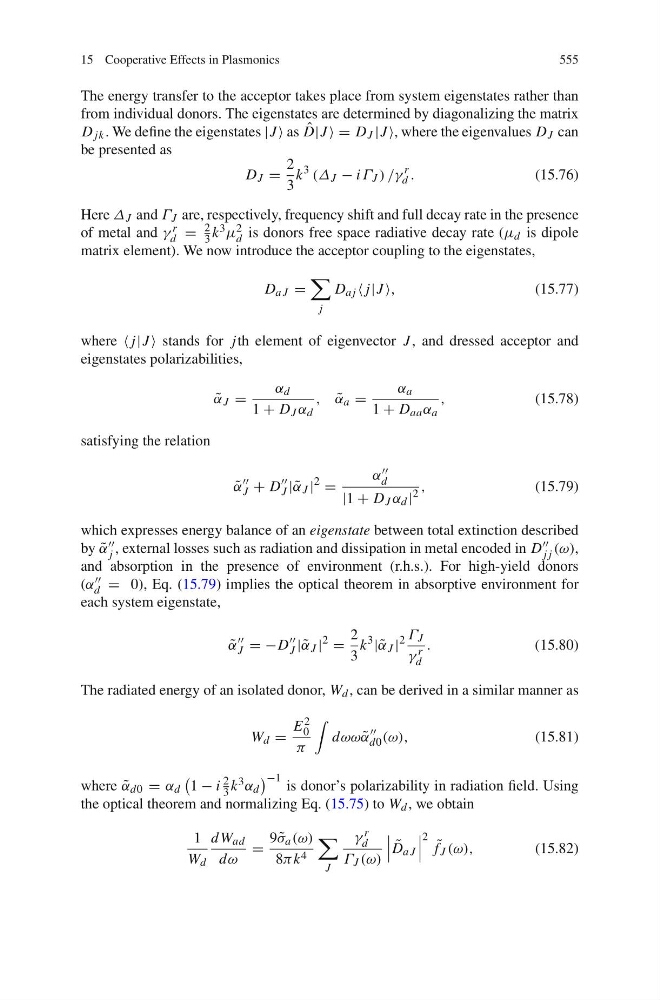
The energy transfer to the acceptor takes place from system eigenstates rather than
from individual donors. The eigenstates are determined by diagonalizing the matrix
D jk . We define the eigenstates |J as ˆ
D|J = D J |J , where the eigenvalues D J can
be presented as
D J =
2
3
k
3
(Δ J − iΓ J ) /γ
r
d .
(15.76)
Here Δ J and Γ J are, respectively, frequency shift and full decay rate in the presence
of metal and γ r
d =
2
3 k 3 μ 2
d is donors free space radiative decay rate (μ d is dipole
matrix element). We now introduce the acceptor coupling to the eigenstates,
D a J =
j
D aj ◦ j|J ,
(15.77)
where ◦ j|J stands for jth element of eigenvector J , and dressed acceptor and
eigenstates polarizabilities,
˜
α J =
α d
1 + D J α d
, ˜
α a =
α a
1 + D aa α a
,
(15.78)
satisfying the relation
˜
α
√√
J + D
√√
J | ˜
α J |
2
=
α √√
d
|1 + D J α d | 2 ,
(15.79)
which expresses energy balance of an eigenstate between total extinction described
by ˜
α √√
j , external losses such as radiation and dissipation in metal encoded in D √√
j j (ω),
and absorption in the presence of environment (r.h.s.). For high-yield donors
(α √√
d = 0), Eq. (15.79) implies the optical theorem in absorptive environment for
each system eigenstate,
˜
α
√√
J = −D
√√
J | ˜
α J |
2
=
2
3
k
3
| ˜
α J |
2 Γ J
γ r
d
.
(15.80)
The radiated energy of an isolated donor, W d , can be derived in a similar manner as
W d =
E 2
0
π
dωω ˜
α
√√
d0 (ω),
(15.81)
where ˜
α d0 = α d
1 − i
2
3 k 3 α d
−1 is donor’s polarizability in radiation field. Using
the optical theorem and normalizing Eq. (15.75) to W d , we obtain
1
W d
dW ad
dω
=
9 ˜
σ a (ω)
8π k 4
J
γ r
d
Γ J (ω)
˜
D a J
2 ˜
f J (ω),
(15.82)
555
The energy transfer to the acceptor takes place from system eigenstates rather than
from individual donors. The eigenstates are determined by diagonalizing the matrix
D jk . We define the eigenstates |J as ˆ
D|J = D J |J , where the eigenvalues D J can
be presented as
D J =
2
3
k
3
(Δ J − iΓ J ) /γ
r
d .
(15.76)
Here Δ J and Γ J are, respectively, frequency shift and full decay rate in the presence
of metal and γ r
d =
2
3 k 3 μ 2
d is donors free space radiative decay rate (μ d is dipole
matrix element). We now introduce the acceptor coupling to the eigenstates,
D a J =
j
D aj ◦ j|J ,
(15.77)
where ◦ j|J stands for jth element of eigenvector J , and dressed acceptor and
eigenstates polarizabilities,
˜
α J =
α d
1 + D J α d
, ˜
α a =
α a
1 + D aa α a
,
(15.78)
satisfying the relation
˜
α
√√
J + D
√√
J | ˜
α J |
2
=
α √√
d
|1 + D J α d | 2 ,
(15.79)
which expresses energy balance of an eigenstate between total extinction described
by ˜
α √√
j , external losses such as radiation and dissipation in metal encoded in D √√
j j (ω),
and absorption in the presence of environment (r.h.s.). For high-yield donors
(α √√
d = 0), Eq. (15.79) implies the optical theorem in absorptive environment for
each system eigenstate,
˜
α
√√
J = −D
√√
J | ˜
α J |
2
=
2
3
k
3
| ˜
α J |
2 Γ J
γ r
d
.
(15.80)
The radiated energy of an isolated donor, W d , can be derived in a similar manner as
W d =
E 2
0
π
dωω ˜
α
√√
d0 (ω),
(15.81)
where ˜
α d0 = α d
1 − i
2
3 k 3 α d
−1 is donor’s polarizability in radiation field. Using
the optical theorem and normalizing Eq. (15.75) to W d , we obtain
1
W d
dW ad
dω
=
9 ˜
σ a (ω)
8π k 4
J
γ r
d
Γ J (ω)
˜
D a J
2 ˜
f J (ω),
(15.82)