

15 Cooperative Effects in Plasmonics
549
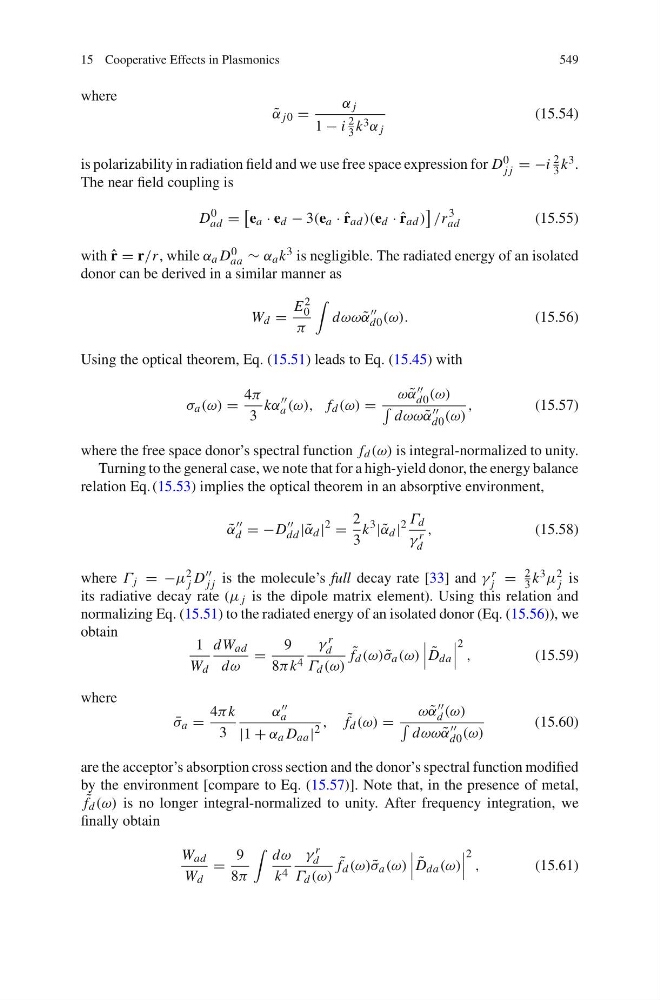
where
˜
α j0 =
α j
1 − i
2
3 k 3 α j
(15.54)
is polarizability in radiation field and we use free space expression for D 0
j j = −i
2
3 k 3 .
The near field coupling is
D
0
ad =
e a · e d − 3(e a · ˆ
r ad )(e d · ˆ
r ad )
/r
3
ad
(15.55)
with ˆ
r = r/r , while α a D 0
aa ∪ α a k 3 is negligible. The radiated energy of an isolated
donor can be derived in a similar manner as
W d =
E 2
0
π
dωω ˜
α
√√
d0 (ω).
(15.56)
Using the optical theorem, Eq. (15.51) leads to Eq. (15.45) with
σ a (ω) =
4π
3
kα
√√
a (ω), f d (ω) =
ω ˜
α √√
d0 (ω)
dωω ˜
α √√
d0 (ω)
,
(15.57)
where the free space donor’s spectral function f d (ω) is integral-normalized to unity.
Turning to the general case, we note that for a high-yield donor, the energy balance
relation Eq. (15.53) implies the optical theorem in an absorptive environment,
˜
α
√√
d = −D
√√
dd | ˜
α d |
2
=
2
3
k
3
| ˜
α d |
2 Γ d
γ r
d
,
(15.58)
where Γ j = −μ 2
j D √√
j j is the molecule’s full decay rate [33] and γ r
j =
2
3 k 3 μ 2
j is
its radiative decay rate (μ j is the dipole matrix element). Using this relation and
normalizing Eq. (15.51) to the radiated energy of an isolated donor (Eq. (15.56)), we
obtain
1
W d
dW ad
dω
=
9
8π k 4
γ r
d
Γ d (ω)
˜
f d (ω) ˜
σ a (ω)
˜
D da
2 ,
(15.59)
where
¯
σ a =
4π k
3
α √√
a
|1 + α a D aa | 2 , ˜
f d (ω) =
ω ˜
α √√
d (ω)
dωω ˜
α √√
d0 (ω)
(15.60)
are the acceptor’s absorption cross section and the donor’s spectral function modified
by the environment [compare to Eq. (15.57)]. Note that, in the presence of metal,
˜
f d (ω) is no longer integral-normalized to unity. After frequency integration, we
finally obtain
W ad
W d
=
9
8π
dω
k 4
γ r
d
Γ d (ω)
˜
f d (ω) ˜
σ a (ω)
˜
D da (ω)
2 ,
(15.61)
549
where
˜
α j0 =
α j
1 − i
2
3 k 3 α j
(15.54)
is polarizability in radiation field and we use free space expression for D 0
j j = −i
2
3 k 3 .
The near field coupling is
D
0
ad =
e a · e d − 3(e a · ˆ
r ad )(e d · ˆ
r ad )
/r
3
ad
(15.55)
with ˆ
r = r/r , while α a D 0
aa ∪ α a k 3 is negligible. The radiated energy of an isolated
donor can be derived in a similar manner as
W d =
E 2
0
π
dωω ˜
α
√√
d0 (ω).
(15.56)
Using the optical theorem, Eq. (15.51) leads to Eq. (15.45) with
σ a (ω) =
4π
3
kα
√√
a (ω), f d (ω) =
ω ˜
α √√
d0 (ω)
dωω ˜
α √√
d0 (ω)
,
(15.57)
where the free space donor’s spectral function f d (ω) is integral-normalized to unity.
Turning to the general case, we note that for a high-yield donor, the energy balance
relation Eq. (15.53) implies the optical theorem in an absorptive environment,
˜
α
√√
d = −D
√√
dd | ˜
α d |
2
=
2
3
k
3
| ˜
α d |
2 Γ d
γ r
d
,
(15.58)
where Γ j = −μ 2
j D √√
j j is the molecule’s full decay rate [33] and γ r
j =
2
3 k 3 μ 2
j is
its radiative decay rate (μ j is the dipole matrix element). Using this relation and
normalizing Eq. (15.51) to the radiated energy of an isolated donor (Eq. (15.56)), we
obtain
1
W d
dW ad
dω
=
9
8π k 4
γ r
d
Γ d (ω)
˜
f d (ω) ˜
σ a (ω)
˜
D da
2 ,
(15.59)
where
¯
σ a =
4π k
3
α √√
a
|1 + α a D aa | 2 , ˜
f d (ω) =
ω ˜
α √√
d (ω)
dωω ˜
α √√
d0 (ω)
(15.60)
are the acceptor’s absorption cross section and the donor’s spectral function modified
by the environment [compare to Eq. (15.57)]. Note that, in the presence of metal,
˜
f d (ω) is no longer integral-normalized to unity. After frequency integration, we
finally obtain
W ad
W d
=
9
8π
dω
k 4
γ r
d
Γ d (ω)
˜
f d (ω) ˜
σ a (ω)
˜
D da (ω)
2 ,
(15.61)