

550
V. N. Pustovit and T. V. Shahbazyan
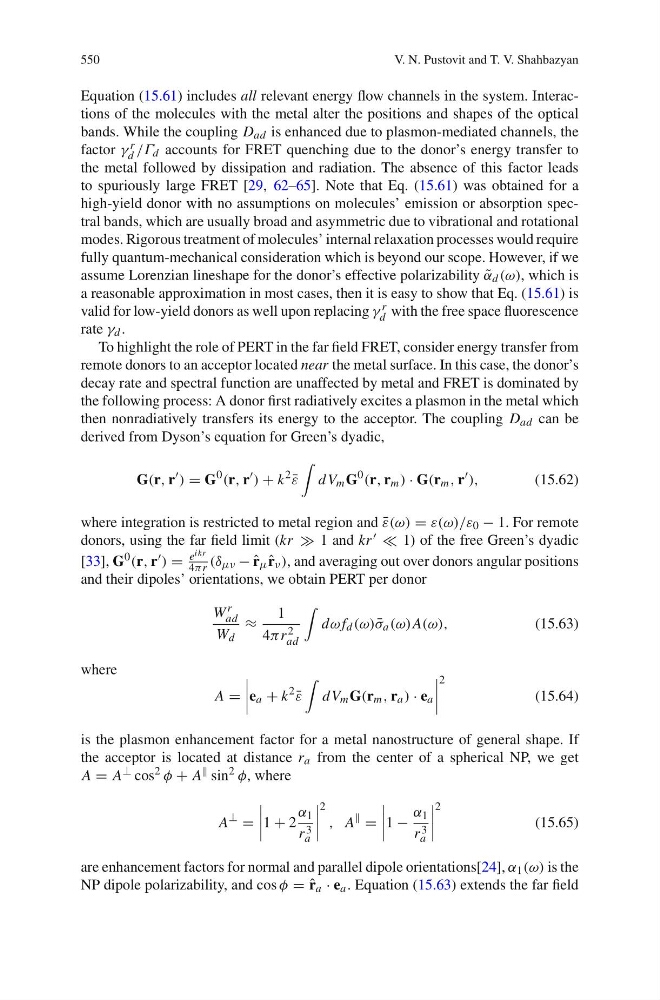
Equation (15.61) includes all relevant energy flow channels in the system. Interactions of the molecules with the metal alter the positions and shapes of the optical
bands. While the coupling D ad is enhanced due to plasmon-mediated channels, the
factor γ r
d /Γ d accounts for FRET quenching due to the donor’s energy transfer to
the metal followed by dissipation and radiation. The absence of this factor leads
to spuriously large FRET [29, 62–65]. Note that Eq. (15.61) was obtained for a
high-yield donor with no assumptions on molecules’ emission or absorption spectral bands, which are usually broad and asymmetric due to vibrational and rotational
modes. Rigorous treatment of molecules’ internal relaxation processes would require
fully quantum-mechanical consideration which is beyond our scope. However, if we
assume Lorenzian lineshape for the donor’s effective polarizability ˜
α d (ω), which is
a reasonable approximation in most cases, then it is easy to show that Eq. (15.61) is
valid for low-yield donors as well upon replacing γ r
d with the free space fluorescence
rate γ d .
To highlight the role of PERT in the far field FRET, consider energy transfer from
remote donors to an acceptor located near the metal surface. In this case, the donor’s
decay rate and spectral function are unaffected by metal and FRET is dominated by
the following process: A donor first radiatively excites a plasmon in the metal which
then nonradiatively transfers its energy to the acceptor. The coupling D ad can be
derived from Dyson’s equation for Green’s dyadic,
G(r, r
√
) = G
0
(r, r
√
) + k
2
¯
ε
dV m G
0
(r, r m ) · G(r m , r
√
),
(15.62)
where integration is restricted to metal region and ¯
ε(ω) = ε(ω)/ε 0 − 1. For remote
donors, using the far field limit (kr ≈ 1 and kr √ ∝ 1) of the free Green’s dyadic
[33], G 0 (r, r √ ) =
e ikr
4πr (δ μν − ˆ
r μ ˆ
r ν ), and averaging out over donors angular positions
and their dipoles’ orientations, we obtain PERT per donor
W r
ad
W d
∈
1
4πr 2
ad
dω f d (ω) ¯
σ a (ω)A(ω),
(15.63)
where
A =
e a + k
2
¯
ε
dV m G(r m , r a ) · e a
2
(15.64)
is the plasmon enhancement factor for a metal nanostructure of general shape. If
the acceptor is located at distance r a from the center of a spherical NP, we get
A = A ≡ cos 2 φ + A ≤ sin 2 φ, where
A
≡
=
1 + 2
α 1
r 3
a
2
, A
≤
=
1 −
α 1
r 3
a
2
(15.65)
are enhancement factors for normal and parallel dipole orientations[24], α 1 (ω) is the
NP dipole polarizability, and cos φ = ˆ
r a · e a . Equation (15.63) extends the far field
V. N. Pustovit and T. V. Shahbazyan
Equation (15.61) includes all relevant energy flow channels in the system. Interactions of the molecules with the metal alter the positions and shapes of the optical
bands. While the coupling D ad is enhanced due to plasmon-mediated channels, the
factor γ r
d /Γ d accounts for FRET quenching due to the donor’s energy transfer to
the metal followed by dissipation and radiation. The absence of this factor leads
to spuriously large FRET [29, 62–65]. Note that Eq. (15.61) was obtained for a
high-yield donor with no assumptions on molecules’ emission or absorption spectral bands, which are usually broad and asymmetric due to vibrational and rotational
modes. Rigorous treatment of molecules’ internal relaxation processes would require
fully quantum-mechanical consideration which is beyond our scope. However, if we
assume Lorenzian lineshape for the donor’s effective polarizability ˜
α d (ω), which is
a reasonable approximation in most cases, then it is easy to show that Eq. (15.61) is
valid for low-yield donors as well upon replacing γ r
d with the free space fluorescence
rate γ d .
To highlight the role of PERT in the far field FRET, consider energy transfer from
remote donors to an acceptor located near the metal surface. In this case, the donor’s
decay rate and spectral function are unaffected by metal and FRET is dominated by
the following process: A donor first radiatively excites a plasmon in the metal which
then nonradiatively transfers its energy to the acceptor. The coupling D ad can be
derived from Dyson’s equation for Green’s dyadic,
G(r, r
√
) = G
0
(r, r
√
) + k
2
¯
ε
dV m G
0
(r, r m ) · G(r m , r
√
),
(15.62)
where integration is restricted to metal region and ¯
ε(ω) = ε(ω)/ε 0 − 1. For remote
donors, using the far field limit (kr ≈ 1 and kr √ ∝ 1) of the free Green’s dyadic
[33], G 0 (r, r √ ) =
e ikr
4πr (δ μν − ˆ
r μ ˆ
r ν ), and averaging out over donors angular positions
and their dipoles’ orientations, we obtain PERT per donor
W r
ad
W d
∈
1
4πr 2
ad
dω f d (ω) ¯
σ a (ω)A(ω),
(15.63)
where
A =
e a + k
2
¯
ε
dV m G(r m , r a ) · e a
2
(15.64)
is the plasmon enhancement factor for a metal nanostructure of general shape. If
the acceptor is located at distance r a from the center of a spherical NP, we get
A = A ≡ cos 2 φ + A ≤ sin 2 φ, where
A
≡
=
1 + 2
α 1
r 3
a
2
, A
≤
=
1 −
α 1
r 3
a
2
(15.65)
are enhancement factors for normal and parallel dipole orientations[24], α 1 (ω) is the
NP dipole polarizability, and cos φ = ˆ
r a · e a . Equation (15.63) extends the far field