

15 Cooperative Effects in Plasmonics
541
(a)
(b)
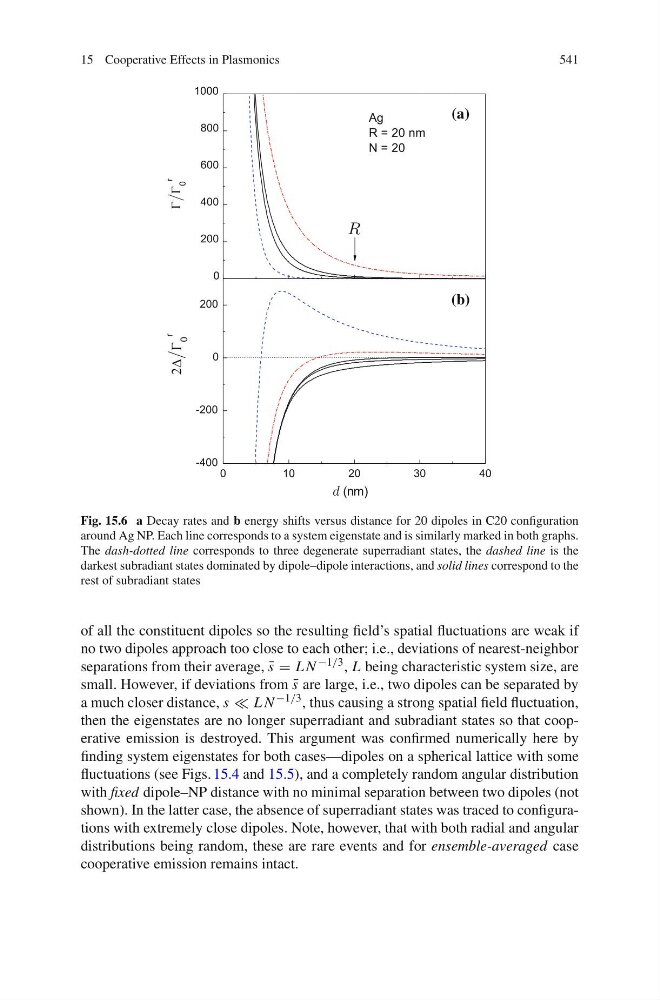
Fig. 15.6 a Decay rates and b energy shifts versus distance for 20 dipoles in C20 configuration
around Ag NP. Each line corresponds to a system eigenstate and is similarly marked in both graphs.
The dash-dotted line corresponds to three degenerate superradiant states, the dashed line is the
darkest subradiant states dominated by dipole–dipole interactions, and solid lines correspond to the
rest of subradiant states
of all the constituent dipoles so the resulting field’s spatial fluctuations are weak if
no two dipoles approach too close to each other; i.e., deviations of nearest-neighbor
separations from their average, ¯
s = L N −1/3 , L being characteristic system size, are
small. However, if deviations from ¯
s are large, i.e., two dipoles can be separated by
a much closer distance, s ∝ L N −1/3 , thus causing a strong spatial field fluctuation,
then the eigenstates are no longer superradiant and subradiant states so that cooperative emission is destroyed. This argument was confirmed numerically here by
finding system eigenstates for both cases—dipoles on a spherical lattice with some
fluctuations (see Figs. 15.4 and 15.5), and a completely random angular distribution
with fixed dipole–NP distance with no minimal separation between two dipoles (not
shown). In the latter case, the absence of superradiant states was traced to configurations with extremely close dipoles. Note, however, that with both radial and angular
distributions being random, these are rare events and for ensemble-averaged case
cooperative emission remains intact.
541
(a)
(b)
Fig. 15.6 a Decay rates and b energy shifts versus distance for 20 dipoles in C20 configuration
around Ag NP. Each line corresponds to a system eigenstate and is similarly marked in both graphs.
The dash-dotted line corresponds to three degenerate superradiant states, the dashed line is the
darkest subradiant states dominated by dipole–dipole interactions, and solid lines correspond to the
rest of subradiant states
of all the constituent dipoles so the resulting field’s spatial fluctuations are weak if
no two dipoles approach too close to each other; i.e., deviations of nearest-neighbor
separations from their average, ¯
s = L N −1/3 , L being characteristic system size, are
small. However, if deviations from ¯
s are large, i.e., two dipoles can be separated by
a much closer distance, s ∝ L N −1/3 , thus causing a strong spatial field fluctuation,
then the eigenstates are no longer superradiant and subradiant states so that cooperative emission is destroyed. This argument was confirmed numerically here by
finding system eigenstates for both cases—dipoles on a spherical lattice with some
fluctuations (see Figs. 15.4 and 15.5), and a completely random angular distribution
with fixed dipole–NP distance with no minimal separation between two dipoles (not
shown). In the latter case, the absence of superradiant states was traced to configurations with extremely close dipoles. Note, however, that with both radial and angular
distributions being random, these are rare events and for ensemble-averaged case
cooperative emission remains intact.