

540
V. N. Pustovit and T. V. Shahbazyan
(a)
(b)
(c)
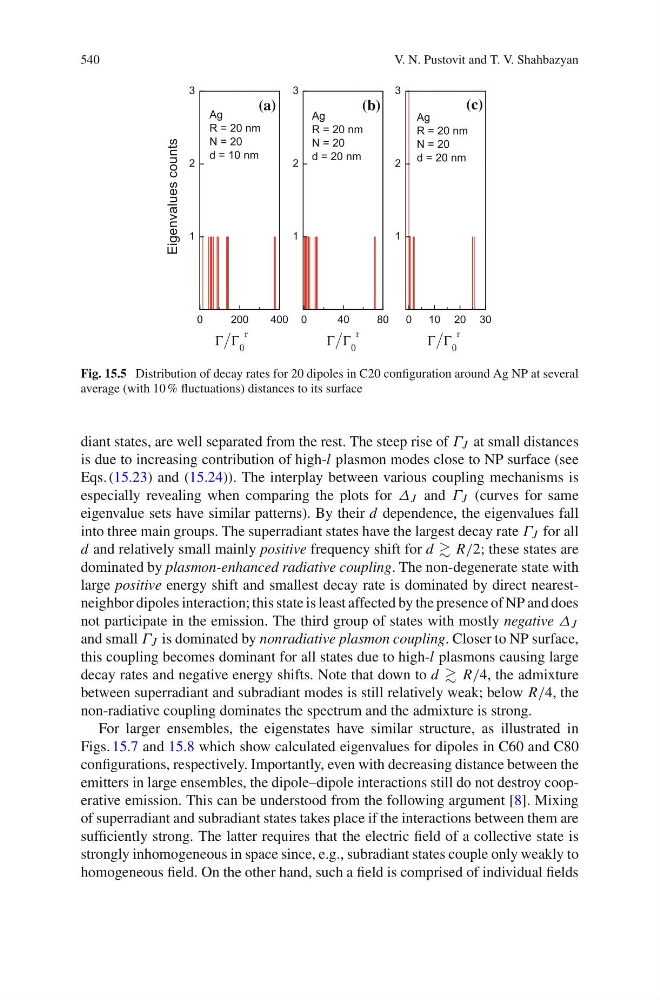
Fig. 15.5 Distribution of decay rates for 20 dipoles in C20 configuration around Ag NP at several
average (with 10 % fluctuations) distances to its surface
diant states, are well separated from the rest. The steep rise of Γ J at small distances
is due to increasing contribution of high-l plasmon modes close to NP surface (see
Eqs. (15.23) and (15.24)). The interplay between various coupling mechanisms is
especially revealing when comparing the plots for Δ J and Γ J (curves for same
eigenvalue sets have similar patterns). By their d dependence, the eigenvalues fall
into three main groups. The superradiant states have the largest decay rate Γ J for all
d and relatively small mainly positive frequency shift for d R/2; these states are
dominated by plasmon-enhanced radiative coupling. The non-degenerate state with
large positive energy shift and smallest decay rate is dominated by direct nearestneighbor dipoles interaction; this state is least affected by the presence of NP and does
not participate in the emission. The third group of states with mostly negative Δ J
and small Γ J is dominated by nonradiative plasmon coupling. Closer to NP surface,
this coupling becomes dominant for all states due to high-l plasmons causing large
decay rates and negative energy shifts. Note that down to d R/4, the admixture
between superradiant and subradiant modes is still relatively weak; below R/4, the
non-radiative coupling dominates the spectrum and the admixture is strong.
For larger ensembles, the eigenstates have similar structure, as illustrated in
Figs. 15.7 and 15.8 which show calculated eigenvalues for dipoles in C60 and C80
configurations, respectively. Importantly, even with decreasing distance between the
emitters in large ensembles, the dipole–dipole interactions still do not destroy cooperative emission. This can be understood from the following argument [8]. Mixing
of superradiant and subradiant states takes place if the interactions between them are
sufficiently strong. The latter requires that the electric field of a collective state is
strongly inhomogeneous in space since, e.g., subradiant states couple only weakly to
homogeneous field. On the other hand, such a field is comprised of individual fields
V. N. Pustovit and T. V. Shahbazyan
(a)
(b)
(c)
Fig. 15.5 Distribution of decay rates for 20 dipoles in C20 configuration around Ag NP at several
average (with 10 % fluctuations) distances to its surface
diant states, are well separated from the rest. The steep rise of Γ J at small distances
is due to increasing contribution of high-l plasmon modes close to NP surface (see
Eqs. (15.23) and (15.24)). The interplay between various coupling mechanisms is
especially revealing when comparing the plots for Δ J and Γ J (curves for same
eigenvalue sets have similar patterns). By their d dependence, the eigenvalues fall
into three main groups. The superradiant states have the largest decay rate Γ J for all
d and relatively small mainly positive frequency shift for d R/2; these states are
dominated by plasmon-enhanced radiative coupling. The non-degenerate state with
large positive energy shift and smallest decay rate is dominated by direct nearestneighbor dipoles interaction; this state is least affected by the presence of NP and does
not participate in the emission. The third group of states with mostly negative Δ J
and small Γ J is dominated by nonradiative plasmon coupling. Closer to NP surface,
this coupling becomes dominant for all states due to high-l plasmons causing large
decay rates and negative energy shifts. Note that down to d R/4, the admixture
between superradiant and subradiant modes is still relatively weak; below R/4, the
non-radiative coupling dominates the spectrum and the admixture is strong.
For larger ensembles, the eigenstates have similar structure, as illustrated in
Figs. 15.7 and 15.8 which show calculated eigenvalues for dipoles in C60 and C80
configurations, respectively. Importantly, even with decreasing distance between the
emitters in large ensembles, the dipole–dipole interactions still do not destroy cooperative emission. This can be understood from the following argument [8]. Mixing
of superradiant and subradiant states takes place if the interactions between them are
sufficiently strong. The latter requires that the electric field of a collective state is
strongly inhomogeneous in space since, e.g., subradiant states couple only weakly to
homogeneous field. On the other hand, such a field is comprised of individual fields