

15 Cooperative Effects in Plasmonics
535
interactions whose main effect is a large frequency shift of subradiant state with the
smallest decay rate.
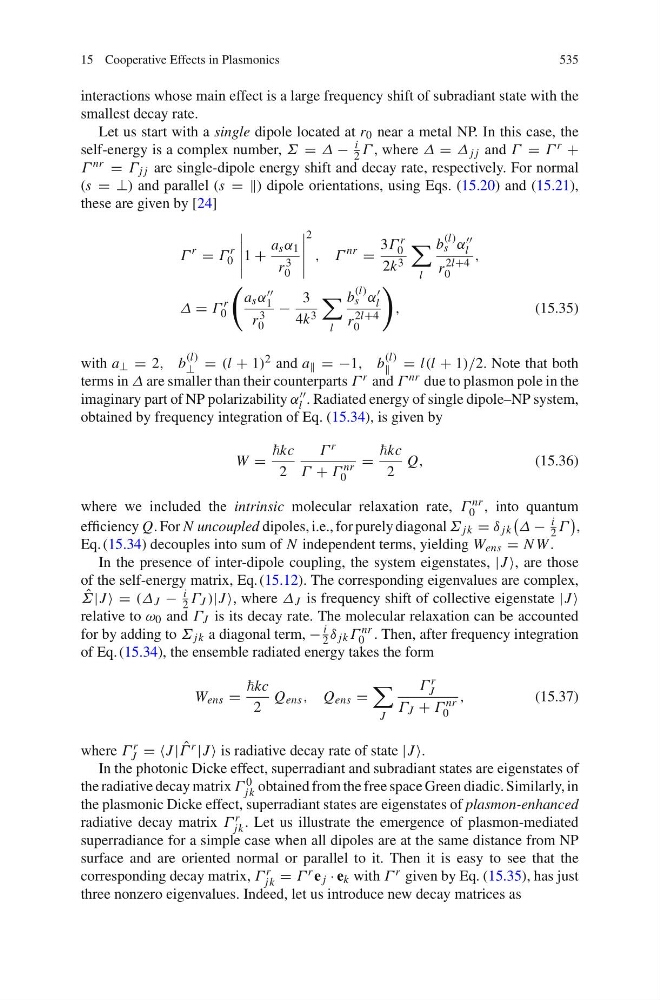
Let us start with a single dipole located at r 0 near a metal NP. In this case, the
self-energy is a complex number, Σ = Δ −
i
2 Γ , where Δ = Δ j j and Γ = Γ r +
Γ nr = Γ j j are single-dipole energy shift and decay rate, respectively. For normal
(s = ≡) and parallel (s = ≤) dipole orientations, using Eqs. (15.20) and (15.21),
these are given by [24]
Γ
r
= Γ
r
0
1 +
a s α 1
r 3
0
2
, Γ
nr
=
3Γ r
0
2k 3
l
b
(l)
s α √√
l
r
2l+4
0
,
Δ = Γ
r
0
a s α √√
1
r 3
0
−
3
4k 3
l
b
(l)
s α √
l
r
2l+4
0
,
(15.35)
with a ≡ = 2, b
(l)
≡ = (l + 1) 2 and a ≤ = −1, b
(l)
≤ = l(l + 1)/2. Note that both
terms in Δ are smaller than their counterparts Γ r and Γ nr due to plasmon pole in the
imaginary part of NP polarizability α √√
l . Radiated energy of single dipole–NP system,
obtained by frequency integration of Eq. (15.34), is given by
W =
kc
2
Γ r
Γ + Γ nr
0
=
kc
2
Q,
(15.36)
where we included the intrinsic molecular relaxation rate, Γ nr
0 , into quantum
efficiency Q. For N uncoupled dipoles, i.e., for purely diagonal Σ jk = δ jk
Δ −
i
2 Γ
,
Eq. (15.34) decouples into sum of N independent terms, yielding W ens = N W .
In the presence of inter-dipole coupling, the system eigenstates, |J , are those
of the self-energy matrix, Eq. (15.12). The corresponding eigenvalues are complex,
ˆ
Σ|J = (Δ J −
i
2 Γ J )|J , where Δ J is frequency shift of collective eigenstate |J
relative to ω 0 and Γ J is its decay rate. The molecular relaxation can be accounted
for by adding to Σ jk a diagonal term, −
i
2 δ jk Γ nr
0 . Then, after frequency integration
of Eq. (15.34), the ensemble radiated energy takes the form
W ens =
kc
2
Q ens , Q ens =
J
Γ r
J
Γ J + Γ nr
0
,
(15.37)
where Γ r
J = ◦J | ˆ
Γ r |J is radiative decay rate of state |J .
In the photonic Dicke effect, superradiant and subradiant states are eigenstates of
the radiative decay matrix Γ 0
jk obtained from the free space Green diadic. Similarly, in
the plasmonic Dicke effect, superradiant states are eigenstates of plasmon-enhanced
radiative decay matrix Γ r
jk . Let us illustrate the emergence of plasmon-mediated
superradiance for a simple case when all dipoles are at the same distance from NP
surface and are oriented normal or parallel to it. Then it is easy to see that the
corresponding decay matrix, Γ r
jk = Γ r e j · e k with Γ r given by Eq. (15.35), has just
three nonzero eigenvalues. Indeed, let us introduce new decay matrices as
535
interactions whose main effect is a large frequency shift of subradiant state with the
smallest decay rate.
Let us start with a single dipole located at r 0 near a metal NP. In this case, the
self-energy is a complex number, Σ = Δ −
i
2 Γ , where Δ = Δ j j and Γ = Γ r +
Γ nr = Γ j j are single-dipole energy shift and decay rate, respectively. For normal
(s = ≡) and parallel (s = ≤) dipole orientations, using Eqs. (15.20) and (15.21),
these are given by [24]
Γ
r
= Γ
r
0
1 +
a s α 1
r 3
0
2
, Γ
nr
=
3Γ r
0
2k 3
l
b
(l)
s α √√
l
r
2l+4
0
,
Δ = Γ
r
0
a s α √√
1
r 3
0
−
3
4k 3
l
b
(l)
s α √
l
r
2l+4
0
,
(15.35)
with a ≡ = 2, b
(l)
≡ = (l + 1) 2 and a ≤ = −1, b
(l)
≤ = l(l + 1)/2. Note that both
terms in Δ are smaller than their counterparts Γ r and Γ nr due to plasmon pole in the
imaginary part of NP polarizability α √√
l . Radiated energy of single dipole–NP system,
obtained by frequency integration of Eq. (15.34), is given by
W =
kc
2
Γ r
Γ + Γ nr
0
=
kc
2
Q,
(15.36)
where we included the intrinsic molecular relaxation rate, Γ nr
0 , into quantum
efficiency Q. For N uncoupled dipoles, i.e., for purely diagonal Σ jk = δ jk
Δ −
i
2 Γ
,
Eq. (15.34) decouples into sum of N independent terms, yielding W ens = N W .
In the presence of inter-dipole coupling, the system eigenstates, |J , are those
of the self-energy matrix, Eq. (15.12). The corresponding eigenvalues are complex,
ˆ
Σ|J = (Δ J −
i
2 Γ J )|J , where Δ J is frequency shift of collective eigenstate |J
relative to ω 0 and Γ J is its decay rate. The molecular relaxation can be accounted
for by adding to Σ jk a diagonal term, −
i
2 δ jk Γ nr
0 . Then, after frequency integration
of Eq. (15.34), the ensemble radiated energy takes the form
W ens =
kc
2
Q ens , Q ens =
J
Γ r
J
Γ J + Γ nr
0
,
(15.37)
where Γ r
J = ◦J | ˆ
Γ r |J is radiative decay rate of state |J .
In the photonic Dicke effect, superradiant and subradiant states are eigenstates of
the radiative decay matrix Γ 0
jk obtained from the free space Green diadic. Similarly, in
the plasmonic Dicke effect, superradiant states are eigenstates of plasmon-enhanced
radiative decay matrix Γ r
jk . Let us illustrate the emergence of plasmon-mediated
superradiance for a simple case when all dipoles are at the same distance from NP
surface and are oriented normal or parallel to it. Then it is easy to see that the
corresponding decay matrix, Γ r
jk = Γ r e j · e k with Γ r given by Eq. (15.35), has just
three nonzero eigenvalues. Indeed, let us introduce new decay matrices as