

536
V. N. Pustovit and T. V. Shahbazyan
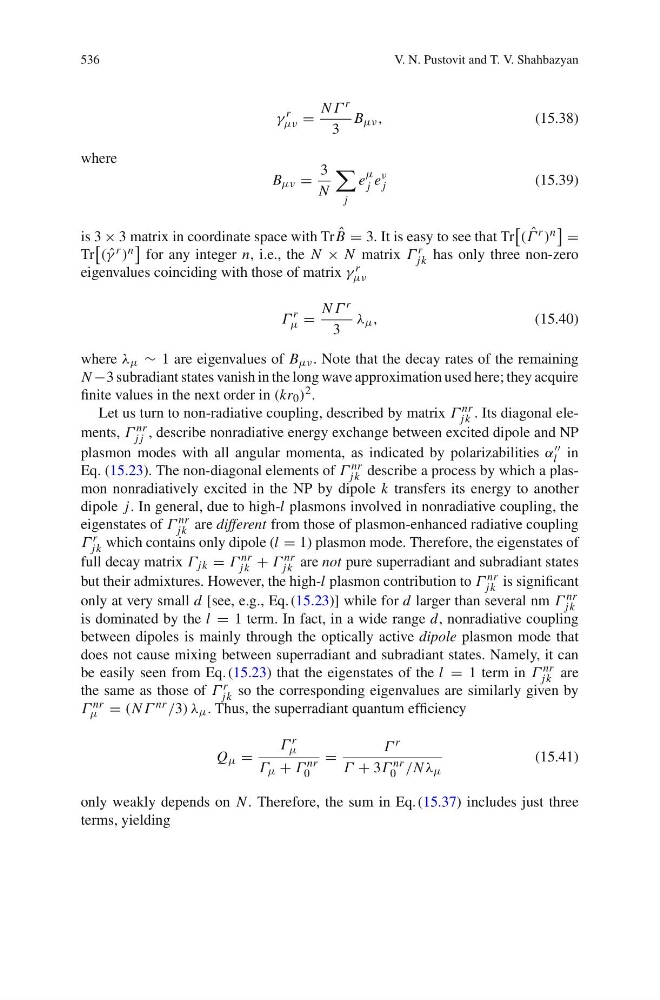
γ
r
μν =
N Γ r
3
B μν ,
(15.38)
where
B μν =
3
N
j
e
μ
j e
ν
j
(15.39)
is 3 × 3 matrix in coordinate space with Tr ˆ
B = 3. It is easy to see that Tr
( ˆ
Γ r ) n =
Tr
( ˆ
γ r ) n
for any integer n, i.e., the N × N matrix Γ r
jk has only three non-zero
eigenvalues coinciding with those of matrix γ r
μν
Γ
r
μ =
N Γ r
3
λ μ ,
(15.40)
where λ μ ∪ 1 are eigenvalues of B μν . Note that the decay rates of the remaining
N −3 subradiant states vanish in the long wave approximation used here; they acquire
finite values in the next order in (kr 0 ) 2 .
Let us turn to non-radiative coupling, described by matrix Γ nr
jk . Its diagonal elements, Γ nr
j j , describe nonradiative energy exchange between excited dipole and NP
plasmon modes with all angular momenta, as indicated by polarizabilities α √√
l in
Eq. (15.23). The non-diagonal elements of Γ nr
jk describe a process by which a plasmon nonradiatively excited in the NP by dipole k transfers its energy to another
dipole j. In general, due to high-l plasmons involved in nonradiative coupling, the
eigenstates of Γ nr
jk are different from those of plasmon-enhanced radiative coupling
Γ r
jk which contains only dipole (l = 1) plasmon mode. Therefore, the eigenstates of
full decay matrix Γ jk = Γ nr
jk + Γ nr
jk are not pure superradiant and subradiant states
but their admixtures. However, the high-l plasmon contribution to Γ nr
jk is significant
only at very small d [see, e.g., Eq. (15.23)] while for d larger than several nm Γ nr
jk
is dominated by the l = 1 term. In fact, in a wide range d, nonradiative coupling
between dipoles is mainly through the optically active dipole plasmon mode that
does not cause mixing between superradiant and subradiant states. Namely, it can
be easily seen from Eq. (15.23) that the eigenstates of the l = 1 term in Γ nr
jk are
the same as those of Γ r
jk so the corresponding eigenvalues are similarly given by
Γ nr
μ = (N Γ nr /3) λ μ . Thus, the superradiant quantum efficiency
Q μ =
Γ r
μ
Γ μ + Γ nr
0
=
Γ r
Γ + 3Γ nr
0 /N λ μ
(15.41)
only weakly depends on N . Therefore, the sum in Eq. (15.37) includes just three
terms, yielding
V. N. Pustovit and T. V. Shahbazyan
γ
r
μν =
N Γ r
3
B μν ,
(15.38)
where
B μν =
3
N
j
e
μ
j e
ν
j
(15.39)
is 3 × 3 matrix in coordinate space with Tr ˆ
B = 3. It is easy to see that Tr
( ˆ
Γ r ) n =
Tr
( ˆ
γ r ) n
for any integer n, i.e., the N × N matrix Γ r
jk has only three non-zero
eigenvalues coinciding with those of matrix γ r
μν
Γ
r
μ =
N Γ r
3
λ μ ,
(15.40)
where λ μ ∪ 1 are eigenvalues of B μν . Note that the decay rates of the remaining
N −3 subradiant states vanish in the long wave approximation used here; they acquire
finite values in the next order in (kr 0 ) 2 .
Let us turn to non-radiative coupling, described by matrix Γ nr
jk . Its diagonal elements, Γ nr
j j , describe nonradiative energy exchange between excited dipole and NP
plasmon modes with all angular momenta, as indicated by polarizabilities α √√
l in
Eq. (15.23). The non-diagonal elements of Γ nr
jk describe a process by which a plasmon nonradiatively excited in the NP by dipole k transfers its energy to another
dipole j. In general, due to high-l plasmons involved in nonradiative coupling, the
eigenstates of Γ nr
jk are different from those of plasmon-enhanced radiative coupling
Γ r
jk which contains only dipole (l = 1) plasmon mode. Therefore, the eigenstates of
full decay matrix Γ jk = Γ nr
jk + Γ nr
jk are not pure superradiant and subradiant states
but their admixtures. However, the high-l plasmon contribution to Γ nr
jk is significant
only at very small d [see, e.g., Eq. (15.23)] while for d larger than several nm Γ nr
jk
is dominated by the l = 1 term. In fact, in a wide range d, nonradiative coupling
between dipoles is mainly through the optically active dipole plasmon mode that
does not cause mixing between superradiant and subradiant states. Namely, it can
be easily seen from Eq. (15.23) that the eigenstates of the l = 1 term in Γ nr
jk are
the same as those of Γ r
jk so the corresponding eigenvalues are similarly given by
Γ nr
μ = (N Γ nr /3) λ μ . Thus, the superradiant quantum efficiency
Q μ =
Γ r
μ
Γ μ + Γ nr
0
=
Γ r
Γ + 3Γ nr
0 /N λ μ
(15.41)
only weakly depends on N . Therefore, the sum in Eq. (15.37) includes just three
terms, yielding