

532
V. N. Pustovit and T. V. Shahbazyan
Γ
r
jk = Γ
r
0
(e j · e k ) − α
√
1
K
(1)
jk + h.c.
+ |α 1 |
2 T
(1)
jk
,
Γ
nr
jk =
3Γ r
0
2k 3
l
α
√√
l T
(l)
jk .
(15.22)
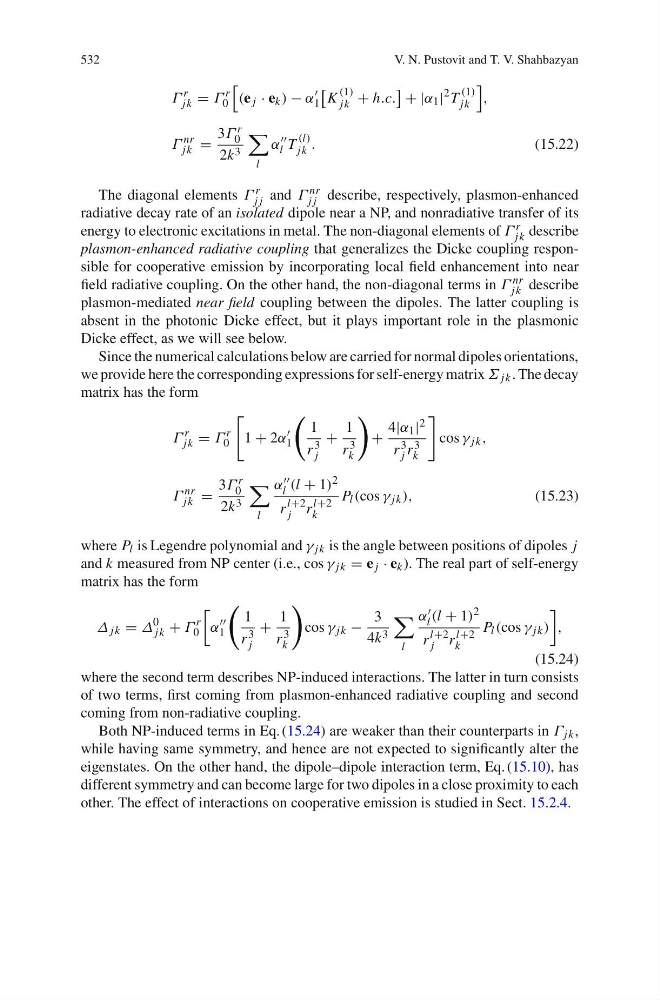
The diagonal elements Γ r
j j and Γ nr
j j describe, respectively, plasmon-enhanced
radiative decay rate of an isolated dipole near a NP, and nonradiative transfer of its
energy to electronic excitations in metal. The non-diagonal elements of Γ r
jk describe
plasmon-enhanced radiative coupling that generalizes the Dicke coupling responsible for cooperative emission by incorporating local field enhancement into near
field radiative coupling. On the other hand, the non-diagonal terms in Γ nr
jk describe
plasmon-mediated near field coupling between the dipoles. The latter coupling is
absent in the photonic Dicke effect, but it plays important role in the plasmonic
Dicke effect, as we will see below.
Since the numerical calculations below are carried for normal dipoles orientations,
we provide here the corresponding expressions for self-energy matrix Σ jk . The decay
matrix has the form
Γ
r
jk = Γ
r
0
1 + 2α
√
1
1
r 3
j
+
1
r 3
k
+
4|α 1 | 2
r 3
j r 3
k
cos γ jk ,
Γ
nr
jk =
3Γ r
0
2k 3
l
α √√
l (l + 1) 2
r
l+2
j r
l+2
k
P l (cos γ jk ),
(15.23)
where P l is Legendre polynomial and γ jk is the angle between positions of dipoles j
and k measured from NP center (i.e., cos γ jk = e j · e k ). The real part of self-energy
matrix has the form
Δ jk = Δ
0
jk + Γ
r
0
α
√√
1
1
r 3
j
+
1
r 3
k
cos γ jk −
3
4k 3
l
α √
l (l + 1) 2
r
l+2
j r
l+2
k
P l (cos γ jk )
,
(15.24)
where the second term describes NP-induced interactions. The latter in turn consists
of two terms, first coming from plasmon-enhanced radiative coupling and second
coming from non-radiative coupling.
Both NP-induced terms in Eq. (15.24) are weaker than their counterparts in Γ jk ,
while having same symmetry, and hence are not expected to significantly alter the
eigenstates. On the other hand, the dipole–dipole interaction term, Eq. (15.10), has
different symmetry and can become large for two dipoles in a close proximity to each
other. The effect of interactions on cooperative emission is studied in Sect. 15.2.4.
V. N. Pustovit and T. V. Shahbazyan
Γ
r
jk = Γ
r
0
(e j · e k ) − α
√
1
K
(1)
jk + h.c.
+ |α 1 |
2 T
(1)
jk
,
Γ
nr
jk =
3Γ r
0
2k 3
l
α
√√
l T
(l)
jk .
(15.22)
The diagonal elements Γ r
j j and Γ nr
j j describe, respectively, plasmon-enhanced
radiative decay rate of an isolated dipole near a NP, and nonradiative transfer of its
energy to electronic excitations in metal. The non-diagonal elements of Γ r
jk describe
plasmon-enhanced radiative coupling that generalizes the Dicke coupling responsible for cooperative emission by incorporating local field enhancement into near
field radiative coupling. On the other hand, the non-diagonal terms in Γ nr
jk describe
plasmon-mediated near field coupling between the dipoles. The latter coupling is
absent in the photonic Dicke effect, but it plays important role in the plasmonic
Dicke effect, as we will see below.
Since the numerical calculations below are carried for normal dipoles orientations,
we provide here the corresponding expressions for self-energy matrix Σ jk . The decay
matrix has the form
Γ
r
jk = Γ
r
0
1 + 2α
√
1
1
r 3
j
+
1
r 3
k
+
4|α 1 | 2
r 3
j r 3
k
cos γ jk ,
Γ
nr
jk =
3Γ r
0
2k 3
l
α √√
l (l + 1) 2
r
l+2
j r
l+2
k
P l (cos γ jk ),
(15.23)
where P l is Legendre polynomial and γ jk is the angle between positions of dipoles j
and k measured from NP center (i.e., cos γ jk = e j · e k ). The real part of self-energy
matrix has the form
Δ jk = Δ
0
jk + Γ
r
0
α
√√
1
1
r 3
j
+
1
r 3
k
cos γ jk −
3
4k 3
l
α √
l (l + 1) 2
r
l+2
j r
l+2
k
P l (cos γ jk )
,
(15.24)
where the second term describes NP-induced interactions. The latter in turn consists
of two terms, first coming from plasmon-enhanced radiative coupling and second
coming from non-radiative coupling.
Both NP-induced terms in Eq. (15.24) are weaker than their counterparts in Γ jk ,
while having same symmetry, and hence are not expected to significantly alter the
eigenstates. On the other hand, the dipole–dipole interaction term, Eq. (15.10), has
different symmetry and can become large for two dipoles in a close proximity to each
other. The effect of interactions on cooperative emission is studied in Sect. 15.2.4.