

15 Cooperative Effects in Plasmonics
531
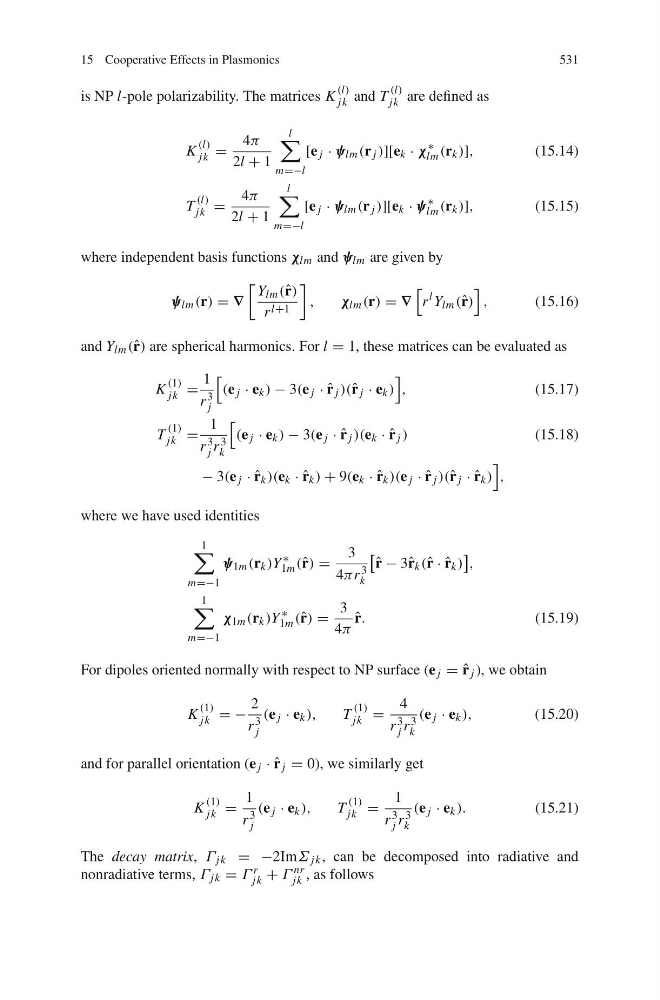
is NP l-pole polarizability. The matrices K
(l)
jk and T
(l)
jk are defined as
K
(l)
jk =
4π
2l + 1
l
m=−l
[e j · ψ lm (r j )][e k · χ
∗
lm (r k )],
(15.14)
T
(l)
jk =
4π
2l + 1
l
m=−l
[e j · ψ lm (r j )][e k · ψ
∗
lm (r k )],
(15.15)
where independent basis functions χ lm and ψ lm are given by
ψ lm (r) = ∇
Y lm (ˆ r)
r l+1
,
χ lm (r) = ∇
r
l Y lm (ˆ r)
,
(15.16)
and Y lm (ˆ r) are spherical harmonics. For l = 1, these matrices can be evaluated as
K
(1)
jk =
1
r 3
j
(e j · e k ) − 3(e j · ˆ
r j )(ˆ r j · e k )
,
(15.17)
T
(1)
jk =
1
r 3
j r 3
k
(e j · e k ) − 3(e j · ˆ
r j )(e k · ˆ
r j )
(15.18)
− 3(e j · ˆ
r k )(e k · ˆ
r k ) + 9(e k · ˆ
r k )(e j · ˆ
r j )(ˆ r j · ˆ
r k )
,
where we have used identities
1
m=−1
ψ 1m (r k )Y
∗
1m (ˆ r) =
3
4πr 3
k
ˆ
r − 3ˆ r k (ˆ r · ˆ
r k )
,
1
m=−1
χ 1m (r k )Y
∗
1m (ˆ r) =
3
4π
ˆ
r.
(15.19)
For dipoles oriented normally with respect to NP surface (e j = ˆ
r j ), we obtain
K
(1)
jk = −
2
r 3
j
(e j · e k ),
T
(1)
jk =
4
r 3
j r 3
k
(e j · e k ),
(15.20)
and for parallel orientation (e j · ˆ
r j = 0), we similarly get
K
(1)
jk =
1
r 3
j
(e j · e k ),
T
(1)
jk =
1
r 3
j r 3
k
(e j · e k ).
(15.21)
The decay matrix, Γ jk = −2ImΣ jk , can be decomposed into radiative and
nonradiative terms, Γ jk = Γ r
jk + Γ nr
jk , as follows
531
is NP l-pole polarizability. The matrices K
(l)
jk and T
(l)
jk are defined as
K
(l)
jk =
4π
2l + 1
l
m=−l
[e j · ψ lm (r j )][e k · χ
∗
lm (r k )],
(15.14)
T
(l)
jk =
4π
2l + 1
l
m=−l
[e j · ψ lm (r j )][e k · ψ
∗
lm (r k )],
(15.15)
where independent basis functions χ lm and ψ lm are given by
ψ lm (r) = ∇
Y lm (ˆ r)
r l+1
,
χ lm (r) = ∇
r
l Y lm (ˆ r)
,
(15.16)
and Y lm (ˆ r) are spherical harmonics. For l = 1, these matrices can be evaluated as
K
(1)
jk =
1
r 3
j
(e j · e k ) − 3(e j · ˆ
r j )(ˆ r j · e k )
,
(15.17)
T
(1)
jk =
1
r 3
j r 3
k
(e j · e k ) − 3(e j · ˆ
r j )(e k · ˆ
r j )
(15.18)
− 3(e j · ˆ
r k )(e k · ˆ
r k ) + 9(e k · ˆ
r k )(e j · ˆ
r j )(ˆ r j · ˆ
r k )
,
where we have used identities
1
m=−1
ψ 1m (r k )Y
∗
1m (ˆ r) =
3
4πr 3
k
ˆ
r − 3ˆ r k (ˆ r · ˆ
r k )
,
1
m=−1
χ 1m (r k )Y
∗
1m (ˆ r) =
3
4π
ˆ
r.
(15.19)
For dipoles oriented normally with respect to NP surface (e j = ˆ
r j ), we obtain
K
(1)
jk = −
2
r 3
j
(e j · e k ),
T
(1)
jk =
4
r 3
j r 3
k
(e j · e k ),
(15.20)
and for parallel orientation (e j · ˆ
r j = 0), we similarly get
K
(1)
jk =
1
r 3
j
(e j · e k ),
T
(1)
jk =
1
r 3
j r 3
k
(e j · e k ).
(15.21)
The decay matrix, Γ jk = −2ImΣ jk , can be decomposed into radiative and
nonradiative terms, Γ jk = Γ r
jk + Γ nr
jk , as follows