

14 Plasmonics and Super-Hydrophobicity
517
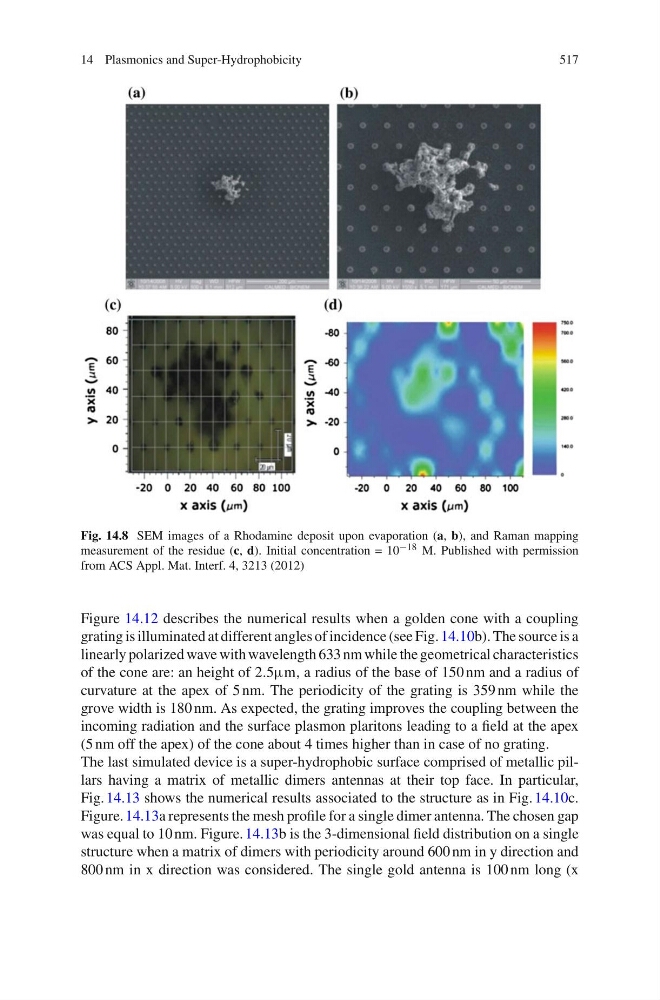
Fig. 14.8 SEM images of a Rhodamine deposit upon evaporation (a, b), and Raman mapping
measurement of the residue (c, d). Initial concentration = 10 −18 M. Published with permission
from ACS Appl. Mat. Interf. 4, 3213 (2012)
Figure 14.12 describes the numerical results when a golden cone with a coupling
grating is illuminated at different angles of incidence (see Fig. 14.10b). The source is a
linearly polarized wave with wavelength 633 nm while the geometrical characteristics
of the cone are: an height of 2.5μm, a radius of the base of 150 nm and a radius of
curvature at the apex of 5 nm. The periodicity of the grating is 359 nm while the
grove width is 180 nm. As expected, the grating improves the coupling between the
incoming radiation and the surface plasmon plaritons leading to a field at the apex
(5 nm off the apex) of the cone about 4 times higher than in case of no grating.
The last simulated device is a super-hydrophobic surface comprised of metallic pillars having a matrix of metallic dimers antennas at their top face. In particular,
Fig. 14.13 shows the numerical results associated to the structure as in Fig. 14.10c.
Figure. 14.13a represents the mesh profile for a single dimer antenna. The chosen gap
was equal to 10 nm. Figure. 14.13b is the 3-dimensional field distribution on a single
structure when a matrix of dimers with periodicity around 600 nm in y direction and
800 nm in x direction was considered. The single gold antenna is 100 nm long (x
517
Fig. 14.8 SEM images of a Rhodamine deposit upon evaporation (a, b), and Raman mapping
measurement of the residue (c, d). Initial concentration = 10 −18 M. Published with permission
from ACS Appl. Mat. Interf. 4, 3213 (2012)
Figure 14.12 describes the numerical results when a golden cone with a coupling
grating is illuminated at different angles of incidence (see Fig. 14.10b). The source is a
linearly polarized wave with wavelength 633 nm while the geometrical characteristics
of the cone are: an height of 2.5μm, a radius of the base of 150 nm and a radius of
curvature at the apex of 5 nm. The periodicity of the grating is 359 nm while the
grove width is 180 nm. As expected, the grating improves the coupling between the
incoming radiation and the surface plasmon plaritons leading to a field at the apex
(5 nm off the apex) of the cone about 4 times higher than in case of no grating.
The last simulated device is a super-hydrophobic surface comprised of metallic pillars having a matrix of metallic dimers antennas at their top face. In particular,
Fig. 14.13 shows the numerical results associated to the structure as in Fig. 14.10c.
Figure. 14.13a represents the mesh profile for a single dimer antenna. The chosen gap
was equal to 10 nm. Figure. 14.13b is the 3-dimensional field distribution on a single
structure when a matrix of dimers with periodicity around 600 nm in y direction and
800 nm in x direction was considered. The single gold antenna is 100 nm long (x