

494
E. Hasman and V. Kleiner
In the measured dispersion of thermal radiation [82], the slow mode exhibits a
clear spin-controlled splitting in the momentum of the emitted waves. The degree
of splitting of these modes, 2Δk, grows linearly with ∂, so as Δk = λ ∂,
(Fig. 13.24c, d). The observed effect of the spin symmetry breaking is due to a
spin-orbit interaction resulting from the dynamics of the surface waves propagating along the structure whose local anisotropy axis is rotated in space. The spin
symmetry breaking is caused by the absence of inversion symmetry (IS) in the system. In general, time reversal symmetry (TRS) in a system results in energy relation
E(k, λ + ) = E(−k, λ − ). If the crystal lattice has inversion symmetry, i.e., the operation r ≥ −r does not change the lattice, one will obtain E(k, λ ± ) = E(−k, λ ± ).
Consequently, if both TRS and IS are present, the band structure should satisfy the
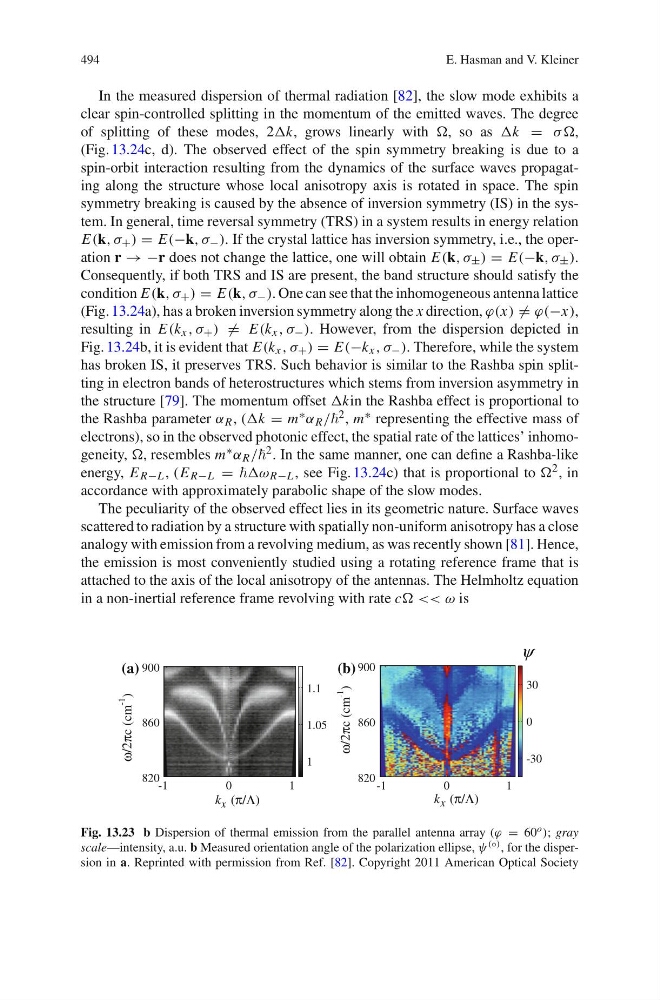
condition E(k, λ + ) = E(k, λ − ). One can see that the inhomogeneous antenna lattice
(Fig. 13.24a), has a broken inversion symmetry along the x direction, π(x) ∗ = π(−x),
resulting in E(k x , λ + ) ∗ = E(k x , λ − ). However, from the dispersion depicted in
Fig. 13.24b, it is evident that E(k x , λ + ) = E(−k x , λ − ). Therefore, while the system
has broken IS, it preserves TRS. Such behavior is similar to the Rashba spin splitting in electron bands of heterostructures which stems from inversion asymmetry in
the structure [79]. The momentum offset Δkin the Rashba effect is proportional to
the Rashba parameter β R , (Δk = m → β R / 2 , m → representing the effective mass of
electrons), so in the observed photonic effect, the spatial rate of the lattices’ inhomogeneity, ∂, resembles m → β R / 2 . In the same manner, one can define a Rashba-like
energy, E R−L , (E R−L = ΔΘ R−L , see Fig. 13.24c) that is proportional to ∂ 2 , in
accordance with approximately parabolic shape of the slow modes.
The peculiarity of the observed effect lies in its geometric nature. Surface waves
scattered to radiation by a structure with spatially non-uniform anisotropy has a close
analogy with emission from a revolving medium, as was recently shown [81]. Hence,
the emission is most conveniently studied using a rotating reference frame that is
attached to the axis of the local anisotropy of the antennas. The Helmholtz equation
in a non-inertial reference frame revolving with rate c∂ << Θ is
ω/2πc (cm
-1
)
-1
0
1
820
860
900
1
1.05
1.1
k x (π/Λ)
k x (π/Λ)
ω/2πc (cm
-1
)
-1
0
1
820
860
900
-30
0
30
ψ
(a)
(b)
Fig. 13.23 b Dispersion of thermal emission from the parallel antenna array (π = 60 o ); gray
scale—intensity, a.u. b Measured orientation angle of the polarization ellipse, ψ (∈) , for the dispersion in a. Reprinted with permission from Ref. [82]. Copyright 2011 American Optical Society
E. Hasman and V. Kleiner
In the measured dispersion of thermal radiation [82], the slow mode exhibits a
clear spin-controlled splitting in the momentum of the emitted waves. The degree
of splitting of these modes, 2Δk, grows linearly with ∂, so as Δk = λ ∂,
(Fig. 13.24c, d). The observed effect of the spin symmetry breaking is due to a
spin-orbit interaction resulting from the dynamics of the surface waves propagating along the structure whose local anisotropy axis is rotated in space. The spin
symmetry breaking is caused by the absence of inversion symmetry (IS) in the system. In general, time reversal symmetry (TRS) in a system results in energy relation
E(k, λ + ) = E(−k, λ − ). If the crystal lattice has inversion symmetry, i.e., the operation r ≥ −r does not change the lattice, one will obtain E(k, λ ± ) = E(−k, λ ± ).
Consequently, if both TRS and IS are present, the band structure should satisfy the
condition E(k, λ + ) = E(k, λ − ). One can see that the inhomogeneous antenna lattice
(Fig. 13.24a), has a broken inversion symmetry along the x direction, π(x) ∗ = π(−x),
resulting in E(k x , λ + ) ∗ = E(k x , λ − ). However, from the dispersion depicted in
Fig. 13.24b, it is evident that E(k x , λ + ) = E(−k x , λ − ). Therefore, while the system
has broken IS, it preserves TRS. Such behavior is similar to the Rashba spin splitting in electron bands of heterostructures which stems from inversion asymmetry in
the structure [79]. The momentum offset Δkin the Rashba effect is proportional to
the Rashba parameter β R , (Δk = m → β R / 2 , m → representing the effective mass of
electrons), so in the observed photonic effect, the spatial rate of the lattices’ inhomogeneity, ∂, resembles m → β R / 2 . In the same manner, one can define a Rashba-like
energy, E R−L , (E R−L = ΔΘ R−L , see Fig. 13.24c) that is proportional to ∂ 2 , in
accordance with approximately parabolic shape of the slow modes.
The peculiarity of the observed effect lies in its geometric nature. Surface waves
scattered to radiation by a structure with spatially non-uniform anisotropy has a close
analogy with emission from a revolving medium, as was recently shown [81]. Hence,
the emission is most conveniently studied using a rotating reference frame that is
attached to the axis of the local anisotropy of the antennas. The Helmholtz equation
in a non-inertial reference frame revolving with rate c∂ << Θ is
ω/2πc (cm
-1
)
-1
0
1
820
860
900
1
1.05
1.1
k x (π/Λ)
k x (π/Λ)
ω/2πc (cm
-1
)
-1
0
1
820
860
900
-30
0
30
ψ
(a)
(b)
Fig. 13.23 b Dispersion of thermal emission from the parallel antenna array (π = 60 o ); gray
scale—intensity, a.u. b Measured orientation angle of the polarization ellipse, ψ (∈) , for the dispersion in a. Reprinted with permission from Ref. [82]. Copyright 2011 American Optical Society