

13 Spinoptics in Plasmonics
495
-1.5 -1 -0.5
0
0.5
1
1.5
x
y
a
(a)
(c)
(b)
(d)
10 μm
k x (π/Λ)
3
S
ω/2πc (cm
-1
)
860
840
-1.5 -1.0 -0.5 0.0 0.5 1.0 1.5
840
860
840
860
840
860
LR
−
Δω ~
k x (π/Λ)
2Δk
Ω = 0.25
Ω = 0.13
Ω = 0.17
ω /2πc (cm
-1
)
1
0
-1
+
σ
−
σ
0.10 0.15 0.20 0.25
0.10
0.15
0.20
0.25
Δk (π/Λ)
Ω (π/Λ)
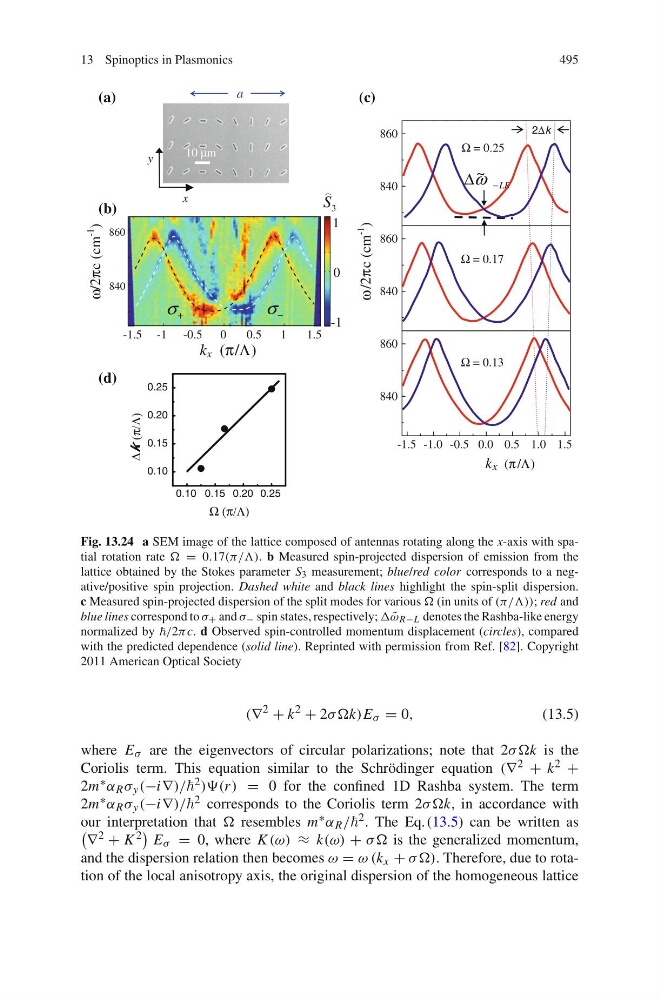
Fig. 13.24 a SEM image of the lattice composed of antennas rotating along the x-axis with spatial rotation rate ∂ = 0.17(α/Φ). b Measured spin-projected dispersion of emission from the
lattice obtained by the Stokes parameter S 3 measurement; blue/red color corresponds to a negative/positive spin projection. Dashed white and black lines highlight the spin-split dispersion.
c Measured spin-projected dispersion of the split modes for various ∂ (in units of (α/Φ)); red and
blue lines correspond to λ + and λ − spin states, respectively; Δ ˜
Θ R−L denotes the Rashba-like energy
normalized by /2α c. d Observed spin-controlled momentum displacement (circles), compared
with the predicted dependence (solid line). Reprinted with permission from Ref. [82]. Copyright
2011 American Optical Society
(∇
2
+ k
2
+ 2λ ∂k)E λ = 0,
(13.5)
where E λ are the eigenvectors of circular polarizations; note that 2λ ∂k is the
Coriolis term. This equation similar to the Schrödinger equation (∇ 2 + k 2 +
2m → β R λ y (−i∇)/ 2 )η(r ) = 0 for the confined 1D Rashba system. The term
2m → β R λ y (−i∇)/ 2 corresponds to the Coriolis term 2λ ∂k, in accordance with
our interpretation that ∂ resembles m → β R / 2 . The Eq.(13.5) can be written as
∇ 2 + K 2
E λ = 0, where K (Θ) ≈ k(Θ) + λ ∂ is the generalized momentum,
and the dispersion relation then becomes Θ = Θ (k x + λ ∂). Therefore, due to rotation of the local anisotropy axis, the original dispersion of the homogeneous lattice
495
-1.5 -1 -0.5
0
0.5
1
1.5
x
y
a
(a)
(c)
(b)
(d)
10 μm
k x (π/Λ)
3
S
ω/2πc (cm
-1
)
860
840
-1.5 -1.0 -0.5 0.0 0.5 1.0 1.5
840
860
840
860
840
860
LR
−
Δω ~
k x (π/Λ)
2Δk
Ω = 0.25
Ω = 0.13
Ω = 0.17
ω /2πc (cm
-1
)
1
0
-1
+
σ
−
σ
0.10 0.15 0.20 0.25
0.10
0.15
0.20
0.25
Δk (π/Λ)
Ω (π/Λ)
Fig. 13.24 a SEM image of the lattice composed of antennas rotating along the x-axis with spatial rotation rate ∂ = 0.17(α/Φ). b Measured spin-projected dispersion of emission from the
lattice obtained by the Stokes parameter S 3 measurement; blue/red color corresponds to a negative/positive spin projection. Dashed white and black lines highlight the spin-split dispersion.
c Measured spin-projected dispersion of the split modes for various ∂ (in units of (α/Φ)); red and
blue lines correspond to λ + and λ − spin states, respectively; Δ ˜
Θ R−L denotes the Rashba-like energy
normalized by /2α c. d Observed spin-controlled momentum displacement (circles), compared
with the predicted dependence (solid line). Reprinted with permission from Ref. [82]. Copyright
2011 American Optical Society
(∇
2
+ k
2
+ 2λ ∂k)E λ = 0,
(13.5)
where E λ are the eigenvectors of circular polarizations; note that 2λ ∂k is the
Coriolis term. This equation similar to the Schrödinger equation (∇ 2 + k 2 +
2m → β R λ y (−i∇)/ 2 )η(r ) = 0 for the confined 1D Rashba system. The term
2m → β R λ y (−i∇)/ 2 corresponds to the Coriolis term 2λ ∂k, in accordance with
our interpretation that ∂ resembles m → β R / 2 . The Eq.(13.5) can be written as
∇ 2 + K 2
E λ = 0, where K (Θ) ≈ k(Θ) + λ ∂ is the generalized momentum,
and the dispersion relation then becomes Θ = Θ (k x + λ ∂). Therefore, due to rotation of the local anisotropy axis, the original dispersion of the homogeneous lattice