

492
E. Hasman and V. Kleiner
chains of annular apertures and rotating nanorods with m = 1, 2 are visualized in
Fig. 13.20. Propeller-like images confirm the orbital AM of l, which is expected from
the obtained interference profile of 1 + cos (lπ), for the OSHE-LI and OSHE-LA.
13.7 Coupled Thermal Antenna Lattices and Rashba-like Spin
Degeneracy Violation
The spin state of elementary particles, atoms and molecules plays a key role in
fundamental effects in physics. An external magnetic field causes energy separation
of electrons (Zeeman effect) [77]. Spin-dependent momentum separation of charge
carriers can occur due to structural inversion asymmetry in a material as result of spinorbit interaction (Rashba and Dresselhaus effects) [78–80]. These two mechanisms
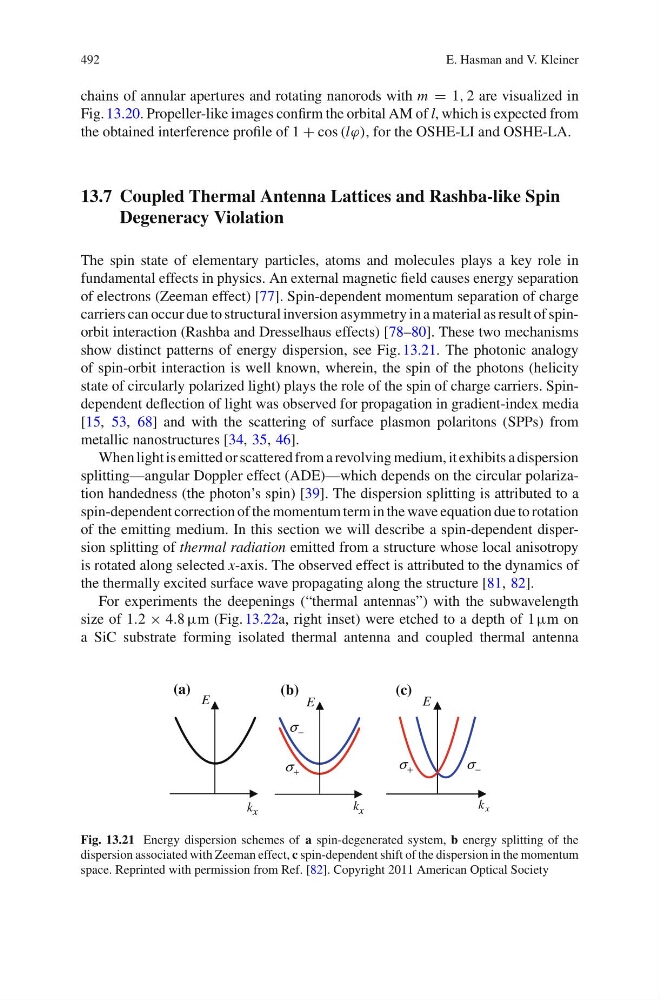
show distinct patterns of energy dispersion, see Fig. 13.21. The photonic analogy
of spin-orbit interaction is well known, wherein, the spin of the photons (helicity
state of circularly polarized light) plays the role of the spin of charge carriers. Spindependent deflection of light was observed for propagation in gradient-index media
[15, 53, 68] and with the scattering of surface plasmon polaritons (SPPs) from
metallic nanostructures [34, 35, 46].
When light is emitted or scattered from a revolving medium, it exhibits a dispersion
splitting—angular Doppler effect (ADE)—which depends on the circular polarization handedness (the photon’s spin) [39]. The dispersion splitting is attributed to a
spin-dependent correction of the momentum term in the wave equation due to rotation
of the emitting medium. In this section we will describe a spin-dependent dispersion splitting of thermal radiation emitted from a structure whose local anisotropy
is rotated along selected x-axis. The observed effect is attributed to the dynamics of
the thermally excited surface wave propagating along the structure [81, 82].
For experiments the deepenings (“thermal antennas”) with the subwavelength
size of 1.2 × 4.8 µm (Fig. 13.22a, right inset) were etched to a depth of 1 µm on
a SiC substrate forming isolated thermal antenna and coupled thermal antenna
E
(c)
(b)
(a)
−
σ
+
σ
−
σ
+
σ
k x
E
k x
k x
E
Fig. 13.21 Energy dispersion schemes of a spin-degenerated system, b energy splitting of the
dispersion associated with Zeeman effect, c spin-dependent shift of the dispersion in the momentum
space. Reprinted with permission from Ref. [82]. Copyright 2011 American Optical Society
E. Hasman and V. Kleiner
chains of annular apertures and rotating nanorods with m = 1, 2 are visualized in
Fig. 13.20. Propeller-like images confirm the orbital AM of l, which is expected from
the obtained interference profile of 1 + cos (lπ), for the OSHE-LI and OSHE-LA.
13.7 Coupled Thermal Antenna Lattices and Rashba-like Spin
Degeneracy Violation
The spin state of elementary particles, atoms and molecules plays a key role in
fundamental effects in physics. An external magnetic field causes energy separation
of electrons (Zeeman effect) [77]. Spin-dependent momentum separation of charge
carriers can occur due to structural inversion asymmetry in a material as result of spinorbit interaction (Rashba and Dresselhaus effects) [78–80]. These two mechanisms
show distinct patterns of energy dispersion, see Fig. 13.21. The photonic analogy
of spin-orbit interaction is well known, wherein, the spin of the photons (helicity
state of circularly polarized light) plays the role of the spin of charge carriers. Spindependent deflection of light was observed for propagation in gradient-index media
[15, 53, 68] and with the scattering of surface plasmon polaritons (SPPs) from
metallic nanostructures [34, 35, 46].
When light is emitted or scattered from a revolving medium, it exhibits a dispersion
splitting—angular Doppler effect (ADE)—which depends on the circular polarization handedness (the photon’s spin) [39]. The dispersion splitting is attributed to a
spin-dependent correction of the momentum term in the wave equation due to rotation
of the emitting medium. In this section we will describe a spin-dependent dispersion splitting of thermal radiation emitted from a structure whose local anisotropy
is rotated along selected x-axis. The observed effect is attributed to the dynamics of
the thermally excited surface wave propagating along the structure [81, 82].
For experiments the deepenings (“thermal antennas”) with the subwavelength
size of 1.2 × 4.8 µm (Fig. 13.22a, right inset) were etched to a depth of 1 µm on
a SiC substrate forming isolated thermal antenna and coupled thermal antenna
E
(c)
(b)
(a)
−
σ
+
σ
−
σ
+
σ
k x
E
k x
k x
E
Fig. 13.21 Energy dispersion schemes of a spin-degenerated system, b energy splitting of the
dispersion associated with Zeeman effect, c spin-dependent shift of the dispersion in the momentum
space. Reprinted with permission from Ref. [82]. Copyright 2011 American Optical Society