

484
E. Hasman and V. Kleiner
-2
2
0
Intensity (a.u.)
m
μ
−
σ
+
σ
(a)
+
σ
−
σ
(c)
(d)
(b)
m
μ
5
m
μ
2
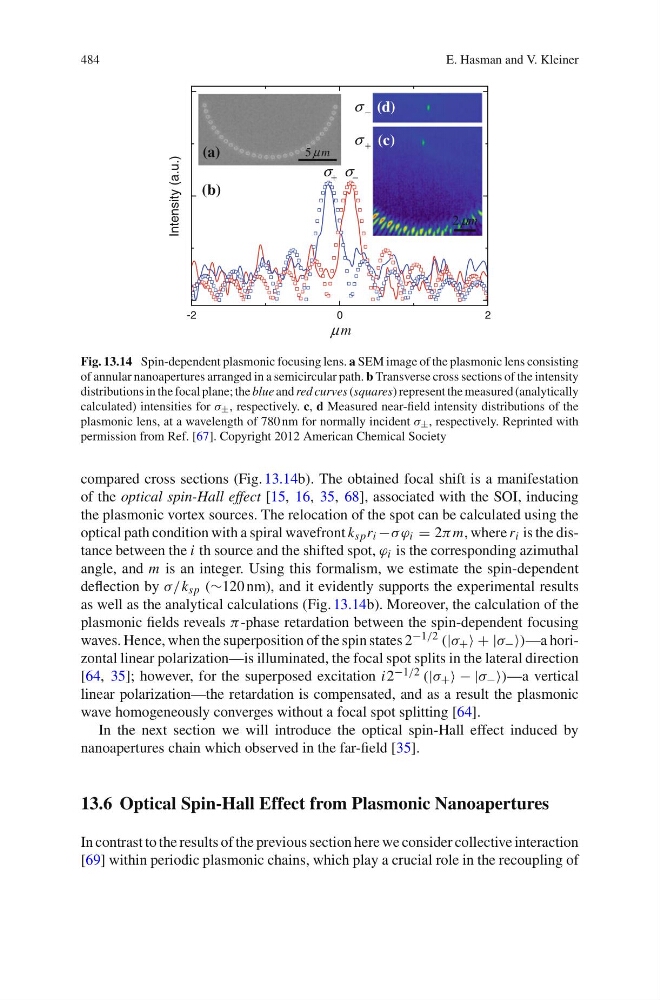
Fig. 13.14 Spin-dependent plasmonic focusing lens. a SEM image of the plasmonic lens consisting
of annular nanoapertures arranged in a semicircular path. b Transverse cross sections of the intensity
distributions in the focal plane; the blue and red curves (squares) represent the measured (analytically
calculated) intensities for λ ± , respectively. c, d Measured near-field intensity distributions of the
plasmonic lens, at a wavelength of 780 nm for normally incident λ ± , respectively. Reprinted with
permission from Ref. [67]. Copyright 2012 American Chemical Society
compared cross sections (Fig. 13.14b). The obtained focal shift is a manifestation
of the optical spin-Hall effect [15, 16, 35, 68], associated with the SOI, inducing
the plasmonic vortex sources. The relocation of the spot can be calculated using the
optical path condition with a spiral wavefront k sp r i −λ π i = 2α m, where r i is the distance between the i th source and the shifted spot, π i is the corresponding azimuthal
angle, and m is an integer. Using this formalism, we estimate the spin-dependent
deflection by λ/k sp (∼120 nm), and it evidently supports the experimental results
as well as the analytical calculations (Fig. 13.14b). Moreover, the calculation of the
plasmonic fields reveals α -phase retardation between the spin-dependent focusing
waves. Hence, when the superposition of the spin states 2 −1/2 (|λ + ≈ + |λ − ≈)—a horizontal linear polarization—is illuminated, the focal spot splits in the lateral direction
[64, 35]; however, for the superposed excitation i2 −1/2 (|λ + ≈ − |λ − ≈)—a vertical
linear polarization—the retardation is compensated, and as a result the plasmonic
wave homogeneously converges without a focal spot splitting [64].
In the next section we will introduce the optical spin-Hall effect induced by
nanoapertures chain which observed in the far-field [35].
13.6 Optical Spin-Hall Effect from Plasmonic Nanoapertures
In contrast to the results of the previous section here we consider collective interaction
[69] within periodic plasmonic chains, which play a crucial role in the recoupling of
E. Hasman and V. Kleiner
-2
2
0
Intensity (a.u.)
m
μ
−
σ
+
σ
(a)
+
σ
−
σ
(c)
(d)
(b)
m
μ
5
m
μ
2
Fig. 13.14 Spin-dependent plasmonic focusing lens. a SEM image of the plasmonic lens consisting
of annular nanoapertures arranged in a semicircular path. b Transverse cross sections of the intensity
distributions in the focal plane; the blue and red curves (squares) represent the measured (analytically
calculated) intensities for λ ± , respectively. c, d Measured near-field intensity distributions of the
plasmonic lens, at a wavelength of 780 nm for normally incident λ ± , respectively. Reprinted with
permission from Ref. [67]. Copyright 2012 American Chemical Society
compared cross sections (Fig. 13.14b). The obtained focal shift is a manifestation
of the optical spin-Hall effect [15, 16, 35, 68], associated with the SOI, inducing
the plasmonic vortex sources. The relocation of the spot can be calculated using the
optical path condition with a spiral wavefront k sp r i −λ π i = 2α m, where r i is the distance between the i th source and the shifted spot, π i is the corresponding azimuthal
angle, and m is an integer. Using this formalism, we estimate the spin-dependent
deflection by λ/k sp (∼120 nm), and it evidently supports the experimental results
as well as the analytical calculations (Fig. 13.14b). Moreover, the calculation of the
plasmonic fields reveals α -phase retardation between the spin-dependent focusing
waves. Hence, when the superposition of the spin states 2 −1/2 (|λ + ≈ + |λ − ≈)—a horizontal linear polarization—is illuminated, the focal spot splits in the lateral direction
[64, 35]; however, for the superposed excitation i2 −1/2 (|λ + ≈ − |λ − ≈)—a vertical
linear polarization—the retardation is compensated, and as a result the plasmonic
wave homogeneously converges without a focal spot splitting [64].
In the next section we will introduce the optical spin-Hall effect induced by
nanoapertures chain which observed in the far-field [35].
13.6 Optical Spin-Hall Effect from Plasmonic Nanoapertures
In contrast to the results of the previous section here we consider collective interaction
[69] within periodic plasmonic chains, which play a crucial role in the recoupling of