

13 Spinoptics in Plasmonics
485
(a)
(b)
x
y
ξ
θ
u
v
ξ
'
θ
'
u
'
v
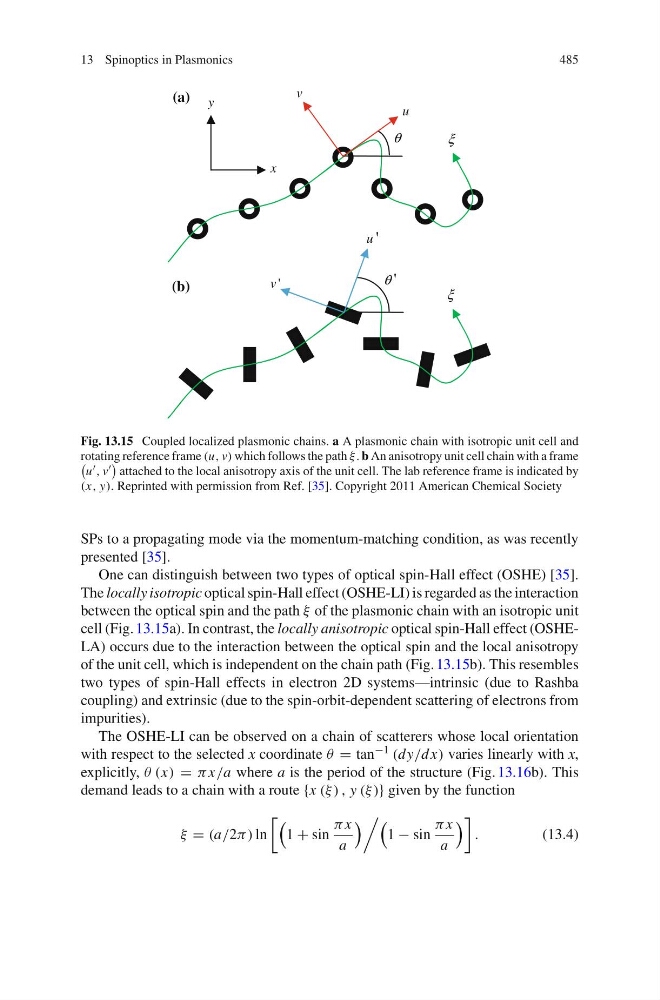
Fig. 13.15 Coupled localized plasmonic chains. a A plasmonic chain with isotropic unit cell and
rotating reference frame (u, v) which follows the path ϕ . b An anisotropy unit cell chain with a frame
u , v
attached to the local anisotropy axis of the unit cell. The lab reference frame is indicated by
(x, y). Reprinted with permission from Ref. [35]. Copyright 2011 American Chemical Society
SPs to a propagating mode via the momentum-matching condition, as was recently
presented [35].
One can distinguish between two types of optical spin-Hall effect (OSHE) [35].
The locally isotropic optical spin-Hall effect (OSHE-LI) is regarded as the interaction
between the optical spin and the path ϕ of the plasmonic chain with an isotropic unit
cell (Fig. 13.15a). In contrast, the locally anisotropic optical spin-Hall effect (OSHELA) occurs due to the interaction between the optical spin and the local anisotropy
of the unit cell, which is independent on the chain path (Fig. 13.15b). This resembles
two types of spin-Hall effects in electron 2D systems—intrinsic (due to Rashba
coupling) and extrinsic (due to the spin-orbit-dependent scattering of electrons from
impurities).
The OSHE-LI can be observed on a chain of scatterers whose local orientation
with respect to the selected x coordinate τ = tan −1 (dy/dx) varies linearly with x,
explicitly, τ (x) = α x/a where a is the period of the structure (Fig. 13.16b). This
demand leads to a chain with a route {x (ϕ ) , y (ϕ )} given by the function
ϕ = (a/2α ) ln
1 + sin
α x
a
1 − sin
α x
a
.
(13.4)
485
(a)
(b)
x
y
ξ
θ
u
v
ξ
'
θ
'
u
'
v
Fig. 13.15 Coupled localized plasmonic chains. a A plasmonic chain with isotropic unit cell and
rotating reference frame (u, v) which follows the path ϕ . b An anisotropy unit cell chain with a frame
u , v
attached to the local anisotropy axis of the unit cell. The lab reference frame is indicated by
(x, y). Reprinted with permission from Ref. [35]. Copyright 2011 American Chemical Society
SPs to a propagating mode via the momentum-matching condition, as was recently
presented [35].
One can distinguish between two types of optical spin-Hall effect (OSHE) [35].
The locally isotropic optical spin-Hall effect (OSHE-LI) is regarded as the interaction
between the optical spin and the path ϕ of the plasmonic chain with an isotropic unit
cell (Fig. 13.15a). In contrast, the locally anisotropic optical spin-Hall effect (OSHELA) occurs due to the interaction between the optical spin and the local anisotropy
of the unit cell, which is independent on the chain path (Fig. 13.15b). This resembles
two types of spin-Hall effects in electron 2D systems—intrinsic (due to Rashba
coupling) and extrinsic (due to the spin-orbit-dependent scattering of electrons from
impurities).
The OSHE-LI can be observed on a chain of scatterers whose local orientation
with respect to the selected x coordinate τ = tan −1 (dy/dx) varies linearly with x,
explicitly, τ (x) = α x/a where a is the period of the structure (Fig. 13.16b). This
demand leads to a chain with a route {x (ϕ ) , y (ϕ )} given by the function
ϕ = (a/2α ) ln
1 + sin
α x
a
1 − sin
α x
a
.
(13.4)