

13 Spinoptics in Plasmonics
483
(a)
(b)
(c)
(d)
±
σ
+
σ
−
σ
π
π
−
m
μ
1
m
μ
5
5 μm
1 μm
m
μ
-2
0
2
Intensity (a.u.)
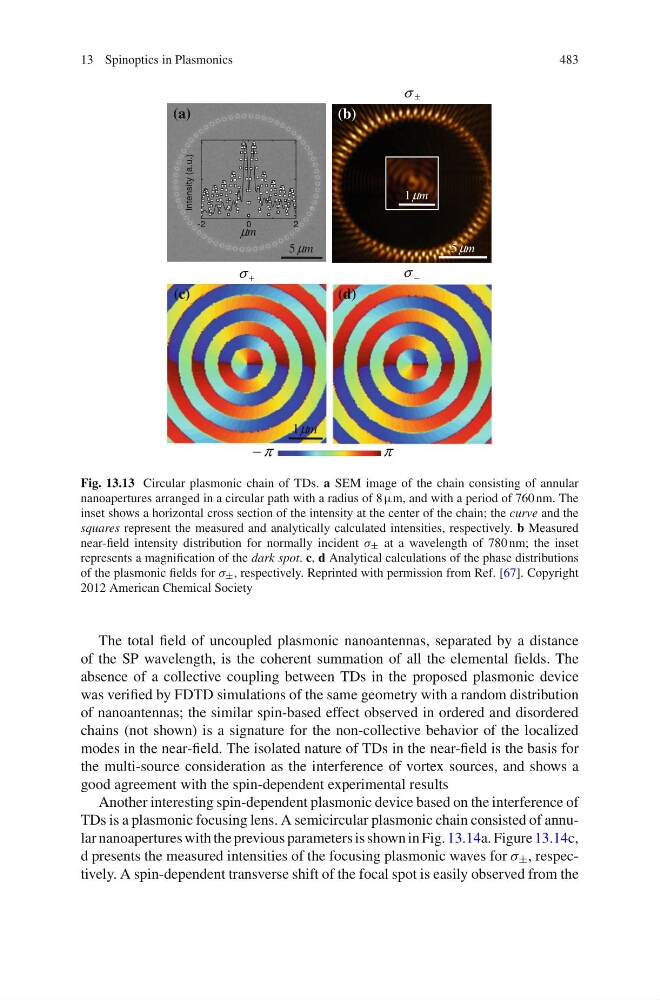
Fig. 13.13 Circular plasmonic chain of TDs. a SEM image of the chain consisting of annular
nanoapertures arranged in a circular path with a radius of 8 µm, and with a period of 760 nm. The
inset shows a horizontal cross section of the intensity at the center of the chain; the curve and the
squares represent the measured and analytically calculated intensities, respectively. b Measured
near-field intensity distribution for normally incident λ ± at a wavelength of 780 nm; the inset
represents a magnification of the dark spot. c, d Analytical calculations of the phase distributions
of the plasmonic fields for λ ± , respectively. Reprinted with permission from Ref. [67]. Copyright
2012 American Chemical Society
The total field of uncoupled plasmonic nanoantennas, separated by a distance
of the SP wavelength, is the coherent summation of all the elemental fields. The
absence of a collective coupling between TDs in the proposed plasmonic device
was verified by FDTD simulations of the same geometry with a random distribution
of nanoantennas; the similar spin-based effect observed in ordered and disordered
chains (not shown) is a signature for the non-collective behavior of the localized
modes in the near-field. The isolated nature of TDs in the near-field is the basis for
the multi-source consideration as the interference of vortex sources, and shows a
good agreement with the spin-dependent experimental results
Another interesting spin-dependent plasmonic device based on the interference of
TDs is a plasmonic focusing lens. A semicircular plasmonic chain consisted of annular nanoapertures with the previous parameters is shown in Fig. 13.14a. Figure 13.14c,
d presents the measured intensities of the focusing plasmonic waves for λ ± , respectively. A spin-dependent transverse shift of the focal spot is easily observed from the
483
(a)
(b)
(c)
(d)
±
σ
+
σ
−
σ
π
π
−
m
μ
1
m
μ
5
5 μm
1 μm
m
μ
-2
0
2
Intensity (a.u.)
Fig. 13.13 Circular plasmonic chain of TDs. a SEM image of the chain consisting of annular
nanoapertures arranged in a circular path with a radius of 8 µm, and with a period of 760 nm. The
inset shows a horizontal cross section of the intensity at the center of the chain; the curve and the
squares represent the measured and analytically calculated intensities, respectively. b Measured
near-field intensity distribution for normally incident λ ± at a wavelength of 780 nm; the inset
represents a magnification of the dark spot. c, d Analytical calculations of the phase distributions
of the plasmonic fields for λ ± , respectively. Reprinted with permission from Ref. [67]. Copyright
2012 American Chemical Society
The total field of uncoupled plasmonic nanoantennas, separated by a distance
of the SP wavelength, is the coherent summation of all the elemental fields. The
absence of a collective coupling between TDs in the proposed plasmonic device
was verified by FDTD simulations of the same geometry with a random distribution
of nanoantennas; the similar spin-based effect observed in ordered and disordered
chains (not shown) is a signature for the non-collective behavior of the localized
modes in the near-field. The isolated nature of TDs in the near-field is the basis for
the multi-source consideration as the interference of vortex sources, and shows a
good agreement with the spin-dependent experimental results
Another interesting spin-dependent plasmonic device based on the interference of
TDs is a plasmonic focusing lens. A semicircular plasmonic chain consisted of annular nanoapertures with the previous parameters is shown in Fig. 13.14a. Figure 13.14c,
d presents the measured intensities of the focusing plasmonic waves for λ ± , respectively. A spin-dependent transverse shift of the focal spot is easily observed from the