

482
E. Hasman and V. Kleiner
to the varying polarization state results in a geometric phase, leading to a plasmonic
field E z (r 0 , π) = exp(−iλ π), where λ is the incident spin. Two additional boundary
conditions are required: zero-field amplitude at the origin and at infinity, arising from
the spiral phase and a single point source, respectively.
The two-dimensional Helmholtz equation, with the SP wave vector k sp , is separable in polar coordinates (r, π), where r is the radius and π is the azimuthal angle. The
different boundary conditions for the internal and external regions dictate different
solutions for the in- and out-propagating plasmonic fields. The resulting solution of
the in- and out-propagating plasmonic fields are
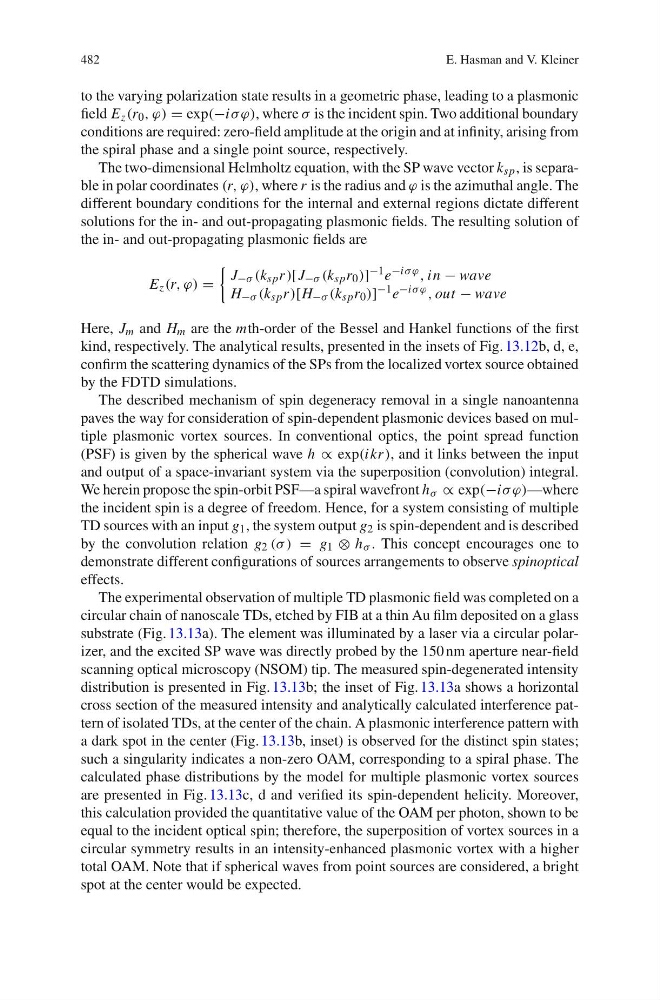
E z (r, π) =
J −λ (k sp r )[J −λ (k sp r 0 )] −1 e −iλ π , in − wave
H −λ (k sp r )[H −λ (k sp r 0 )] −1 e −iλ π , out − wave
Here, J m and H m are the mth-order of the Bessel and Hankel functions of the first
kind, respectively. The analytical results, presented in the insets of Fig. 13.12b, d, e,
confirm the scattering dynamics of the SPs from the localized vortex source obtained
by the FDTD simulations.
The described mechanism of spin degeneracy removal in a single nanoantenna
paves the way for consideration of spin-dependent plasmonic devices based on multiple plasmonic vortex sources. In conventional optics, the point spread function
(PSF) is given by the spherical wave h ∪ exp(ikr), and it links between the input
and output of a space-invariant system via the superposition (convolution) integral.
We herein propose the spin-orbit PSF—a spiral wavefront h λ ∪ exp(−iλ π)—where
the incident spin is a degree of freedom. Hence, for a system consisting of multiple
TD sources with an input g 1 , the system output g 2 is spin-dependent and is described
by the convolution relation g 2 (λ ) = g 1 √ h λ . This concept encourages one to
demonstrate different configurations of sources arrangements to observe spinoptical
effects.
The experimental observation of multiple TD plasmonic field was completed on a
circular chain of nanoscale TDs, etched by FIB at a thin Au film deposited on a glass
substrate (Fig. 13.13a). The element was illuminated by a laser via a circular polarizer, and the excited SP wave was directly probed by the 150 nm aperture near-field
scanning optical microscopy (NSOM) tip. The measured spin-degenerated intensity
distribution is presented in Fig. 13.13b; the inset of Fig. 13.13a shows a horizontal
cross section of the measured intensity and analytically calculated interference pattern of isolated TDs, at the center of the chain. A plasmonic interference pattern with
a dark spot in the center (Fig. 13.13b, inset) is observed for the distinct spin states;
such a singularity indicates a non-zero OAM, corresponding to a spiral phase. The
calculated phase distributions by the model for multiple plasmonic vortex sources
are presented in Fig. 13.13c, d and verified its spin-dependent helicity. Moreover,
this calculation provided the quantitative value of the OAM per photon, shown to be
equal to the incident optical spin; therefore, the superposition of vortex sources in a
circular symmetry results in an intensity-enhanced plasmonic vortex with a higher
total OAM. Note that if spherical waves from point sources are considered, a bright
spot at the center would be expected.
E. Hasman and V. Kleiner
to the varying polarization state results in a geometric phase, leading to a plasmonic
field E z (r 0 , π) = exp(−iλ π), where λ is the incident spin. Two additional boundary
conditions are required: zero-field amplitude at the origin and at infinity, arising from
the spiral phase and a single point source, respectively.
The two-dimensional Helmholtz equation, with the SP wave vector k sp , is separable in polar coordinates (r, π), where r is the radius and π is the azimuthal angle. The
different boundary conditions for the internal and external regions dictate different
solutions for the in- and out-propagating plasmonic fields. The resulting solution of
the in- and out-propagating plasmonic fields are
E z (r, π) =
J −λ (k sp r )[J −λ (k sp r 0 )] −1 e −iλ π , in − wave
H −λ (k sp r )[H −λ (k sp r 0 )] −1 e −iλ π , out − wave
Here, J m and H m are the mth-order of the Bessel and Hankel functions of the first
kind, respectively. The analytical results, presented in the insets of Fig. 13.12b, d, e,
confirm the scattering dynamics of the SPs from the localized vortex source obtained
by the FDTD simulations.
The described mechanism of spin degeneracy removal in a single nanoantenna
paves the way for consideration of spin-dependent plasmonic devices based on multiple plasmonic vortex sources. In conventional optics, the point spread function
(PSF) is given by the spherical wave h ∪ exp(ikr), and it links between the input
and output of a space-invariant system via the superposition (convolution) integral.
We herein propose the spin-orbit PSF—a spiral wavefront h λ ∪ exp(−iλ π)—where
the incident spin is a degree of freedom. Hence, for a system consisting of multiple
TD sources with an input g 1 , the system output g 2 is spin-dependent and is described
by the convolution relation g 2 (λ ) = g 1 √ h λ . This concept encourages one to
demonstrate different configurations of sources arrangements to observe spinoptical
effects.
The experimental observation of multiple TD plasmonic field was completed on a
circular chain of nanoscale TDs, etched by FIB at a thin Au film deposited on a glass
substrate (Fig. 13.13a). The element was illuminated by a laser via a circular polarizer, and the excited SP wave was directly probed by the 150 nm aperture near-field
scanning optical microscopy (NSOM) tip. The measured spin-degenerated intensity
distribution is presented in Fig. 13.13b; the inset of Fig. 13.13a shows a horizontal
cross section of the measured intensity and analytically calculated interference pattern of isolated TDs, at the center of the chain. A plasmonic interference pattern with
a dark spot in the center (Fig. 13.13b, inset) is observed for the distinct spin states;
such a singularity indicates a non-zero OAM, corresponding to a spiral phase. The
calculated phase distributions by the model for multiple plasmonic vortex sources
are presented in Fig. 13.13c, d and verified its spin-dependent helicity. Moreover,
this calculation provided the quantitative value of the OAM per photon, shown to be
equal to the incident optical spin; therefore, the superposition of vortex sources in a
circular symmetry results in an intensity-enhanced plasmonic vortex with a higher
total OAM. Note that if spherical waves from point sources are considered, a bright
spot at the center would be expected.