

468
E. Hasman and V. Kleiner
z
x
y
ϕ
ϕ
v
u
Ω
+
Ω
u,v;u`
v`
( )
ϕ
p
k
( )
0
p
k
( )
ϕ
p
k
σ ± n
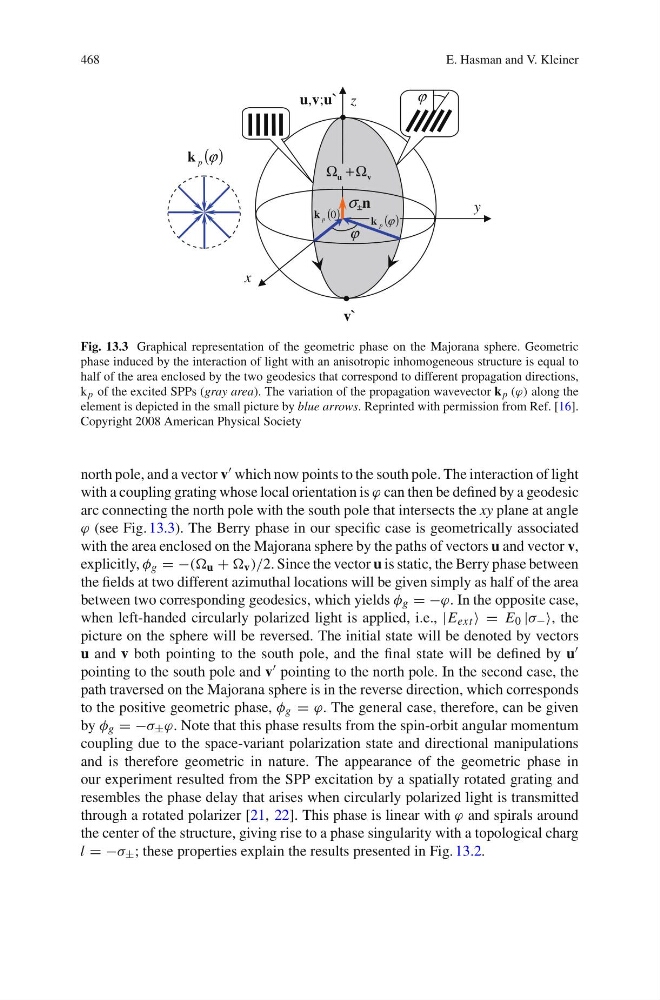
Fig. 13.3 Graphical representation of the geometric phase on the Majorana sphere. Geometric
phase induced by the interaction of light with an anisotropic inhomogeneous structure is equal to
half of the area enclosed by the two geodesics that correspond to different propagation directions,
k p of the excited SPPs (gray area). The variation of the propagation wavevector k p (π) along the
element is depicted in the small picture by blue arrows. Reprinted with permission from Ref. [16].
Copyright 2008 American Physical Society
north pole, and a vector v which now points to the south pole. The interaction of light
with a coupling grating whose local orientation is π can then be defined by a geodesic
arc connecting the north pole with the south pole that intersects the xy plane at angle
π (see Fig. 13.3). The Berry phase in our specific case is geometrically associated
with the area enclosed on the Majorana sphere by the paths of vectors u and vector v,
explicitly, γ g = −(∂ u + ∂ v )/2. Since the vector u is static, the Berry phase between
the fields at two different azimuthal locations will be given simply as half of the area
between two corresponding geodesics, which yields γ g = −π. In the opposite case,
when left-handed circularly polarized light is applied, i.e., |E ext ≈ = E 0 |λ − ≈, the
picture on the sphere will be reversed. The initial state will be denoted by vectors
u and v both pointing to the south pole, and the final state will be defined by u
pointing to the south pole and v pointing to the north pole. In the second case, the
path traversed on the Majorana sphere is in the reverse direction, which corresponds
to the positive geometric phase, γ g = π. The general case, therefore, can be given
by γ g = −λ ± π. Note that this phase results from the spin-orbit angular momentum
coupling due to the space-variant polarization state and directional manipulations
and is therefore geometric in nature. The appearance of the geometric phase in
our experiment resulted from the SPP excitation by a spatially rotated grating and
resembles the phase delay that arises when circularly polarized light is transmitted
through a rotated polarizer [21, 22]. This phase is linear with π and spirals around
the center of the structure, giving rise to a phase singularity with a topological charg
l = −λ ± ; these properties explain the results presented in Fig. 13.2.
E. Hasman and V. Kleiner
z
x
y
ϕ
ϕ
v
u
Ω
+
Ω
u,v;u`
v`
( )
ϕ
p
k
( )
0
p
k
( )
ϕ
p
k
σ ± n
Fig. 13.3 Graphical representation of the geometric phase on the Majorana sphere. Geometric
phase induced by the interaction of light with an anisotropic inhomogeneous structure is equal to
half of the area enclosed by the two geodesics that correspond to different propagation directions,
k p of the excited SPPs (gray area). The variation of the propagation wavevector k p (π) along the
element is depicted in the small picture by blue arrows. Reprinted with permission from Ref. [16].
Copyright 2008 American Physical Society
north pole, and a vector v which now points to the south pole. The interaction of light
with a coupling grating whose local orientation is π can then be defined by a geodesic
arc connecting the north pole with the south pole that intersects the xy plane at angle
π (see Fig. 13.3). The Berry phase in our specific case is geometrically associated
with the area enclosed on the Majorana sphere by the paths of vectors u and vector v,
explicitly, γ g = −(∂ u + ∂ v )/2. Since the vector u is static, the Berry phase between
the fields at two different azimuthal locations will be given simply as half of the area
between two corresponding geodesics, which yields γ g = −π. In the opposite case,
when left-handed circularly polarized light is applied, i.e., |E ext ≈ = E 0 |λ − ≈, the
picture on the sphere will be reversed. The initial state will be denoted by vectors
u and v both pointing to the south pole, and the final state will be defined by u
pointing to the south pole and v pointing to the north pole. In the second case, the
path traversed on the Majorana sphere is in the reverse direction, which corresponds
to the positive geometric phase, γ g = π. The general case, therefore, can be given
by γ g = −λ ± π. Note that this phase results from the spin-orbit angular momentum
coupling due to the space-variant polarization state and directional manipulations
and is therefore geometric in nature. The appearance of the geometric phase in
our experiment resulted from the SPP excitation by a spatially rotated grating and
resembles the phase delay that arises when circularly polarized light is transmitted
through a rotated polarizer [21, 22]. This phase is linear with π and spirals around
the center of the structure, giving rise to a phase singularity with a topological charg
l = −λ ± ; these properties explain the results presented in Fig. 13.2.