

466
E. Hasman and V. Kleiner
dependence on the incident spin. An annular ring structure with a dark spot in the
center for |λ + ≈ illumination and with a bright spot for |λ − ≈ illumination indicates coupling to different spiral plasmonic modes. The origin of the spin-dependent change
in the near-field intensity distributions lies in the phase of the excited plasmonic
mode. This phase has been verified by FDTD calculation (see Fig. 13.1g, h) and was
found to correspond to a spiral mode exp (ilπ), where π is the azimuthal angle, with
topological charge l = −2 for |λ + ≈ and l = 0 for |λ − ≈ illumination. The origin of the
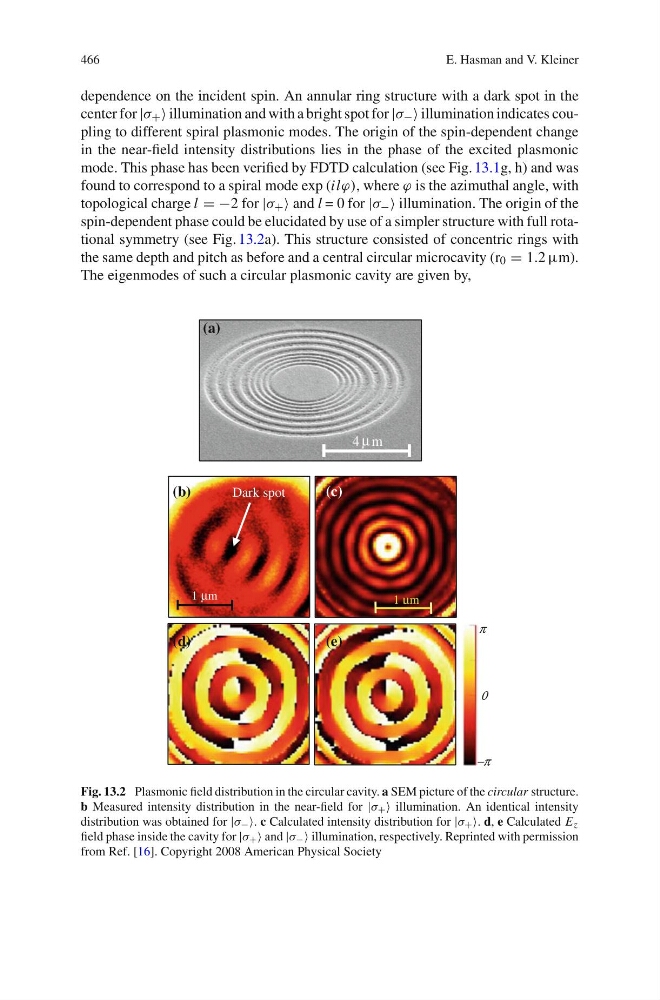
spin-dependent phase could be elucidated by use of a simpler structure with full rotational symmetry (see Fig. 13.2a). This structure consisted of concentric rings with
the same depth and pitch as before and a central circular microcavity (r 0 = 1.2 µm).
The eigenmodes of such a circular plasmonic cavity are given by,
4 μ m
(a)
1 μm
(b)
(c)
Dark spot
π
−π
0
1 μm
(d)
(e)
Fig. 13.2 Plasmonic field distribution in the circular cavity. a SEM picture of the circular structure.
b Measured intensity distribution in the near-field for |λ + ≈ illumination. An identical intensity
distribution was obtained for |λ − ≈. c Calculated intensity distribution for |λ + ≈. d, e Calculated E z
field phase inside the cavity for |λ + ≈ and |λ − ≈ illumination, respectively. Reprinted with permission
from Ref. [16]. Copyright 2008 American Physical Society
E. Hasman and V. Kleiner
dependence on the incident spin. An annular ring structure with a dark spot in the
center for |λ + ≈ illumination and with a bright spot for |λ − ≈ illumination indicates coupling to different spiral plasmonic modes. The origin of the spin-dependent change
in the near-field intensity distributions lies in the phase of the excited plasmonic
mode. This phase has been verified by FDTD calculation (see Fig. 13.1g, h) and was
found to correspond to a spiral mode exp (ilπ), where π is the azimuthal angle, with
topological charge l = −2 for |λ + ≈ and l = 0 for |λ − ≈ illumination. The origin of the
spin-dependent phase could be elucidated by use of a simpler structure with full rotational symmetry (see Fig. 13.2a). This structure consisted of concentric rings with
the same depth and pitch as before and a central circular microcavity (r 0 = 1.2 µm).
The eigenmodes of such a circular plasmonic cavity are given by,
4 μ m
(a)
1 μm
(b)
(c)
Dark spot
π
−π
0
1 μm
(d)
(e)
Fig. 13.2 Plasmonic field distribution in the circular cavity. a SEM picture of the circular structure.
b Measured intensity distribution in the near-field for |λ + ≈ illumination. An identical intensity
distribution was obtained for |λ − ≈. c Calculated intensity distribution for |λ + ≈. d, e Calculated E z
field phase inside the cavity for |λ + ≈ and |λ − ≈ illumination, respectively. Reprinted with permission
from Ref. [16]. Copyright 2008 American Physical Society