

456
S. V. Boriskina
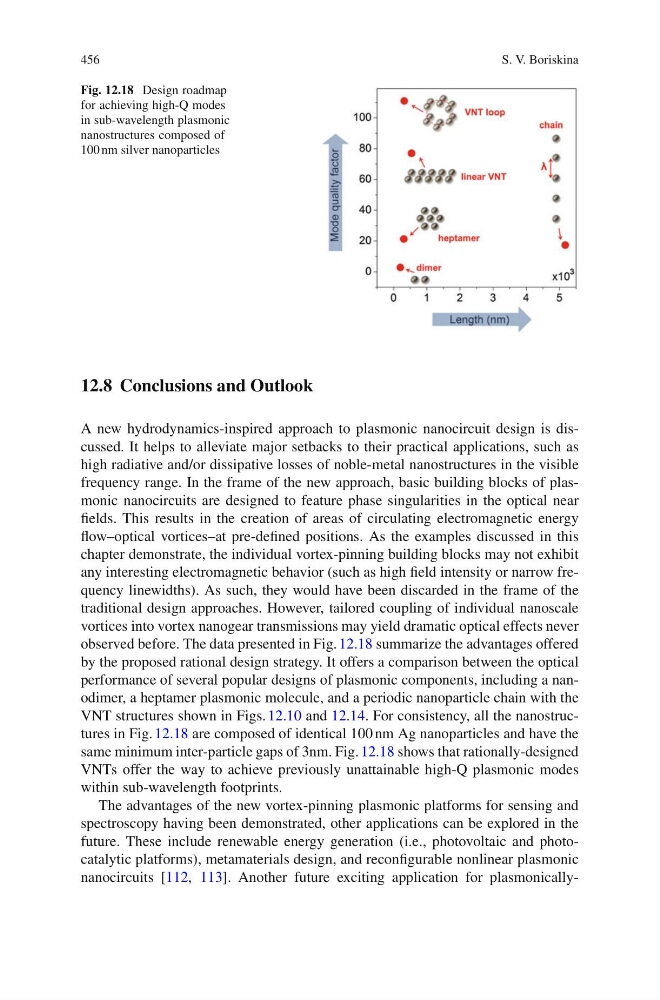
Fig. 12.18 Design roadmap
for achieving high-Q modes
in sub-wavelength plasmonic
nanostructures composed of
100 nm silver nanoparticles
12.8 Conclusions and Outlook
A new hydrodynamics-inspired approach to plasmonic nanocircuit design is discussed. It helps to alleviate major setbacks to their practical applications, such as
high radiative and/or dissipative losses of noble-metal nanostructures in the visible
frequency range. In the frame of the new approach, basic building blocks of plasmonic nanocircuits are designed to feature phase singularities in the optical near
fields. This results in the creation of areas of circulating electromagnetic energy
flow–optical vortices–at pre-defined positions. As the examples discussed in this
chapter demonstrate, the individual vortex-pinning building blocks may not exhibit
any interesting electromagnetic behavior (such as high field intensity or narrow frequency linewidths). As such, they would have been discarded in the frame of the
traditional design approaches. However, tailored coupling of individual nanoscale
vortices into vortex nanogear transmissions may yield dramatic optical effects never
observed before. The data presented in Fig. 12.18 summarize the advantages offered
by the proposed rational design strategy. It offers a comparison between the optical
performance of several popular designs of plasmonic components, including a nanodimer, a heptamer plasmonic molecule, and a periodic nanoparticle chain with the
VNT structures shown in Figs. 12.10 and 12.14. For consistency, all the nanostructures in Fig. 12.18 are composed of identical 100 nm Ag nanoparticles and have the
same minimum inter-particle gaps of 3nm. Fig. 12.18 shows that rationally-designed
VNTs offer the way to achieve previously unattainable high-Q plasmonic modes
within sub-wavelength footprints.
The advantages of the new vortex-pinning plasmonic platforms for sensing and
spectroscopy having been demonstrated, other applications can be explored in the
future. These include renewable energy generation (i.e., photovoltaic and photocatalytic platforms), metamaterials design, and reconfigurable nonlinear plasmonic
nanocircuits [112, 113]. Another future exciting application for plasmonically-
S. V. Boriskina
Fig. 12.18 Design roadmap
for achieving high-Q modes
in sub-wavelength plasmonic
nanostructures composed of
100 nm silver nanoparticles
12.8 Conclusions and Outlook
A new hydrodynamics-inspired approach to plasmonic nanocircuit design is discussed. It helps to alleviate major setbacks to their practical applications, such as
high radiative and/or dissipative losses of noble-metal nanostructures in the visible
frequency range. In the frame of the new approach, basic building blocks of plasmonic nanocircuits are designed to feature phase singularities in the optical near
fields. This results in the creation of areas of circulating electromagnetic energy
flow–optical vortices–at pre-defined positions. As the examples discussed in this
chapter demonstrate, the individual vortex-pinning building blocks may not exhibit
any interesting electromagnetic behavior (such as high field intensity or narrow frequency linewidths). As such, they would have been discarded in the frame of the
traditional design approaches. However, tailored coupling of individual nanoscale
vortices into vortex nanogear transmissions may yield dramatic optical effects never
observed before. The data presented in Fig. 12.18 summarize the advantages offered
by the proposed rational design strategy. It offers a comparison between the optical
performance of several popular designs of plasmonic components, including a nanodimer, a heptamer plasmonic molecule, and a periodic nanoparticle chain with the
VNT structures shown in Figs. 12.10 and 12.14. For consistency, all the nanostructures in Fig. 12.18 are composed of identical 100 nm Ag nanoparticles and have the
same minimum inter-particle gaps of 3nm. Fig. 12.18 shows that rationally-designed
VNTs offer the way to achieve previously unattainable high-Q plasmonic modes
within sub-wavelength footprints.
The advantages of the new vortex-pinning plasmonic platforms for sensing and
spectroscopy having been demonstrated, other applications can be explored in the
future. These include renewable energy generation (i.e., photovoltaic and photocatalytic platforms), metamaterials design, and reconfigurable nonlinear plasmonic
nanocircuits [112, 113]. Another future exciting application for plasmonically-