

12 Plasmonics with a Twist: Taming Optical Tornadoes on the Nanoscale
453
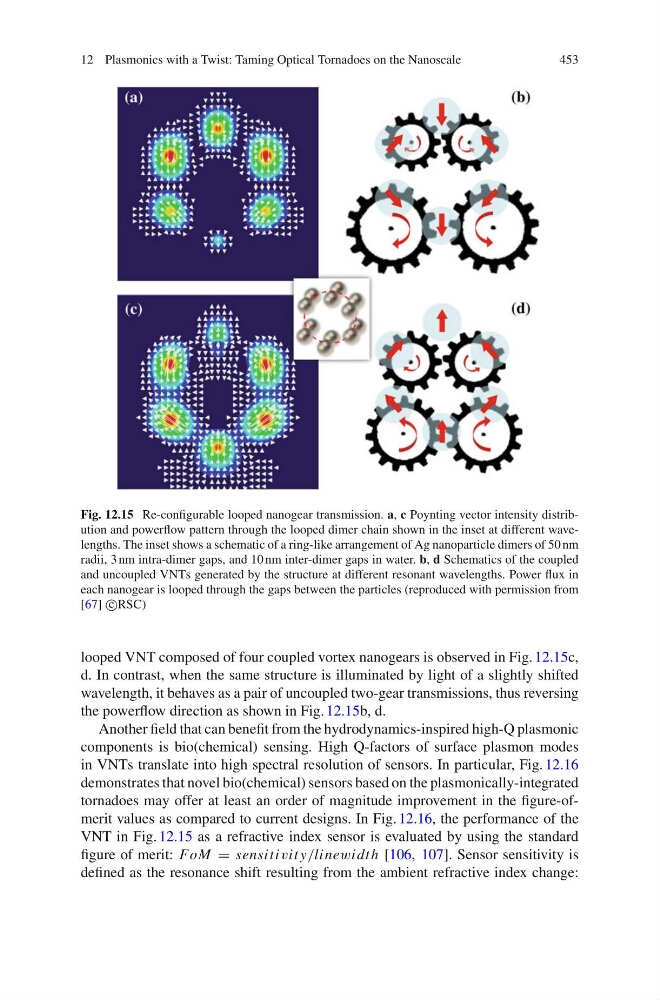
Fig. 12.15 Re-configurable looped nanogear transmission. a, c Poynting vector intensity distribution and powerflow pattern through the looped dimer chain shown in the inset at different wavelengths. The inset shows a schematic of a ring-like arrangement of Ag nanoparticle dimers of 50 nm
radii, 3 nm intra-dimer gaps, and 10 nm inter-dimer gaps in water. b, d Schematics of the coupled
and uncoupled VNTs generated by the structure at different resonant wavelengths. Power flux in
each nanogear is looped through the gaps between the particles (reproduced with permission from
[67] c
∪RSC)
looped VNT composed of four coupled vortex nanogears is observed in Fig. 12.15c,
d. In contrast, when the same structure is illuminated by light of a slightly shifted
wavelength, it behaves as a pair of uncoupled two-gear transmissions, thus reversing
the powerflow direction as shown in Fig. 12.15b, d.
Another field that can benefit from the hydrodynamics-inspired high-Q plasmonic
components is bio(chemical) sensing. High Q-factors of surface plasmon modes
in VNTs translate into high spectral resolution of sensors. In particular, Fig. 12.16
demonstrates that novel bio(chemical) sensors based on the plasmonically-integrated
tornadoes may offer at least an order of magnitude improvement in the figure-ofmerit values as compared to current designs. In Fig. 12.16, the performance of the
VNT in Fig. 12.15 as a refractive index sensor is evaluated by using the standard
figure of merit: FoM = sensitivit y/linewidth [106, 107]. Sensor sensitivity is
defined as the resonance shift resulting from the ambient refractive index change:
453
Fig. 12.15 Re-configurable looped nanogear transmission. a, c Poynting vector intensity distribution and powerflow pattern through the looped dimer chain shown in the inset at different wavelengths. The inset shows a schematic of a ring-like arrangement of Ag nanoparticle dimers of 50 nm
radii, 3 nm intra-dimer gaps, and 10 nm inter-dimer gaps in water. b, d Schematics of the coupled
and uncoupled VNTs generated by the structure at different resonant wavelengths. Power flux in
each nanogear is looped through the gaps between the particles (reproduced with permission from
[67] c
∪RSC)
looped VNT composed of four coupled vortex nanogears is observed in Fig. 12.15c,
d. In contrast, when the same structure is illuminated by light of a slightly shifted
wavelength, it behaves as a pair of uncoupled two-gear transmissions, thus reversing
the powerflow direction as shown in Fig. 12.15b, d.
Another field that can benefit from the hydrodynamics-inspired high-Q plasmonic
components is bio(chemical) sensing. High Q-factors of surface plasmon modes
in VNTs translate into high spectral resolution of sensors. In particular, Fig. 12.16
demonstrates that novel bio(chemical) sensors based on the plasmonically-integrated
tornadoes may offer at least an order of magnitude improvement in the figure-ofmerit values as compared to current designs. In Fig. 12.16, the performance of the
VNT in Fig. 12.15 as a refractive index sensor is evaluated by using the standard
figure of merit: FoM = sensitivit y/linewidth [106, 107]. Sensor sensitivity is
defined as the resonance shift resulting from the ambient refractive index change: