

448
S. V. Boriskina
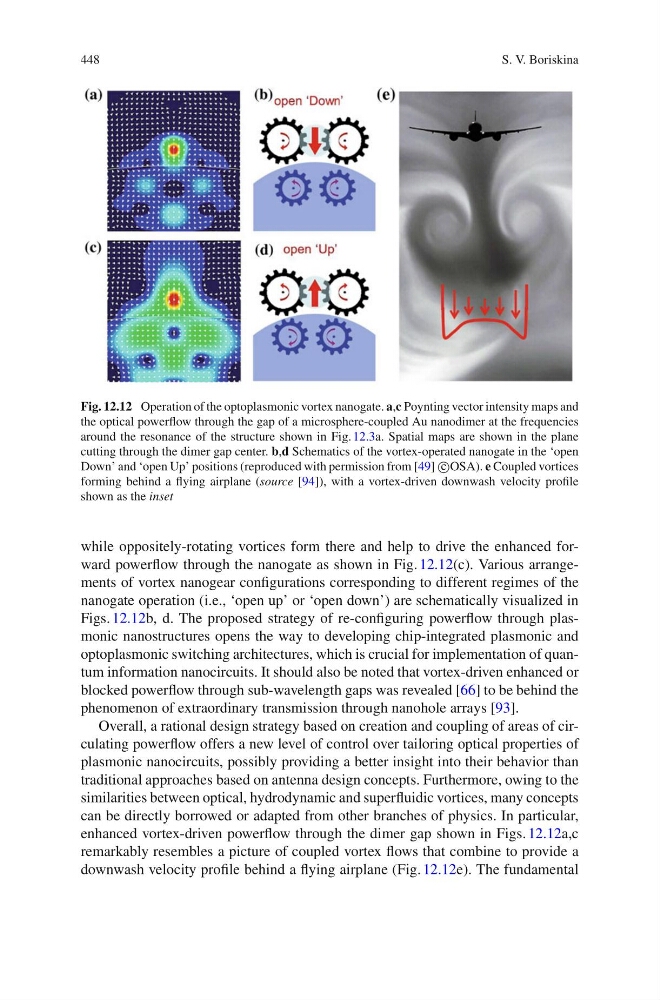
Fig. 12.12 Operation of the optoplasmonic vortex nanogate. a,c Poynting vector intensity maps and
the optical powerflow through the gap of a microsphere-coupled Au nanodimer at the frequencies
around the resonance of the structure shown in Fig. 12.3a. Spatial maps are shown in the plane
cutting through the dimer gap center. b,d Schematics of the vortex-operated nanogate in the ‘open
Down’ and ‘open Up’ positions (reproduced with permission from [49] c
∪OSA). e Coupled vortices
forming behind a flying airplane (source [94]), with a vortex-driven downwash velocity profile
shown as the inset
while oppositely-rotating vortices form there and help to drive the enhanced forward powerflow through the nanogate as shown in Fig. 12.12(c). Various arrangements of vortex nanogear configurations corresponding to different regimes of the
nanogate operation (i.e., ‘open up’ or ‘open down’) are schematically visualized in
Figs. 12.12b, d. The proposed strategy of re-configuring powerflow through plasmonic nanostructures opens the way to developing chip-integrated plasmonic and
optoplasmonic switching architectures, which is crucial for implementation of quantum information nanocircuits. It should also be noted that vortex-driven enhanced or
blocked powerflow through sub-wavelength gaps was revealed [66] to be behind the
phenomenon of extraordinary transmission through nanohole arrays [93].
Overall, a rational design strategy based on creation and coupling of areas of circulating powerflow offers a new level of control over tailoring optical properties of
plasmonic nanocircuits, possibly providing a better insight into their behavior than
traditional approaches based on antenna design concepts. Furthermore, owing to the
similarities between optical, hydrodynamic and superfluidic vortices, many concepts
can be directly borrowed or adapted from other branches of physics. In particular,
enhanced vortex-driven powerflow through the dimer gap shown in Figs. 12.12a,c
remarkably resembles a picture of coupled vortex flows that combine to provide a
downwash velocity profile behind a flying airplane (Fig. 12.12e). The fundamental
S. V. Boriskina
Fig. 12.12 Operation of the optoplasmonic vortex nanogate. a,c Poynting vector intensity maps and
the optical powerflow through the gap of a microsphere-coupled Au nanodimer at the frequencies
around the resonance of the structure shown in Fig. 12.3a. Spatial maps are shown in the plane
cutting through the dimer gap center. b,d Schematics of the vortex-operated nanogate in the ‘open
Down’ and ‘open Up’ positions (reproduced with permission from [49] c
∪OSA). e Coupled vortices
forming behind a flying airplane (source [94]), with a vortex-driven downwash velocity profile
shown as the inset
while oppositely-rotating vortices form there and help to drive the enhanced forward powerflow through the nanogate as shown in Fig. 12.12(c). Various arrangements of vortex nanogear configurations corresponding to different regimes of the
nanogate operation (i.e., ‘open up’ or ‘open down’) are schematically visualized in
Figs. 12.12b, d. The proposed strategy of re-configuring powerflow through plasmonic nanostructures opens the way to developing chip-integrated plasmonic and
optoplasmonic switching architectures, which is crucial for implementation of quantum information nanocircuits. It should also be noted that vortex-driven enhanced or
blocked powerflow through sub-wavelength gaps was revealed [66] to be behind the
phenomenon of extraordinary transmission through nanohole arrays [93].
Overall, a rational design strategy based on creation and coupling of areas of circulating powerflow offers a new level of control over tailoring optical properties of
plasmonic nanocircuits, possibly providing a better insight into their behavior than
traditional approaches based on antenna design concepts. Furthermore, owing to the
similarities between optical, hydrodynamic and superfluidic vortices, many concepts
can be directly borrowed or adapted from other branches of physics. In particular,
enhanced vortex-driven powerflow through the dimer gap shown in Figs. 12.12a,c
remarkably resembles a picture of coupled vortex flows that combine to provide a
downwash velocity profile behind a flying airplane (Fig. 12.12e). The fundamental