

12 Plasmonics with a Twist: Taming Optical Tornadoes on the Nanoscale
447
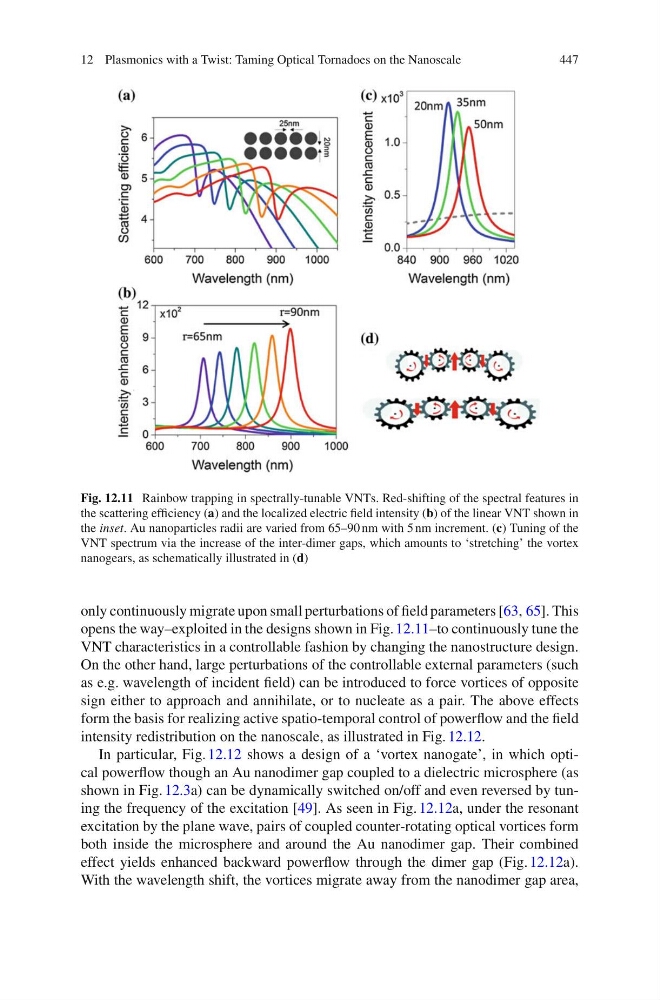
Fig. 12.11 Rainbow trapping in spectrally-tunable VNTs. Red-shifting of the spectral features in
the scattering efficiency (a) and the localized electric field intensity (b) of the linear VNT shown in
the inset. Au nanoparticles radii are varied from 65–90 nm with 5 nm increment. (c) Tuning of the
VNT spectrum via the increase of the inter-dimer gaps, which amounts to ‘stretching’ the vortex
nanogears, as schematically illustrated in (d)
only continuously migrate upon small perturbations of field parameters [63, 65]. This
opens the way–exploited in the designs shown in Fig. 12.11–to continuously tune the
VNT characteristics in a controllable fashion by changing the nanostructure design.
On the other hand, large perturbations of the controllable external parameters (such
as e.g. wavelength of incident field) can be introduced to force vortices of opposite
sign either to approach and annihilate, or to nucleate as a pair. The above effects
form the basis for realizing active spatio-temporal control of powerflow and the field
intensity redistribution on the nanoscale, as illustrated in Fig. 12.12.
In particular, Fig. 12.12 shows a design of a ‘vortex nanogate’, in which optical powerflow though an Au nanodimer gap coupled to a dielectric microsphere (as
shown in Fig. 12.3a) can be dynamically switched on/off and even reversed by tuning the frequency of the excitation [49]. As seen in Fig. 12.12a, under the resonant
excitation by the plane wave, pairs of coupled counter-rotating optical vortices form
both inside the microsphere and around the Au nanodimer gap. Their combined
effect yields enhanced backward powerflow through the dimer gap (Fig. 12.12a).
With the wavelength shift, the vortices migrate away from the nanodimer gap area,
447
Fig. 12.11 Rainbow trapping in spectrally-tunable VNTs. Red-shifting of the spectral features in
the scattering efficiency (a) and the localized electric field intensity (b) of the linear VNT shown in
the inset. Au nanoparticles radii are varied from 65–90 nm with 5 nm increment. (c) Tuning of the
VNT spectrum via the increase of the inter-dimer gaps, which amounts to ‘stretching’ the vortex
nanogears, as schematically illustrated in (d)
only continuously migrate upon small perturbations of field parameters [63, 65]. This
opens the way–exploited in the designs shown in Fig. 12.11–to continuously tune the
VNT characteristics in a controllable fashion by changing the nanostructure design.
On the other hand, large perturbations of the controllable external parameters (such
as e.g. wavelength of incident field) can be introduced to force vortices of opposite
sign either to approach and annihilate, or to nucleate as a pair. The above effects
form the basis for realizing active spatio-temporal control of powerflow and the field
intensity redistribution on the nanoscale, as illustrated in Fig. 12.12.
In particular, Fig. 12.12 shows a design of a ‘vortex nanogate’, in which optical powerflow though an Au nanodimer gap coupled to a dielectric microsphere (as
shown in Fig. 12.3a) can be dynamically switched on/off and even reversed by tuning the frequency of the excitation [49]. As seen in Fig. 12.12a, under the resonant
excitation by the plane wave, pairs of coupled counter-rotating optical vortices form
both inside the microsphere and around the Au nanodimer gap. Their combined
effect yields enhanced backward powerflow through the dimer gap (Fig. 12.12a).
With the wavelength shift, the vortices migrate away from the nanodimer gap area,